Every mobility app founder has the same conversation at least once with investors or their own team: how do we compete against Uber? The answer that works isn't to try to be a smaller Uber. It's to be something Uber structurally cannot be.
This article lays out the real levers a regional or national operator has to compete against the giants. They aren't secrets — they're structural advantages the big players can't exploit without destroying their own business model. The challenge is recognizing them and building around them.
The scale myth
The "Uber has scale" argument assumes scale is always an advantage. It isn't. Uber's scale lets them be efficient when there's high supply-and-demand density — Mexico City, São Paulo, central Buenos Aires. In zones where density drops, their model collapses: wait times go up, drivers leave, customers leave. And Uber has no incentive to fix it — every subsidy poured into a secondary zone is money that isn't being extracted from a major city.
The result is that entire cities, peripheral neighborhoods and off-peak hours end up underserved. That's your market. You don't compete with Uber in Polanco or Vitacura — you compete in the 47 secondary cities in your country where Uber is degraded or absent.
The local operator's structural advantages
- You personally know your top drivers — the giants don't even know their names
- You respond in hours, not days: support tickets resolved the same day
- You adapt fares in real time to local events: concerts, fairs, weather
- You accept cash frictionlessly because you know the market
- You integrate local payment methods: bank transfer, regional wallets, QR
- You speak the city's language: slang, informal addresses, real routes
B2B: where the giants lose money
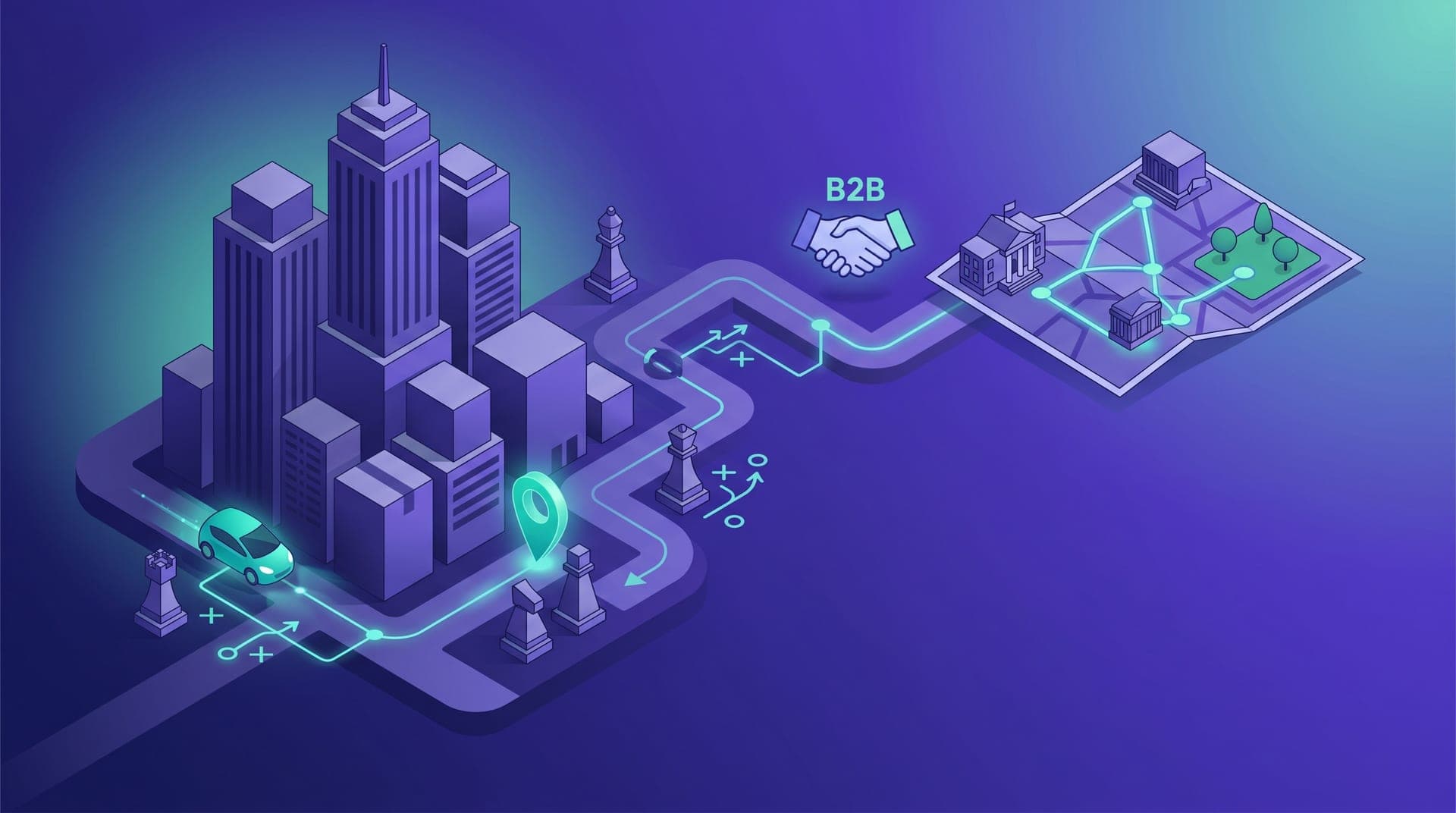
The corporate market is where local advantage becomes decisive. Uber for Business works if you're a multinational with offices in big cities. For the mid-sized local company — a distributor, a clinic, a construction firm — the giants don't have a rep, don't negotiate rates, don't issue invoices in the format accounting needs. You do.
A regional operator that builds 30 local B2B accounts wins two things: guaranteed Monday-to-Friday trips and loyal drivers with stable demand. Each account is worth $5,000 to $40,000 USD per year in GMV. The giants don't chase that segment because the acquisition cost doesn't pencil out. For you, a two-hour in-person visit closes the deal.
Diversifying services without diluting your brand
Uber is, first and foremost, a transport app. Then came Uber Eats. Then Uber Freight. Every new product costs them thousands of engineers and years of integration. You can add adjacent services — local parcel delivery, food delivery, scheduled corporate trips, fixed-fare airport rides — in weeks if you run on a unified platform.
Smart diversification isn't adding features for the sake of it. It's identifying which three services share the same driver, the same customer or the same sales channel. A taxi operator in Quetzaltenango adding pharmacy delivery isn't diversifying on trend — they're using the same fleet that sits idle between morning and evening peaks to generate extra revenue at zero marginal cost.
Human support as a defensive moat
Customer support at the giants is designed to scale, not to resolve. A customer with a complex issue can go through five chatbot exchanges before reaching a human — if they ever do. A driver with a payment dispute waits 3 to 7 days. Every local operator hears the mirror complaint: customers who left Uber or Cabify over a mishandled incident.
Your advantage here is almost silly to build. A team of 2 to 4 support agents, a WhatsApp number that answers in 10 minutes, a driver who can call a real manager when something breaks. That turns into retention, NPS, word of mouth. And it's impossible to replicate at scale without blowing up the cost per trip.
Measuring the right things
Metrics winning local operators chase that the giants don't prioritize:
- Average support response time — target: under 15 minutes
- Top-driver retention at 6 months — target: over 75%
- B2B trips as share of total trips — rising target: 25% → 40%
- Driver NPS — target: over 50
- Trips canceled for "no nearby driver" — target: under 3%
What's measured at Uber is conversion rates, matching time and market share. What wins in regional markets is measured differently: trust, retention and network. If you use the giant's metrics to run your company, you'll make decisions for a company you aren't.
We didn't win because we were cheaper. We won because when a driver had a problem, I answered in 20 minutes myself. That was our marketing for two years.
The strategy that works
A regional operator that executes well doesn't try to be the Uber of their country. They try to be indispensable to a specific set of customers — usually businesses, usually in underserved cities, usually with a mix of services. Reaching 200 drivers with this strategy is far more realistic and far more defensible than chasing the 2,000 drivers of a mass-market play.
The giants will still be there. The game isn't to push them out — it's to carve a space where they structurally cannot operate. That space exists in almost every LATAM market, and the time to claim it is now.