The logic of adding delivery to a ride-hailing operation sounds airtight: drivers already have a vehicle, already know the city, and are already in the app. Every hour a driver isn't carrying a passenger is capacity that delivery could use. Delivery ticket margins are lower than trip margins, but if the fleet has idle time, that marginal revenue has no incremental supply cost. That reasoning is correct in the abstract — and it produces bad decisions in most concrete cases where an operator applies it without first reviewing the demand patterns of both services.
This article is for operators with between 60 and 300 active drivers who are evaluating delivery as a second service line, who have already added it and are wondering why the numbers don't add up, or who are growing and want to understand at what point diversification stops being a risk to the core business. The central argument isn't that delivery is a bad extension for a mobility platform — regional operations do integrate it successfully. It's that the conditions for it to work are specific, and most operators who add it don't meet those conditions at the moment they make the decision.
Why the 'same drivers, more revenue' logic is incomplete
The 'same drivers' premise ignores a fundamental operational detail: drivers with idle time are not randomly distributed throughout the day. They are idle at the same hours when your passenger operation has low demand — typically between 10 a.m. and 1 p.m., and between 4 and 6 p.m. The problem is that those low-demand windows in ride-hailing are exactly when delivery peaks: lunch hour and end of the workday. When you add delivery without mapping that pattern, you are not filling gaps in your fleet's availability — you are creating internal competition between two services for the same drivers at the exact moments both need them simultaneously.
The most common result isn't that the fleet manages both services efficiently — it's that drivers prioritize whichever service offers higher expected active-hour earnings in that moment, and the other degrades. In secondary LATAM markets, the average passenger trip ticket ($3 to $5 USD) exceeds the average delivery order ticket ($1.50 to $2.80 USD) during most overlap hours. Drivers learn within a few weeks which service maximizes their hourly income, and delivery orders begin accumulating higher acceptance times, last-minute cancellations, and deteriorating service metrics that the operator reads as a technology problem when it is actually an incentive structure problem.
Two types of fleet: which one can handle delivery and which one can't
Not every fleet has the same capacity to absorb a second service. The key difference isn't total fleet size — it's the distribution of driver availability throughout the day and the driver profile. A fleet of 150 drivers with high concentration in morning and evening peak windows, and genuinely sparse availability during midday hours, has exactly the problem described: the drivers available during lunch hour are the same ones who are most active in ride-hailing during peak windows, and their delivery availability is overestimated because the operator calculated it when those drivers had no alternative income source on the platform.
The fleet that can support delivery without degrading the main service has a specific characteristic: drivers with sustained availability during low-passenger-demand hours who, because of vehicle type, geographic zone, or schedule preference, are not competing for the same trips during peak windows. In practice, that means motorcycle couriers for restaurant or pharmacy delivery in dense areas; compact-vehicle drivers whose availability window falls in delivery demand hours but not high-ticket ride-hailing hours; or part-time drivers whose main availability coincides with the midday peak. Without that additional driver profile — real, not estimated from occasional idle time — delivery does not complement ride-hailing: it competes directly with it for the same scarce resource.
When the two services' peak hours collide
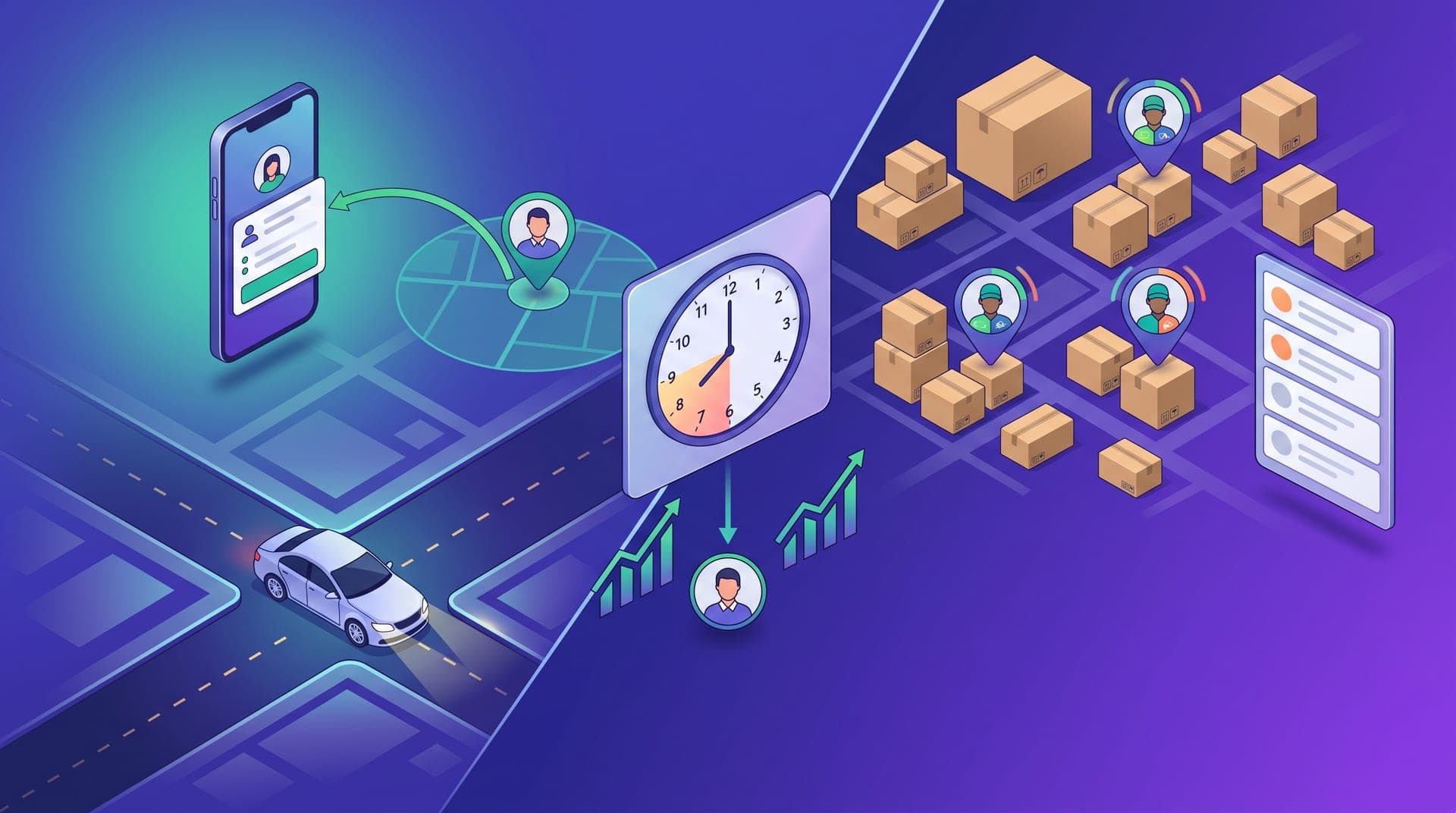
Delivery demand in secondary LATAM cities peaks in three main windows: midday from noon to 2 p.m., evening from 7 to 10 p.m., and weekends in general. Ride-hailing in those same cities peaks in early morning from 6 to 9 a.m., in the afternoon from 6 to 8 p.m., and on weekend nights from 10 p.m. to 1 a.m. The most critical direct overlap falls in the 6-to-8 p.m. window: both dinner delivery and end-of-workday ride-hailing need available drivers at the same time. During that period, an unsegmented mixed-mode fleet produces the worst experience in both services simultaneously — longer wait times in ride-hailing and slower deliveries, with the same drivers split between two competing assignment queues.
There's a second collision point that's harder to anticipate: special events. A city of 200,000 with a local soccer match, a regional fair, or a concert experiences a ride-hailing demand spike that can triple the baseline for three or four hours. During those windows, dual-mode drivers deactivate delivery to focus on higher-income trips. The result is that exactly when more people are out in the city — and potentially generating higher demand for food and drink delivery — the delivery service runs out of available supply because the entire driver pool has switched to passenger mode. The same infrastructure presented as flexible turns rigid when both services need it simultaneously.
The three signals that tell you it's time to add delivery
If delivery harms more regional mobility operations than it helps, the question isn't whether to add it but when to do so without the passenger service paying the price. Three conditions must all be present simultaneously — not individually — for delivery to be a genuine business extension rather than a burden on the core operation:
- Sustained driver surplus during off-peak hours: not occasional idle drivers but a consistent pattern of 15% to 20% of the active fleet without an assigned trip for at least three hours a day, five days a week, for more than four consecutive weeks — that surplus is the minimum condition for delivery to use genuine spare capacity without drawing from passenger supply
- A delivery average ticket that is profitable for drivers without permanent subsidies: in markets where a delivery ticket doesn't reach the per-hour income threshold that retains drivers (typically $2.50 to $5.50 USD per active hour in secondary LATAM), the service requires ongoing incentives to stay active — that fixed cost must be calculated before launch, not discovered in month three
- Three consecutive months above operational break-even in ride-hailing: adding a second service before the first is financially stable doesn't diversify risk — it amplifies it with a double cost structure before either service is sustainable
How to design the pilot without putting the core business at risk
If all three conditions are present, the delivery pilot must be built around one fundamental constraint: the pilot's drivers cannot be the same ones covering peak ride-hailing demand. That means identifying a specific group of drivers — between 8 and 15 depending on fleet size — with real, consistent availability during low-passenger-demand hours, and running the pilot exclusively with that group for the first six to eight weeks. The pilot is not a technology test — the platform can handle both services from day one. It is a test of whether that specific driver group can absorb delivery demand without affecting passenger service response times during overlap hours.
Four signals that delivery is hurting your ride-hailing
Early-warning indicators that the delivery operation is degrading the passenger service:
- Ride-hailing assignment time rises consistently without a corresponding increase in passenger demand: drivers who are in-app are in dual mode and prioritizing delivery when the order competes in expected value with the trip in that time window
- Post-assignment cancellation rate in ride-hailing increases: drivers who accept a trip cancel when a higher-expected-value delivery order appears in the same window, producing a damaged passenger experience that no demand metric explains
- Driver active-hour earnings in ride-hailing fall without any demand or competition explanation: average trip time is increasing because drivers are managing notifications from both services while in route, extending each trip beyond the actual travel time
- 30-day passenger retention falls without pricing changes or new competitor entry: the latest and most costly signal, because it means experience degradation has already produced disengagement before the operator identified the source of the problem
Adding delivery seemed natural: we had drivers complaining about slow hours between 10 a.m. and 1 p.m. Within six weeks, ride-hailing wait times went from 3.5 to 6.2 minutes. Drivers were in-app but watching for delivery orders, not trips. It took us two months to understand the problem wasn't the technology — it was that the same drivers couldn't serve two services well during hours that overlapped more than we had calculated.
The decision to add delivery is not primarily a technology question — it is a supply management decision. The platform can handle both services from day one. The problem isn't the platform; it's whether the fleet has the measurable surplus that delivery needs to work without compromising the passenger operation. An operator who adds delivery before that surplus exists isn't expanding their operation — they're splitting the same supply between two services that will compete for it during the highest-demand moments of both.
The right question isn't whether delivery is a good extension for a regional mobility operation. The answer depends on a single condition: whether the fleet has real capacity surplus during the hours when delivery generates demand. That condition can be measured with four weeks of per-hour driver availability data. If the measurement confirms the surplus, delivery is a natural, low-risk extension that requires no significant upfront investment. If it doesn't, the right moment isn't now — it's when ride-hailing has reached the volume needed to generate that surplus consistently, without drawing from the same drivers who cover the core service's peak hours.