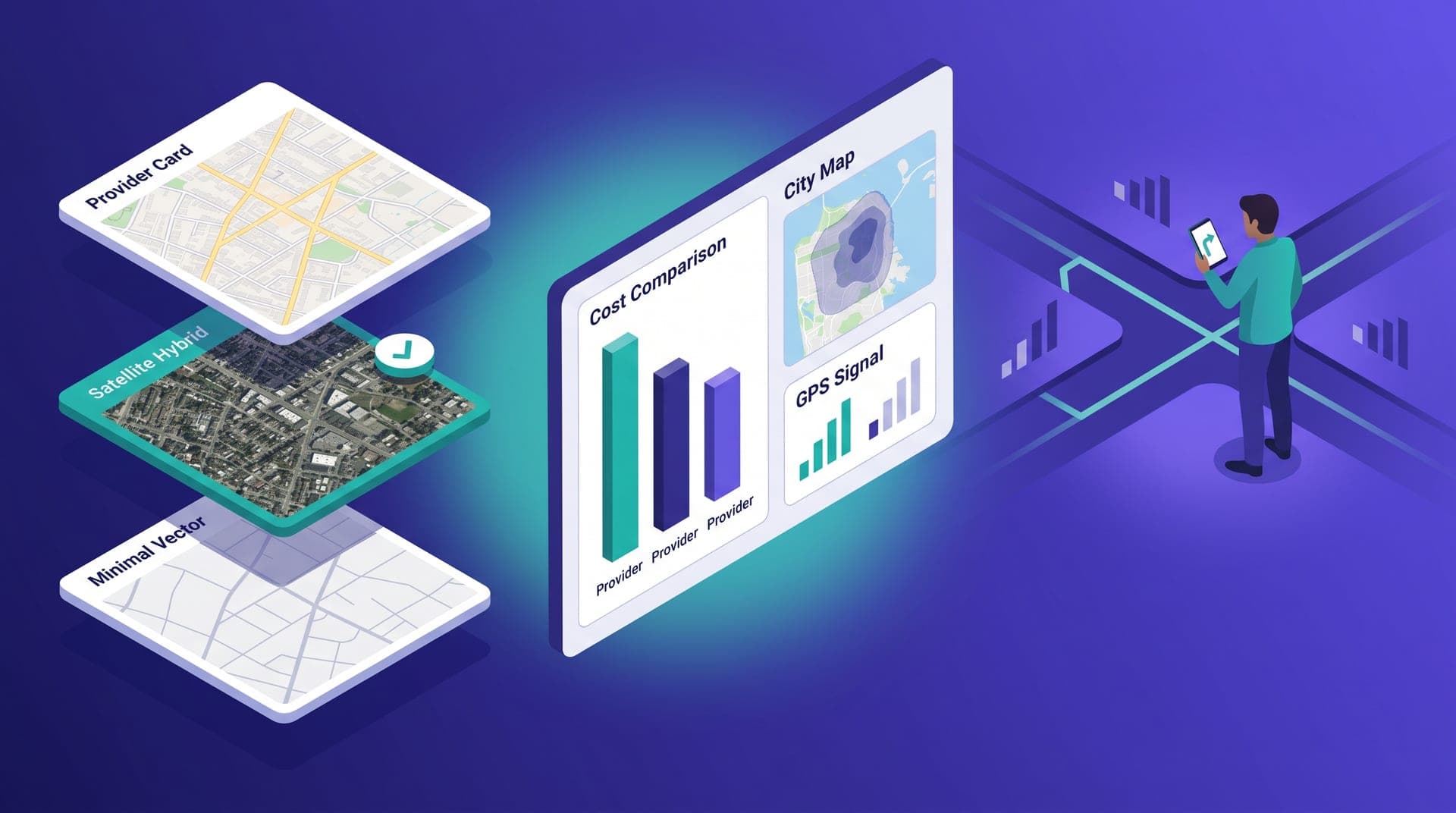
The decision about which maps provider to use in a regional transport app is typically made early in the project — based on what is fastest to integrate or cheapest at the free tier. What that decision rarely accounts for is that the map is not the visual backdrop on the passenger screen. It is the engine that calculates ETAs before trip acceptance, routes the driver from their current position to the pickup, geocodes the addresses users type in ways that rarely match official street nomenclature, and determines whether a driver in a low-connectivity area can navigate without internet. In operations running 300 to 700 daily trips across mid-sized Mexican or Colombian cities, the wrong provider produces problems that have no name in the dashboard but have a real cost: actual wait times that exceed promised ETAs, requests that never connect to a driver, and failed trips in neighborhoods where the geocoder has insufficient data.
This article is for operators choosing their maps stack before launch, or who already have one running and are evaluating whether monthly costs or operational issues justify a migration. The three providers most adopted in regional ride-hailing platforms — Google Maps Platform, HERE Maps, and Mapbox — differ on price at scale, on coverage depth in secondary LATAM cities, on the offline capabilities each SDK exposes, and on how well each interprets the ways regional passengers actually write their addresses. The right choice is not the same across all contexts: it depends on current trip volume, the specific cities where the platform operates, and whether driver and passenger requirements point to the same provider or two different ones.
The three map providers and where they actually differ
Google Maps Platform dominates the consumer app market for concrete reasons: it has the deepest data density in nearly every LATAM city, including secondary and tertiary markets where both competing providers have visible gaps. Its database of places, turn restrictions, and newly built streets is updated more frequently, and its geocoder can interpret the establishment references that regional users give as addresses — not the street number but the corner store or the central market. The structural downside is the pricing model: Google Maps Platform charges per API call, with no flat-rate option, and costs compound non-linearly as the operation scales. On a platform using routing, geocoding, real-time tracking, and distance matrices simultaneously, that model produces invoices the operator didn't anticipate when projecting initial costs against a small operation's volume.
HERE Maps has a different origin: it was built as navigation software for the automotive industry and for years was the maps data provider powering in-car navigation systems from major auto manufacturers. That history gives it a specific strength in ride-hailing: high-precision real-time traffic data, maps designed for vehicle navigation with solid offline route support, and a pricing model that at mid-range volumes can run 30% to 50% cheaper than Google Maps Platform. The weaknesses are in SDK familiarity for technical teams who learned on Google, and in small and peripheral LATAM cities where street coverage is thinner and informal address geocoding produces more errors than the dominant competitor.
Mapbox takes the most open approach: it builds its coverage on top of OpenStreetMap, the collaborative geographic database anyone can edit, and layers proprietary commercial data and design tooling that neither competitor matches. Its SDK is the most customizable — operators can modify the map's visual style, integrate their own data, and build navigation components with a level of control that Google and HERE don't expose. Pricing is competitive: the free tier is generous and per-call costs in the base map and real-time tracking categories are lower than the alternatives. The primary limitation in LATAM is the OpenStreetMap dependency: in mid-sized cities across Mexico, Colombia, Peru, and Bolivia where the active contributor community is small, street data can be incomplete or outdated in new residential areas, gated communities, and peripheral zones where a meaningful share of taxi demand originates.
The real cost of API calls in a 400-trip-per-day operation
Comparing prices between providers is only useful when calculated against the actual calls a trip generates, not against the list price of a single API type. A ride-hailing trip produces an average of 8 to 14 map API calls: origin address geocoding, destination geocoding, pre-assignment ETA calculation, driver routing to the passenger, trip routing, real-time position updates during the ride, and in some implementations a final fare recalculation against the actual route traveled. For an operation of 400 daily trips with 10 to 12 calls per trip, that represents between 120,000 and 145,000 monthly calls — enough volume for the difference between providers to be meaningful in the cost structure.
Estimated monthly ranges at that volume, using the API mix typical of a ride-hailing platform, are:
- Google Maps Platform: between $800 and $1,400 USD per month including routing, geocoding, tracking, and distance matrices, before adding the real-time position update volume, which can push that number higher depending on the configured update interval
- HERE Maps: between $400 and $700 USD per month on the mid-scale plan, with better price-to-performance for vehicle routing and real-time traffic data compared to the market leader
- Mapbox: between $250 and $600 USD per month depending on API mix, with the most accessible tier when primary usage is base map and real-time tracking, and greater price variability if intensive geocoding is added
Why offline coverage matters more in LATAM than in Europe or the US
Maps provider performance benchmarks are published primarily for markets where cellular coverage in urban zones is near-universal. In mid-sized LATAM cities, the driver's real-world connectivity is different: peripheral neighborhoods, access roads to new residential developments, and industrial zones where 4G signal is inconsistent leave drivers without navigation when the SDK requires a continuous connection to recalculate routes. The problem is not exclusive to small cities — it occurs in cities of 300,000 to 500,000 residents with recent peripheral growth where telecom infrastructure hasn't yet reached the density that coverage maps suggest. In those zones, a SDK that requires continuous connectivity to update the route leaves the driver without functional navigation precisely in the stretch that generates the most uncertainty for the waiting passenger.
The offline capabilities of the three providers differ significantly. HERE Maps has the most mature offline functionality, a direct result of its automotive navigation history: it supports downloading regional map packages and computing full routes with no active connection. Google Maps SDK for iOS and Android can operate partially offline in previously downloaded areas, but with limitations on dynamic route recalculation when the driver deviates from the original path. Mapbox allows downloading specific base map areas, but turn-by-turn offline navigation capabilities vary more depending on how the SDK is implemented and which components are enabled. For operators in cities where driver connectivity is a real constraint, the offline capability evaluation is not a secondary feature — it is one of the three primary decision criteria alongside price and street coverage.
Geocoding informal addresses: the differentiator that appears in no benchmark
One of the least-documented differences between map providers — and one of the most relevant for LATAM operations — is how well each geocoder performs when the user writes an address the way they actually know it. Across Mexico, Colombia, and much of LATAM, many addresses have no formal street number, or the number doesn't match any official database: the passenger writes 'across from the corner store on Insurgentes Avenue,' 'half a block from the Juárez market,' or simply the neighborhood name with a nearby cross-street as reference. The geocoder that produces the most accurate coordinates for that kind of input is the one that reduces pickup errors — drivers waiting at the wrong address, passengers seeing the pin on the wrong side of the street — which are the second most common cause of cancellations after long wait times. Google Maps has a structural advantage here because of its place database depth: the geocoder can interpret known establishment references and return useful coordinates even for very informal entries. HERE performs well on formal addresses but less consistently with informal references in secondary cities. Mapbox depends on OpenStreetMap data density in the area, producing more variable results in cities with low contributor activity.
The driver SDK and the passenger SDK have different requirements
A common mistake when choosing a maps provider is applying the same evaluation criteria to the driver SDK as to the passenger SDK. The priorities differ because the use cases differ. The passenger SDK primarily needs a clean visual map, accurate address autocomplete, and smooth real-time driver tracking — all three being Google Maps Platform's strong points. The driver SDK primarily needs reliable turn-by-turn navigation with GPS snapping to the correct street, functionality under intermittent connectivity, and fast route recalculation when detours occur — the areas where HERE Maps holds historical advantage. Some regional operators resolve this requirement mismatch by using separate providers for each app: Google Maps for the passenger app where visual experience and geocoding are the priority, and HERE Maps or an offline Mapbox implementation for the driver app where navigation without connectivity is more relevant. This approach carries additional integration cost but eliminates the compromise of using a single provider that isn't the best fit for either application. The evaluation becomes worthwhile once the operation exceeds 200 daily trips and navigation or geocoding issues start appearing repeatedly in the same type of trip.
When switching providers is worth it and when the switching cost isn't
For operations under 200 daily trips, maps API costs rarely represent a meaningful share of the cost structure — at that volume, no provider generates invoices that materially affect the operation's economics. At that stage the most relevant criterion is integration speed: how quickly the technical team can get the SDK running with core functionality. Google Maps wins that criterion through documentation maturity and developer community breadth. The conversation about migrating to HERE or Mapbox for cost reasons becomes relevant once the operation exceeds 300 to 400 daily trips and the monthly maps bill exceeds $600 to $800 USD. At that point, the difference between providers can represent $300 to $700 USD per month — enough to justify four to six weeks of migration technical work. What the migration analysis needs to account for, beyond the price differential, is the quality degradation period that occurs while the new provider calibrates against actual operational data: drivers reporting inconsistencies in GPS snapping, geocoding returning different results than passengers expect, and zones where the new provider's coverage is thinner than the prior one.
We used Google Maps for everything through the first year. By the time we reached 450 daily trips, the maps bill was $1,100 a month. We spent three months evaluating whether to migrate to HERE just for the driver app, keeping Google for the passenger side. The technical migration took six weeks but brought total cost down to $490 per month. What we didn't anticipate was a two-week window where drivers reported GPS not snapping to the right streets in two peripheral neighborhoods where HERE's data had less detail than Google's. It resolved on its own as HERE updated coverage, but if we had launched the migration in December during peak season it would have been a more serious problem. Now we schedule all provider migrations for January or February.
The maps provider decision is not a one-time architecture call the product team makes at project start and never revisits. It carries direct operational consequences: in the cancellation rate from inaccurate ETAs, in the failed trip percentage from geocoding errors in peripheral neighborhoods, and in platform costs that at 400 daily trips can represent a $200 to $700 USD monthly difference depending on the provider and API mix. The operator who reviews this decision with real volume has the data to make it well; the one who optimizes it in month one against estimates of what they expect to happen makes the decision with incomplete information about how drivers and passengers actually behave in their specific cities.
What makes the provider comparison useful is not an abstract benchmark of which is better under controlled conditions — it is the evaluation of each against the operation's concrete requirements: the specific cities where the platform runs and each provider's data density there, the connectivity profile of drivers in active peripheral zones, the formality level of the addresses passengers type, and the volume at which the cost differential becomes meaningful. That evaluation takes two to three weeks with tests in a real production environment, and it is considerably cheaper than six months operating with a provider that generates problems the operator cannot name but can measure in the metrics that matter.