Local events — a soccer match, a regional fair, a concert in the city center — produce the most predictable demand peaks a regional mobility operator will encounter in any given week. They aren't calendar surprises: they're announced days or weeks ahead, concentrate demand in known zones and defined time windows, and follow an arrival-and-departure pattern that doesn't require complex modeling to anticipate. Yet they're also where the most operators fail: drivers connected in the wrong zones, dynamic pricing triggering cancellations without prior notice, and passengers waiting twenty minutes outside a stadium because the platform wasn't ready. The difference between capturing that peak or missing it doesn't come down to pricing technology — it comes down to what happened 72 hours earlier.
This article is for operators with at least 60 days of operation and an active driver base who are already noticing that some days behave differently but can't always predict which ones or why. The central argument is that local events are predictable demand, and predictable demand isn't managed reactively — it's prepared for. We'll cover how to build an event calendar that drives concrete operational actions, how to activate drivers in the right zones without relying on surge to attract them, how to communicate dynamic pricing before the complaint arrives, and how to manage the event's close — the 90 minutes after the peak — that determine whether passengers come back next time.
Local events are the most predictable demand of the month
For a regional mobility operation, no demand type is more valuable than predictable demand. A regular Tuesday fluctuates with weather, traffic, and variables the operator doesn't control. Demand from a match at the local stadium starts exactly when the final whistle blows, within a 500-to-1,500-meter radius of the venue. That geographic and temporal concentration makes the event the most plannable asset of the week: the operator can position supply precisely where demand is going to be, early enough that drivers don't have to decide on their own whether moving there is worth it.
The problem isn't that operators don't know the event is happening — it's that they treat it as a normal day until the dashboard shows four-minute assignment times near the stadium. At that point, dynamic pricing pulls in drivers, but at an operational cost: drivers who connect because of surge arrive after the peak is already active, not as the passenger queue is forming. They cover the first wave and disconnect before the second exits the venue. The result is uneven coverage at the highest-demand moment — exactly the pattern that advance preparation avoids.
The demand calendar: which types of events matter and which don't
Not every local event generates actionable demand peaks. Those that do share three characteristics: they concentrate more than 500 people at a defined geographic point, have an end time with a relatively simultaneous departure, and occur in zones where private transport or parking is limited. A soccer game at a stadium with no ample parking, or a concert in a pedestrianized park, creates real demand for the platform. An all-day exhibition without a defined closing time, or an event with easy vehicular access, doesn't produce the same concentrated pattern.
Events that generate capturable demand for a regional mobility platform:
- Sports events at stadiums with 3,000 to 15,000 attendees and limited parking — soccer, baseball or basketball games in secondary cities where the venue sits in the historic center
- Concerts and performances in enclosed venues or central parks with pedestrian access and limited or no public transit after 10 pm
- Regional fairs and festivals in historical or pedestrianized zones that restrict vehicular access during the event and around their closing hours
- High-attendance religious events with a defined departure time: processions, midnight masses, patron saint celebrations concentrated at a single location
- University graduation ceremonies or civic events with departure concentrated in a 30-to-60-minute window from a single venue
- Corporate dinners and company events with a defined closing time at hotels or event halls without dedicated transportation for attendees
The most frequent calendar management mistake is including low-attendance events out of fear of missing opportunities. A private 200-person dinner at a restaurant doesn't produce the concentrated departure pattern that makes operational preparation viable. Focusing on events that combine high attendance, a defined closing time, and limited vehicular access produces a calendar of 8 to 15 dates per month in most secondary LATAM cities — enough to run a useful activation protocol without the operator preparing a special operation every other day.
72 hours out: activating drivers without depending on price
The most costly preparation mistake before an event is trusting that dynamic pricing will attract enough drivers when demand rises. That approach partially works — surge does activate drivers — but it has two important constraints. First: drivers who connect because of surge arrive after the peak is already active, not while the passenger queue is forming. Second: at large events, demand concentration can saturate the assignment queue even when drivers are available in adjacent zones, because the distance to the venue makes the trip not worth it without an additional multiplier. The result is late coverage in the first twenty minutes of the peak — the most frustrating stretch for the passenger.
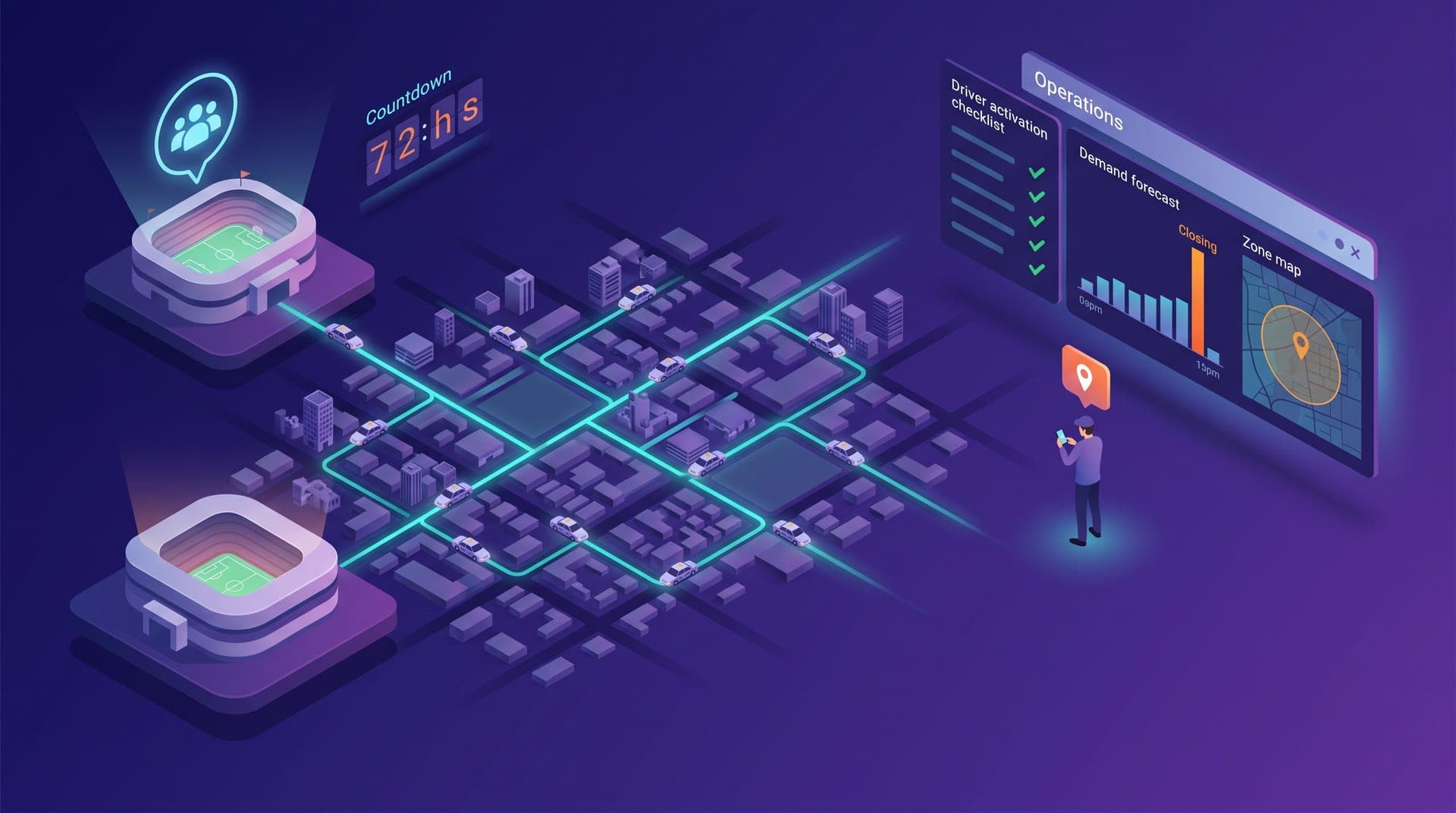
The alternative is proactive activation: communicate the event to drivers 72 hours ahead, specify the high-demand zone, and offer a zone-specific incentive active from 30 minutes before the estimated close. That incentive doesn't have to be a surge multiplier — it can be a flat zone bonus activated on completing a minimum number of trips in the event area during the defined time window. The key difference between an advance zone incentive and reactive surge is the timing of driver response: the first moves drivers to the zone before the peak; the second moves them during the peak, when demand already exceeds local supply and passengers have been waiting for minutes.
Zones and windows: where to position supply and for how long
The right position isn't the venue itself — it's the departure radius. Passengers don't request trips from inside the stadium; they request from the exterior pedestrian exits, which for events with 3,000 to 10,000 attendees can spread across a 300-to-800-meter radius from the central point. Identifying those exits on the map before the event — not during — is the first preparation action. An operator who knows the venue's pedestrian exits can configure the priority coverage zone before the event starts and communicate that zone to drivers precisely. Drivers who arrive at the main entrance and find no passengers because everyone is at the side exits disconnect and don't return.
The coverage window matters as much as the zone. Most events with 3,000 to 8,000 attendees produce two departure demand waves: the first in the first 15 to 20 minutes after close, made up of attendees who left early or have easy exits; the second, 25 to 40 minutes later, when the event's structure dissolves and most attendees begin moving. Drivers who finish a first-wave trip and disconnect leave the second wave without coverage. Communicating that departure curve to drivers — with data from previous events if available, with a reasoned estimate if it's the first — is what keeps coverage active through the full peak and not only its opening minutes.
Dynamic pricing during events: the communication that prevents reactive cancellations
Dynamic pricing during a local event isn't the problem — the problem is activating it without prior notice. A passenger who has waited fifteen minutes outside a stadium, sees a 2.3x multiplier without context, cancels before accepting the trip and leaves a negative review while looking for a street cab. That sequence is avoidable with a push notification sent two hours before the event: something to the effect that there may be dynamic pricing near the stadium area that night and that drivers will be available. It doesn't eliminate frustration with a higher price — it reduces the surprise, which is the primary driver of reactive cancellations, not the price level itself.
Advance communication to drivers matters equally. A driver who knows dynamic pricing will be active in a specific zone between 10:30 pm and 12:30 am can plan their evening differently than one who discovers the surge mid-peak. The difference between those two scenarios isn't the price level — it's the driver's ability to be in the right zone when the multiplier is highest. Operations that communicate expected surge two hours in advance see 30% to 45% stronger coverage response than those that activate dynamic pricing reactively without prior notice.
The 90 minutes after the peak
Post-event demand doesn't disappear abruptly — it drops in steps. The first drop is a 60% to 70% demand reduction in the first 30 minutes after close, as passengers who already had a trip requested exit the system. The second drop is the residual decline in the following 45 to 60 minutes, as passengers who waited have found alternatives or decided to stay put. Drivers who remain in the zone during that second drop face longer wait times between trips and tend to disconnect before the residual demand runs out — which creates a cluster of passengers without coverage in the last 20 to 30 minutes of the post-peak, precisely the stretch that's hardest to fix once it starts.
We completely missed the first game of the season. Six thousand people leaving the stadium and only four drivers in the area because no one had given advance notice. By the second game, I sent a message three days out with the zone and the estimated time window. Eighteen drivers showed up. Passengers waited less than four minutes on average.
Local events are the one demand type a regional operator can see arriving 72 hours out, plan with geographic precision, and communicate to drivers and passengers before it begins. Operations that capture this opportunity consistently don't do so because they have more drivers or better pricing algorithms — they do it because events are built into the weekly operational routine and an activation protocol runs before the calendar demands it.
The difference between an operation that ends an event weekend with zero wait-time complaints and one that ends it with frustrated passengers and disconnected drivers isn't the size of the event — it's whether the operator treated it as a special case three days out or as a normal day until the dashboard showed the problem. Local events don't require additional infrastructure; they require a calendar, a protocol, and advance communication. All three are available from the first month of operation.