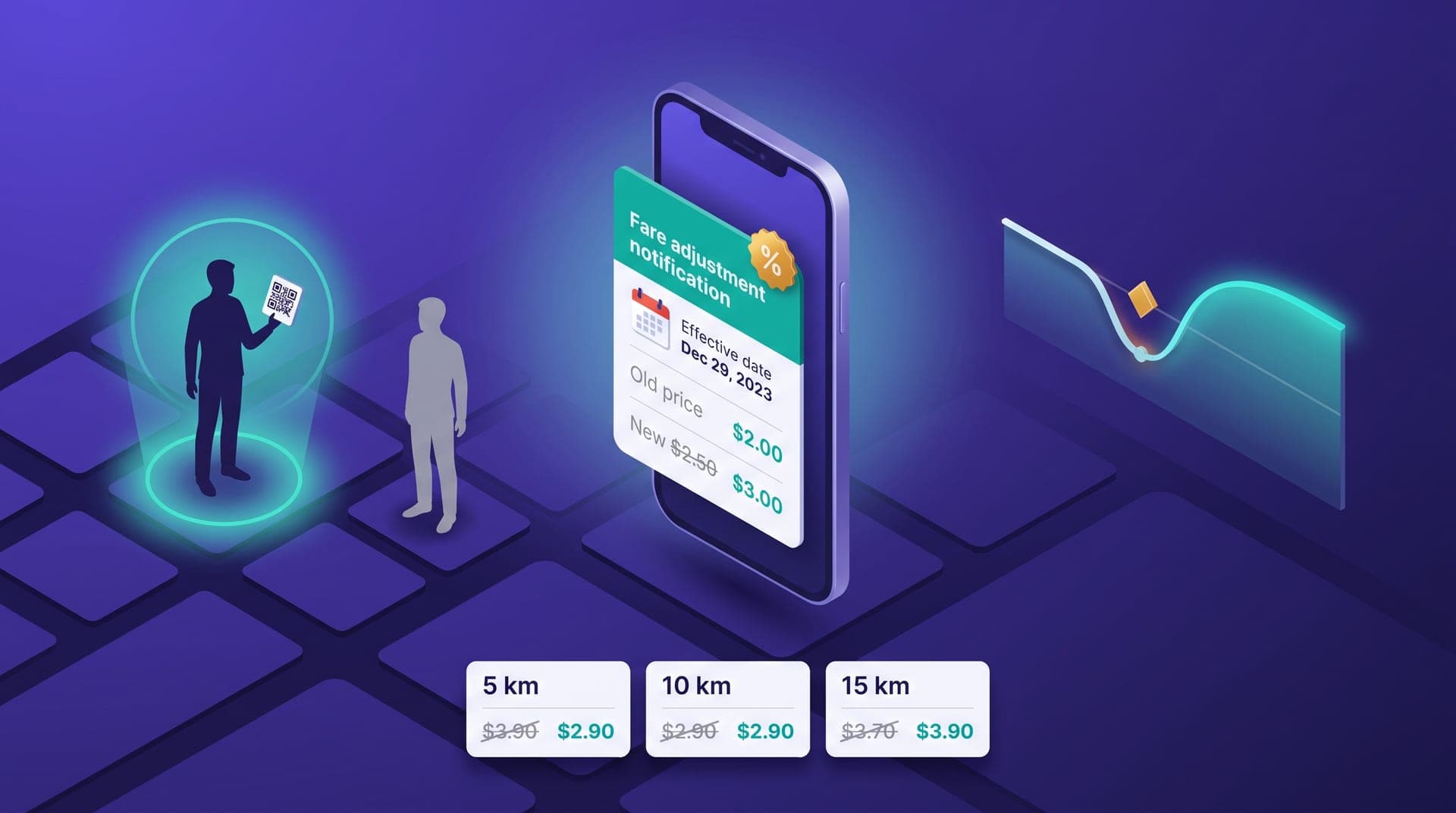
Most operators launching a regional mobility app frame the pricing question incorrectly: fixed rates or dynamic pricing? The right question is different: in what order and under what conditions? Fixed rates and dynamic pricing aren't opposing philosophies — they are different tools that solve different problems at different points in the operation. Activating dynamic pricing in month one of a new city doesn't generate more revenue; it generates distrust in a market that hasn't yet decided whether it can rely on your platform.
This article is for operators in mid-sized cities — 50,000 to 500,000 inhabitants — who are either evaluating their pricing model before launch, or who have weeks or months of operation behind them and are wondering if the time has come to activate variable multipliers. We'll cover why fixed rates win early adoption, when dynamic pricing begins to make sense, three indicators that confirm your market is ready, and the hybrid model that the most profitable regional operators are running today.
Fixed rates as an adoption lever, not a permanent strategy
Fixed rates reduce first-ride friction in a way dynamic pricing simply cannot match. When a passenger knows the cost from point A to point B is always the same — regardless of time, traffic, or how many others are requesting at that moment — the trust threshold for trying the platform drops significantly. In cities where Uber or Cabify operate, passengers already understand that prices can change without notice. In cities where they don't, variable pricing is either unknown or directly suspicious. Launching with dynamic pricing in that context means solving a problem the operation doesn't have yet.
Operators who launch with fixed rates report trip completion rates 15% to 22% higher in the first 60 days compared to those who launch with variable pricing from day one. The explanation isn't that passengers are irrational — it's that in a new service, predictable pricing is part of the product. If someone knows what a trip to the airport will cost before opening the app, the app becomes a useful tool rather than a risk to evaluate each time. That predictability builds the usage habit that dynamic pricing will later need to work.
Fixed rates aren't the final answer — they are a market-opening tool. Using them indefinitely means leaving peak-hour demand surplus on the table and squeezing drivers at moments when their real operating costs rise with traffic or distance. The move to dynamic pricing isn't an upgrade from fixed rates; it's a different instrument that requires different conditions to work.
When dynamic pricing creates revenue — and when it creates churn
Dynamic pricing solves a real problem: at peak hours, demand outpaces available driver supply. A multiplier of 1.3x to 1.5x at those moments produces two positive effects: it motivates idle drivers to go online, and it rations demand between passengers who can wait and those who need the ride immediately. In cities where operators understand their data well, a correctly calibrated surge can increase per-trip revenue by 20% to 35% without meaningful impact on the cancellation rate.
The problem appears when the multiplier is too high, too frequent, or activates in a market where driver supply can't respond. A 1.8x in a city with 25 active drivers doesn't redistribute demand — it pushes passengers away without generating more trips because there's no supply capacity to answer them. In LATAM regional markets, the passenger churn threshold sits between 1.6x and 1.8x for short trips under 10 minutes, and between 1.4x and 1.6x for longer ones. Exceeding those ranges without enough driver density produces a double-negative outcome: fewer completed trips and drivers online without enough demand to make their time worthwhile.
Three indicators that tell you your market is ready for variable pricing
There's no calendar date that tells you when to activate dynamic pricing — there are three operational conditions that have to be met simultaneously. If all three are in place, the market is ready. If any one is missing, dynamic pricing will cause more harm than benefit regardless of how well-designed the surge algorithm is.
Three conditions that must be met before activating variable multipliers:
- More than 45 active drivers during peak hours: without that base, the multiplier has no supply to answer demand and only produces a cascade of cancellations.
- More than 150 completed trips per day for two consecutive weeks: a signal of sustained demand, not sporadic spikes that won't repeat.
- App store rating above 4.2: a product with a weak reputation can't survive the added friction that variable pricing creates.
If the operation meets all three metrics but you haven't tested dynamic pricing yet, the first step is a moderate multiplier — between 1.2x and 1.4x — during limited time windows: Friday and Saturday nights from 9 PM to 1 AM, or whatever the most predictable high-demand window is in your city. Measure the impact on completion rates, cancellations and driver reconnections for two or three weeks before expanding it to other time slots.
How to set the base rate before activating any multiplier
The most common mistake when designing dynamic pricing isn't the multiplier — it's a miscalculated base rate. A 1.4x on a base rate that doesn't cover the driver's operating costs solves nothing. And in the opposite direction, an inflated base rate designed to compensate for the lack of dynamic pricing erodes competitiveness during normal-demand hours, which represent 60% to 75% of any operation's daily trips.
The base rate has to cover three components: the driver's variable costs (fuel, wear, dead time between trips), the platform's margin, and land below the price the passenger perceives as fair in your specific city. The range that works in mid-sized cities in Mexico, Colombia and Central America sits between $0.28 and $0.45 USD per kilometer for the base rate, with an opening charge between $0.60 and $1.20 USD. Those ranges vary by local fuel cost, urban density and whatever reference price the passenger already knows from alternatives — street taxis, shared vans, mototaxis.
The most direct validation: before activating dynamic pricing, confirm that the base rate allows an average driver to earn between $8 and $14 USD per active hour in your city. If it doesn't, no multiplier will retain drivers at peak hours — they'll be connected but rejecting the longer requests because the effective income doesn't justify the time. That is the scenario that degrades the passenger experience faster than any other system failure.
How to communicate variable pricing without losing passengers
Dynamic pricing doesn't fail because of its economic logic — it fails because of its communication. Passengers don't object to prices going up at peak hours; they object to discovering it at the moment they already need a ride. Communication that works in regional markets does three things before the multiplier activates: explains the logic in plain language before the passenger first encounters it, shows it clearly on the trip confirmation screen, and offers a real alternative — booking the trip 15 to 20 minutes early to avoid the high-demand window.
The notification that most reduces abandonment is a push message sent 10 to 15 minutes before known high-demand windows: 'High demand expected tonight. If you can, request your trip before 11 PM for better availability.' That message doesn't mention price — it speaks to availability, which is the passenger's actual problem. Operators who implement those alerts report 18% to 27% fewer cancellations during dynamic pricing windows compared to those who activate surge with no prior communication.
The hybrid model that profitable regional operators actually use
Operators who maximize revenue without sacrificing passenger or driver retention don't use pure dynamic pricing or pure fixed rates. They use a three-layer model built in sequence: fixed rates for scheduled services and corporate accounts, moderate dynamic pricing capped at 1.2x to 1.6x for weekend peak hours, and negotiated special rates for high-frequency routes like airports, bus terminals and hospitals.
This model works because it correctly segments the passenger. The corporate or frequent user gets predictability and builds the usage habit that sustains baseline revenue. The occasional weekend user accepts the dynamic pricing range because the alternative is waiting longer or not finding a driver at all. High-frequency routes generate guaranteed volume that stabilizes driver income and reduces their dependence on surge to make their hours worthwhile. The result is a more stable revenue curve and higher driver retention because their earnings are more predictable.
The trip distribution by category in mature operations of this type runs between 25% and 40% in corporate accounts or scheduled services, 45% to 60% in open demand with dynamic pricing active during peak windows, and 10% to 20% in fixed high-frequency routes. Reaching that distribution takes 8 to 14 months from launch and requires building the three layers in sequence. The base rate first — without it, nothing else has a foundation. Moderate surge windows next. Corporate accounts and special routes as the final stabilization layer.
We ran fixed rates for the first four months because we didn't have enough drivers to sustain surge. By the time we activated it, we had 80 drivers and over 200 daily trips. In the first week, per-trip revenue went up 22%. We didn't do it earlier because earlier it wouldn't have worked.
The choice between dynamic pricing and fixed rates isn't a product philosophy decision — it's a sequenced decision that responds to the real conditions of the operation. Starting with fixed rates isn't the conservative path: it's the path that preserves early adoption while the operation builds the driver density and user base that dynamic pricing needs to produce positive results. Trying to skip that sequence produces a system with all the implementation complexity of variable pricing and none of its benefits.
The model that maximizes medium-term revenue in regional markets isn't the most sophisticated-looking one — it's the one that respects the order of operations. Well-calculated base rate first. Enough drivers next. Moderate surge in controlled windows once supply can respond. Corporate accounts and special routes as the third stabilization layer. That's the path that builds a financially sustainable operation, not the one that looks most ambitious on day-one slides.