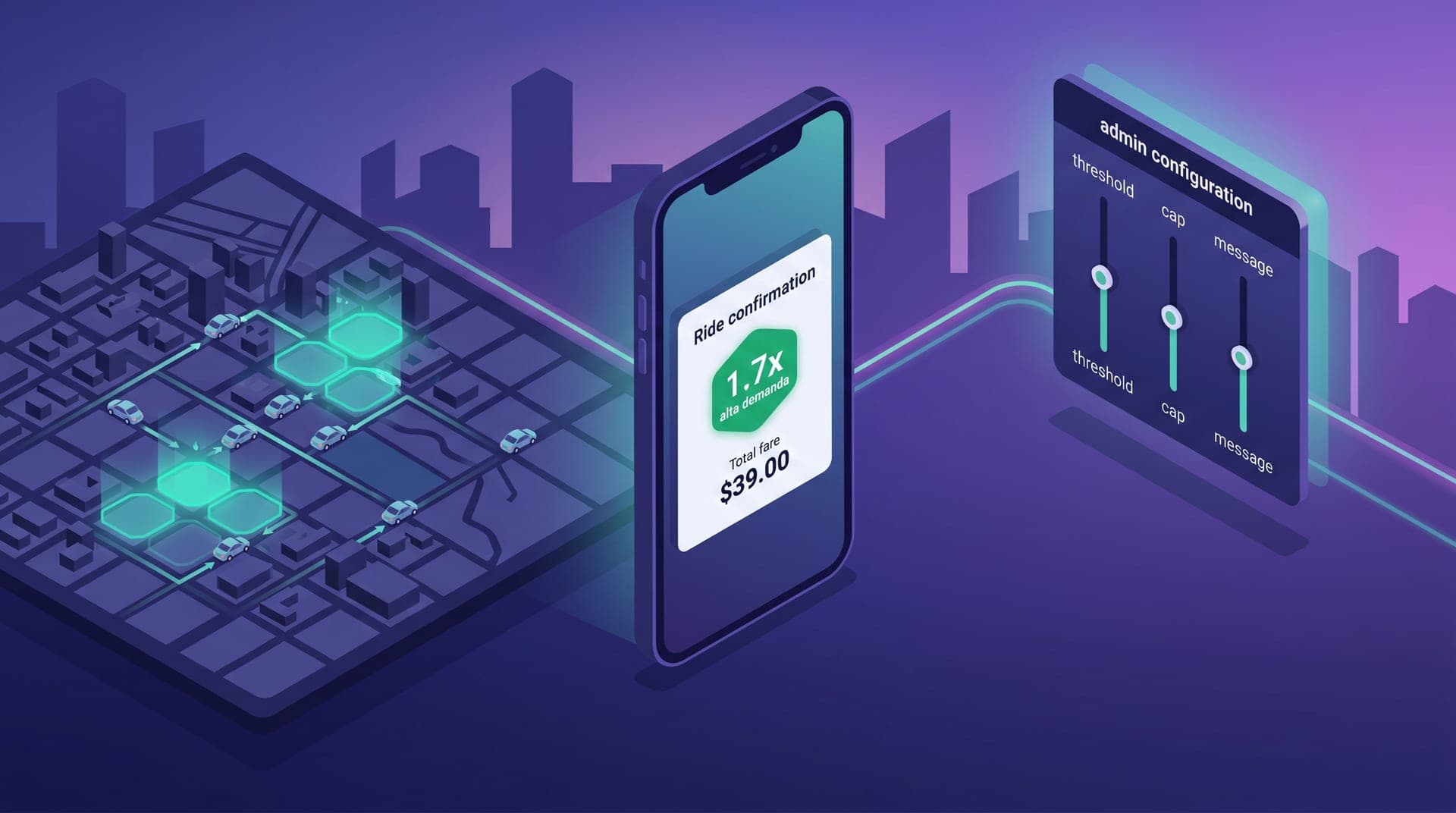
Surge pricing is active by default on almost every mobility platform from day one of operation. The problem isn't that it's on — it's that most operators never adjusted the three variables that determine whether it works as a tool or as a source of friction: the activation threshold, the multiplier cap, and the message the passenger sees before confirming the trip. A surge with too low a threshold activates on any minor supply-demand imbalance, including ones that would resolve themselves in three minutes without a price increase. A cap set too high produces mass cancellations exactly when the platform most needs conversion. And a multiplier with no context generates the worst reaction of all: the passenger sees the price went up without understanding why, and closes the app to look for an alternative.
This article doesn't debate whether dynamic pricing is better than fixed fares — that's a strategic decision that depends on the market and the passenger profile. This article is for operators who already have surge active or are about to configure it for the first time, and need to understand what to calibrate so the mechanism does what it's supposed to: attract drivers to zones with real demand, manage peaks without losing recurring passengers, and not destroy confidence in the base fare with frequent activations the passenger reads as noise rather than as a scarcity signal.
What surge solves — and what it cannot solve on its own
Surge pricing has two distinct operational functions that are frequently confused as one. The first is attracting drivers to high-demand zones: when the multiplier is high enough, drivers available in adjacent zones choose to reposition because the additional revenue compensates their travel time. In markets with an average ticket of $3 to $5 USD, a 1.2x multiplier generates an increase of $0.60 to $1.00 USD per trip — not enough to move a driver who is eight minutes away. A 1.5x to 1.8x multiplier generates between $1.50 and $4.50 USD extra, which does produce repositioning. The second function is demand management: the higher price makes some passengers wait or look for alternatives, reducing the queue of unassigned requests. That second function only works in markets where the passenger has real options. In a city of 100,000 with a single dominant mobility platform, surge doesn't reduce demand — it generates frustration.
The most common mistake is assuming surge does both things well with any configuration. In operations with 60 to 150 active drivers, surge can activate on minor imbalances that would resolve themselves in under four minutes — not because there is real supply scarcity, but because the threshold was never calibrated for the fleet size. The result is a multiplier that activates dozens of times a day without producing driver repositioning, and that creates a passenger experience where the price when opening the app differs from what they expected in a significant share of requests. That inconsistency erodes confidence in the base fare more than any well-communicated peak event.
The activation threshold: how to calibrate it for your fleet
The activation threshold defines at what supply-demand imbalance the platform raises the multiplier. Most platforms use a requests-per-available-driver ratio within a defined radius and time window: when that ratio exceeds a configured value, surge activates. The problem isn't the mechanism — it's that the value is rarely adjusted to actual fleet size or the specific market's demand patterns. A city where demand concentrates in two or three sharp daily peaks has a completely different imbalance distribution from one with demand spread throughout the day. In the first, the threshold can be more sensitive because real scarcity is pronounced during specific windows. In the second, the same threshold activates dozens of times daily without real scarcity — just normal variation in distributed demand.
The multiplier cap — why 1.7x is usually enough
If the threshold determines when surge activates, the cap determines how far it goes — and it is the variable with the most direct impact on whether the mechanism attracts supply or destroys conversion. In most secondary LATAM markets, cancellation rates start rising noticeably above 1.8x to 2.0x and exceed 35% above 2.5x. Above that level, surge captures less revenue than it destroys in lost trips and negative experiences from passengers who completed the ride feeling penalized. The multiplier that maximizes captured revenue without destroying conversion in most secondary markets sits between 1.5x and 1.8x — not at the technical limits of 3x or 4x that some platforms allow. That cap isn't a universal number: it's the point where local passenger elasticity produces the first mass cancellation, and it varies with per-capita income and the density of available transport alternatives.
The most important argument for a low cap isn't marginal revenue — it's who cancels when surge is high. Passengers who complete a trip at 2.5x are generally those with no alternatives or visitors without local context. Those who cancel are the frequent riders with options: the passenger six months on the app who knows they can wait twenty minutes for the price to drop, or call a trusted driver directly. Losing that passenger on a high-demand Friday isn't a lost transaction — it's the start of disengagement from the platform for their regular trips. A cap of 1.6x or 1.7x preserves that relationship while still moving enough supply to resolve the real imbalance in the zone.
How to display surge without triggering cancellations
How surge appears on the trip confirmation screen has a measurable impact on the cancellation rate, independent of the multiplier level. There are three common variants: showing the abstract multiplier (1.8x), showing the projected fare without context ($5.40), or showing the fare with a context line ('$5.40 — alta demanda in your area'). The abstract multiplier produces the highest cancellation rate because the passenger has to translate it into a real number in real time — and during that three-to-five-second uncertainty window, cancellation probability rises. The fare without context produces confusion: the passenger knows something changed but doesn't know whether it's normal or an error. The fare with context produces the lowest cancellation because it communicates that the increase has a known, temporary cause, applies equally to everyone, and the platform is being transparent before the passenger confirms.
The minimum context that reduces cancellations is a line of text next to the fare explaining the reason for the increase and indicating it's temporary. On most platforms, that text is a configurable field in the admin panel — no technical development required. What it does require is that someone configure it with a concrete message in the passenger's language, rather than the generic English text that comes as default. An additional step that reduces cancellations further is indicating when the price is expected to return to the base fare: 'alta demanda — regular price in approximately 15 minutes' transforms the experience from feeling penalized to receiving useful information. That reframing has a measurable effect on the passenger's decision at exactly the moment when conversion matters most.
Surge in tourist markets: when not to apply it
Dynamic pricing has different effects when the passenger has no context about what a normal fare looks like in that city. In a residential market, a passenger who sees 1.8x on a Friday night understands there's high demand — that context reduces friction. In a tourist market, a visitor opening the app for the first time in an unfamiliar city who sees 1.8x has no such reference: they don't know whether the multiplier is normal, whether they're being charged differently for being a foreigner, or whether they should look for an alternative before confirming. Uncertainty produces cancellation more readily because tourists have lower switching costs — they can pull up TripAdvisor, find the hotel shuttle number, or ask the concierge for a recommendation in under a minute. The right response in those markets for demand peaks is a planned increase in supply with additional drivers positioned in the highest-flow zones, not an automatic multiplier.
The practical distinction in a tourist city is to deactivate dynamic pricing for the highest-ticket routes — airport, hotel to main attraction, transfers between tourist zones — and keep it active only for residential demand, where the passenger has the context to interpret the multiplier without friction. For moments of genuine high tourist demand, the answer is positioning additional drivers in advance in the highest-flow zones — as high-season planning requires — rather than letting surge activate automatically when the system detects the imbalance.
The mistakes that turn surge into noise for the passenger
The four patterns that make surge do more harm than good:
- Surge without passenger context communication: showing the multiplier without explaining the cause generates cancellation rates up to 40% higher than showing the fare with an 'alta demanda in your area' label
- Threshold not calibrated for fleet size: in 60-to-100-driver operations, surge can activate on imbalances that would resolve themselves in three to four minutes without a price increase
- Cap set too high for local market price sensitivity: every city has a point where cancellation exceeds the marginal revenue benefit — that number must be measured from your own operational data, not assumed to be the platform's technical limit
- Surge active without driver notification: if drivers don't receive an alert when surge activates in a zone, there is no repositioning — the passenger pays more but available supply in the zone doesn't change
I had surge active from day one with the default threshold. In a city of 120,000 it was activating forty times a day. My regular passengers stopped trusting the app's pricing because they never knew what they were going to pay. It took me four months to understand why NPS kept falling week after week while trips were still growing.
Well-calibrated surge pricing is one of the most valuable mechanisms in a regional mobility platform's operation because it balances supply and demand automatically, without the operator manually intervening at each peak. But that efficiency only exists when all three variables are properly set: a threshold that activates on real imbalances, a cap that moves drivers without triggering mass cancellations, and a passenger message that transforms the price increase into understandable information rather than an unexpected penalty. None of those three calibrations require additional technical infrastructure — they require that the operator has reviewed them deliberately at least once since the platform launched.
The clearest signal that surge is working correctly isn't how much additional revenue it generates at peaks — it's that drivers reposition when it activates and frequent passengers keep completing trips even when the price is higher than usual. When both of those things happen simultaneously, surge is doing what it's supposed to: resolving a real supply scarcity problem with a price that reflects that imbalance and a communication that passengers accept because they understand it. That's the standard worth measuring your current configuration against, regardless of how long it has been active.