Airport trips carry the highest average fare of any route in most regional mobility operations — typically 2.5x to 4x the standard urban ticket. Yet they're also among the most poorly executed services: fixed rates calculated without the driver's empty return leg, trips assigned reactively to whoever happens to be online, and passengers arriving at the terminal at 5 a.m. with no confirmation that their driver left home. The problem isn't the fixed rate or the airport as a route — it's running an airport transfer with the same logic as an on-demand trip to the downtown market.
This article is for operators who already have a regular trip base and are evaluating the airport as a new service, or who already offer it but haven't made it a consistent revenue stream. The central argument is that a profitable airport service isn't another option in the app menu — it's a scheduled transfer service with its own logic: pricing built on the full route's real cost, a specific vehicle profile, advance booking as an operational prerequisite, and a natural progression toward hotel and corporate contracts that turn the route into the most predictable revenue in the fleet.
Airport trips operate on a different logic than on-demand
An on-demand city trip has a relatively symmetric structure: the passenger requests, the platform assigns the nearest available driver, and the system works when there's enough supply in the zone. An airport trip is structured differently across three dimensions. First, anticipation: a passenger with a 6:30 a.m. flight cannot wait for an available driver within 800 meters — they need to know 12 to 24 hours in advance that their trip is confirmed and with whom. Second, punctuality: arriving late to a flight is not a minor inconvenience — it's the error that produces a one-star review and a passenger who never returns. Third, distance: most airports in secondary LATAM cities sit 15 to 35 km from the urban center, which means the driver's empty return leg is part of the real cost of the trip and must be included in the fare.
Those three dimensions — anticipation, punctuality, and distance — require an operational response that pure on-demand doesn't have. Reactive assignment doesn't guarantee availability for early morning flights. A standard affiliate fleet doesn't ensure punctuality when the driver decides to wake up at 4:30 a.m. without having confirmed the trip the night before. And a fare calculated only on the outbound leg ignores the 45-minute empty return that's part of the trip's real cost. Adding the airport to the app menu without changing anything else is why so many operations drop the service within 90 days without quite understanding what went wrong.
How to set the fare without leaving margin on the table
The fixed airport fare is calculated on the real cost of the complete trip, not on what the street taxi charges or on the point at which the passenger stops complaining. The real cost includes the outbound leg, a terminal waiting window if the flight is delayed — 15 to 30 minutes before additional charges apply is a reasonable standard — and the empty return leg. On top of that total operational cost goes the platform margin plus a buffer for delay scenarios that generate no extra revenue. In practice, this puts the right airport fare for most secondary LATAM cities at 30% to 55% above what the same route would cost as an on-demand trip at peak dynamic pricing.
The five variables that determine the real cost of an airport trip:
- Round-trip distance from the most common pickup zone to the airport — not just the outbound leg the passenger pays for
- Actual average terminal waiting time over the past 30 days, including flight delays that produce no additional revenue
- Local fuel cost per kilometer, distinguishing between an affiliate's personal vehicle cost and a directly controlled fleet vehicle
- Cleaning and vehicle preparation cost if the airport presentation standard is higher than for regular trips
- Competitor reference pricing — licensed taxi, other apps, private transfers — as a price ceiling, not as a starting point
The most frequent pricing mistake is using the competitor's fare as a starting point rather than a ceiling reference. If the licensed taxi charges $18 USD for the same route and the operator sets $14 USD to gain market share quickly, the result is a fare that doesn't cover the real trip cost once empty return legs and delays are included. The airport isn't won on price — it's won on experience: advance confirmation, a punctual driver, a vehicle in good condition. A passenger who has used the same transfer for three months without a single problem pays $18 without shopping around. One who paid $14 and waited forty minutes on the curb doesn't come back.
The vehicle profile you cannot ignore
Vehicle profile for airport service isn't an aesthetic preference — it's part of the product. A passenger on an airport transfer is carrying luggage, likely more stressed than usual, and in many cases heading to a flight that represents a significant line item in their budget. The vehicle experience — luggage space, interior cleanliness, working air conditioning, cabin noise level — determines whether that passenger books the platform next time or calls the hotel's private shuttle directly. In cities where the airport is 25 km or more away, that in-vehicle time is long enough for a poor experience to leave a mark even when the driver arrived on time.
In practical terms, the minimum vehicle profile for airport service in a regional LATAM market includes: trunk capacity for two large suitcases, year-round functional air conditioning, documented cleaning before each airport shift, and a driver with a punctual arrival protocol the operator can verify. The model doesn't need to be luxury — it needs to be predictable. A four-to-six-year-old sedan in good presentable condition outperforms a deteriorated SUV for a passenger who just flew two hours and wants to get home. In operations with an owned-fleet component, vehicles designated for airport runs are always part of the controlled core, never the general affiliate pool — for exactly this reason.
Why advance booking changes the entire model
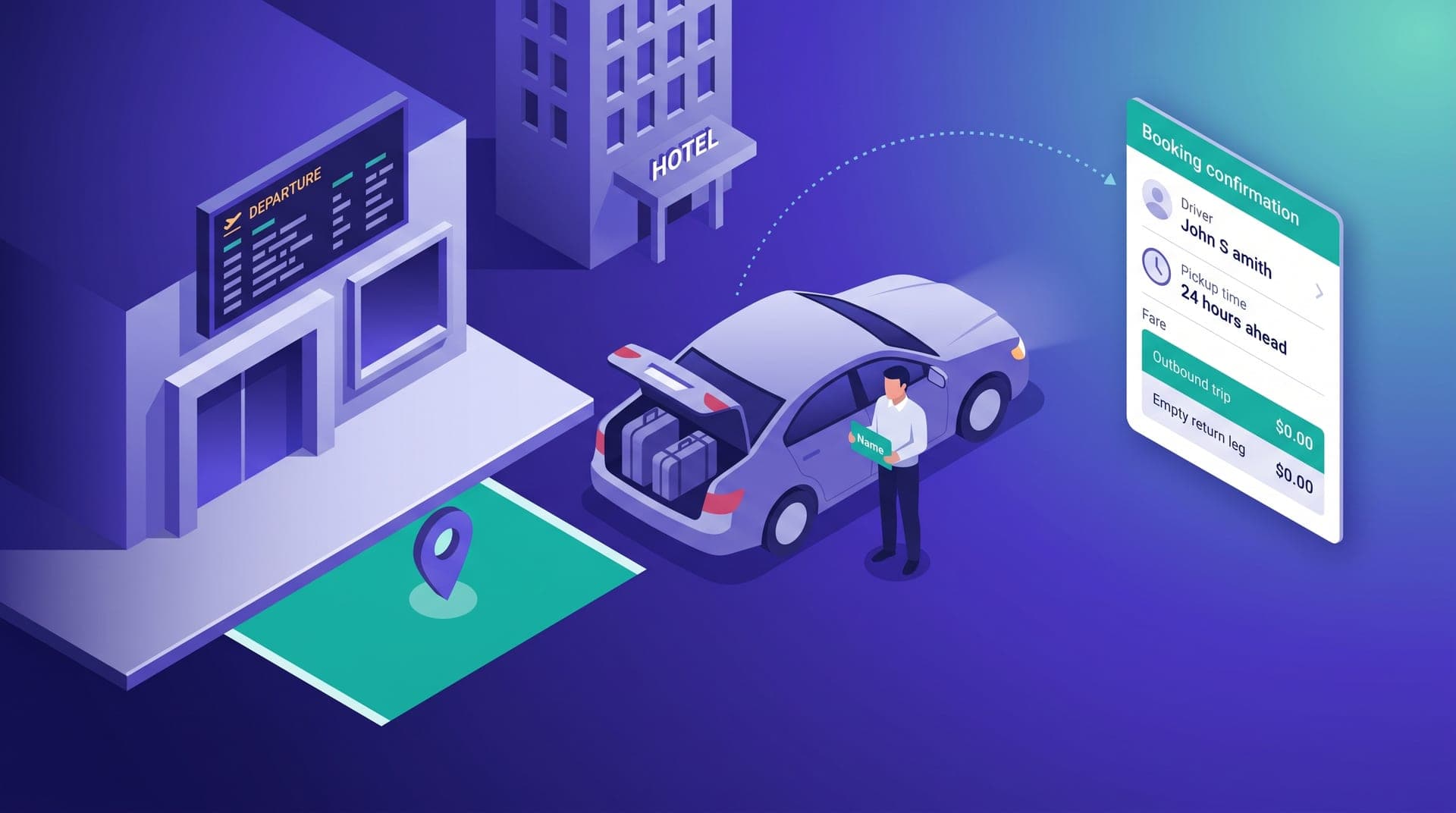
Advance booking for airport trips isn't an optional feature — it's the mechanism that turns an informal service into a sellable product. With a booking confirmed 12 to 24 hours ahead, the operator can assign the specific driver who has the right vehicle and verified availability for the flight time. The driver can plan their shift without uncertainty. The passenger can sleep knowing their trip is confirmed, not simply 'in the platform waiting for assignment.' That certainty is worth more than a 10% discount to most frequent airport passengers — it's the primary reason why pre-confirmed private transfers continue to capture a significant share of the market even when apps offer lower fares.
The simplest implementation of advance booking for operations without a native flow is WhatsApp or phone reservations for airport trips, separate from the regular on-demand flow. It's a manual step that scales poorly as volume grows, but it's infinitely better than no advance booking during the first six to twelve months. What matters at that stage isn't the channel — it's that the passenger receives confirmation with the driver's name and pickup time before going to sleep the night before their flight. That standard, however rudimentary the channel, establishes the difference between an airport service passengers recommend and one that simply exists in the app menu.
From app to contract: hotels and corporate accounts
The airport is the natural entry point to hotel and corporate accounts — the highest-predictability, lowest-acquisition-cost demand segment in a regional mobility operation. A four-star hotel in a secondary city managing 40 to 80 guests with weekly flights has a concrete problem: how to guarantee reliable airport transport for its guests without depending on the chain's shuttle or a street taxi. An operator with a working airport service has exactly the product that hotel needs — the difference between having them as a client or not is whether someone showed up to propose the agreement.
The sales argument for a hotel or a company with frequent travelers isn't technology — it's predictability and accountability. Pre-agreed fares, a named driver with a phone number, passenger arrival confirmation, and a billing mechanism that works for the client's accounting department. A contract with a 60-room hotel or a company with five weekly travelers can represent between $2,800 and $6,500 USD in monthly recurring revenue, at margins similar to individual transfers, but with zero acquisition cost after signing. The natural progression is: airport service working in the app, first hotel contract within three months of stable operation, expansion to local corporate accounts within the first year.
The mistakes that turn the airport into a drain
The patterns that destroy airport service in regional operations are consistent and almost always appear within the first 60 days. The first is a fare calculated on the outbound leg without including the empty return: the operator discovers that drivers earn less per active hour on airport runs than in the city, stops assigning quality drivers to the route, and service quality drops exactly where it matters most. The second is the absence of advance confirmation: the passenger books at 11 p.m. for a 5 a.m. flight and the system has no driver available, resulting in a last-minute cancellation the passenger doesn't forget. The third is adding the airport as another app menu option without differentiating it operationally — no designated vehicle, no punctuality protocol, no presentation standard. The result is a product with the right name but without the experience that makes it worth choosing.
The first month I added the airport to the app menu without changing anything else. Within three weeks I had four last-minute cancellations because no driver was available at 4 a.m. I lost those four clients. The second month I assigned airport runs to two specific drivers with good vehicles and started taking reservations by WhatsApp the day before. Zero cancellations over the next ninety days. By the fourth month I signed my first hotel contract.
A profitable airport service doesn't require more technology than the rest of the operation — it requires a different operational model. The fare covers the full trip including the empty return. The driver is a specific person with the right vehicle who knows their passenger and pickup time. The passenger has confirmation the night before. Those three conditions aren't sophisticated — they're the minimum baseline without which the airport produces inconsistent experiences and routes the best passengers to competitors.
The path from airport service as a basic product to a signed contract with the city's largest hotel isn't long when the operation works well. What separates the two isn't scale — it's whether the product proved reliable enough consecutive times for someone managing frequent travelers to decide that the informal alternative no longer makes sense. That reliability threshold is built in the first 30 to 60 transfers executed correctly, and once crossed, the airport route stops being the hardest service to manage in the platform and becomes the most predictable in the entire fleet.