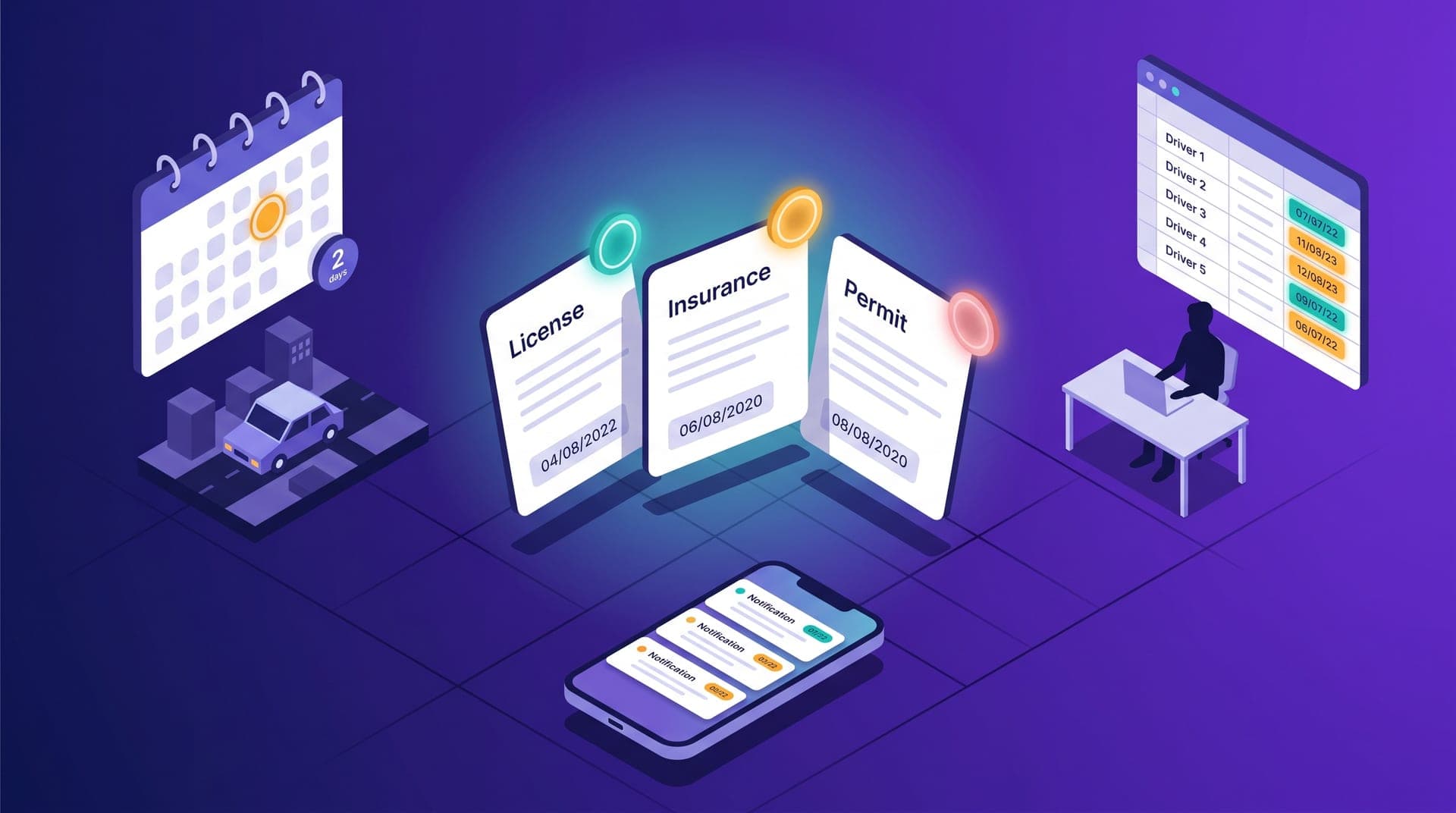
A regional mobility platform's web registration portal averages four to six steps that require uploading document photos. On a mid-range Android phone — the device used by most driver candidates in secondary LATAM markets — those steps produce a drop-off rate between 55% and 75% before the driver completes registration. WhatsApp, in those same markets, has a message open rate above 85% and an average response time under four minutes. The gap between those two numbers is not a statistical anomaly — it is a map of the channel where the driver already operates versus the channel where the operator wishes they would go.
This article is for operators with between 20 and 200 active drivers who see new-driver activation times exceeding seven days, high drop-off rates in the registration process, or fleets growing slower than expected without any visible recruitment problem. The central argument is that in most regional LATAM operations, the constraint on fleet growth isn't the value proposition or the commission structure — it's the documentation channel: the registration portal is designed for a desktop experience in a market where the typical driver candidate will never start that process from a computer.
Why the registration portal loses drivers before they ever activate
The web registration portal is the solution that ships with most mobility platforms. The operator assumes that if the portal is available and well-designed, candidates will complete it. What that assumption ignores is the profile of the candidate in secondary LATAM markets: someone who learned about the opportunity through Facebook, a friend, or a physical ad, and who in that same moment — on their phone, without prior planning — tries to start the process. The sequence that follows — opening a browser, finding the URL, creating an account, filling in a form, and uploading six photos in separate steps — carries enough cumulative friction for more than half of candidates to abandon before reaching the end.
The drop-off is not random: it concentrates at steps that require uploading photos from the phone. In a typical four-to-six-document registration flow, the largest drop-off occurs after the second or third document requested. The driver completed the basic information and uploaded their license, but when the portal asks for the vehicle registration document, the file isn't on the phone, the portal camera doesn't work correctly with that version of Android, or the process simply feels too long to finish in that moment. The candidate closes the browser. The operator never learns that candidate existed or which step caused the exit.
WhatsApp as the first point of contact: the logic of the right channel
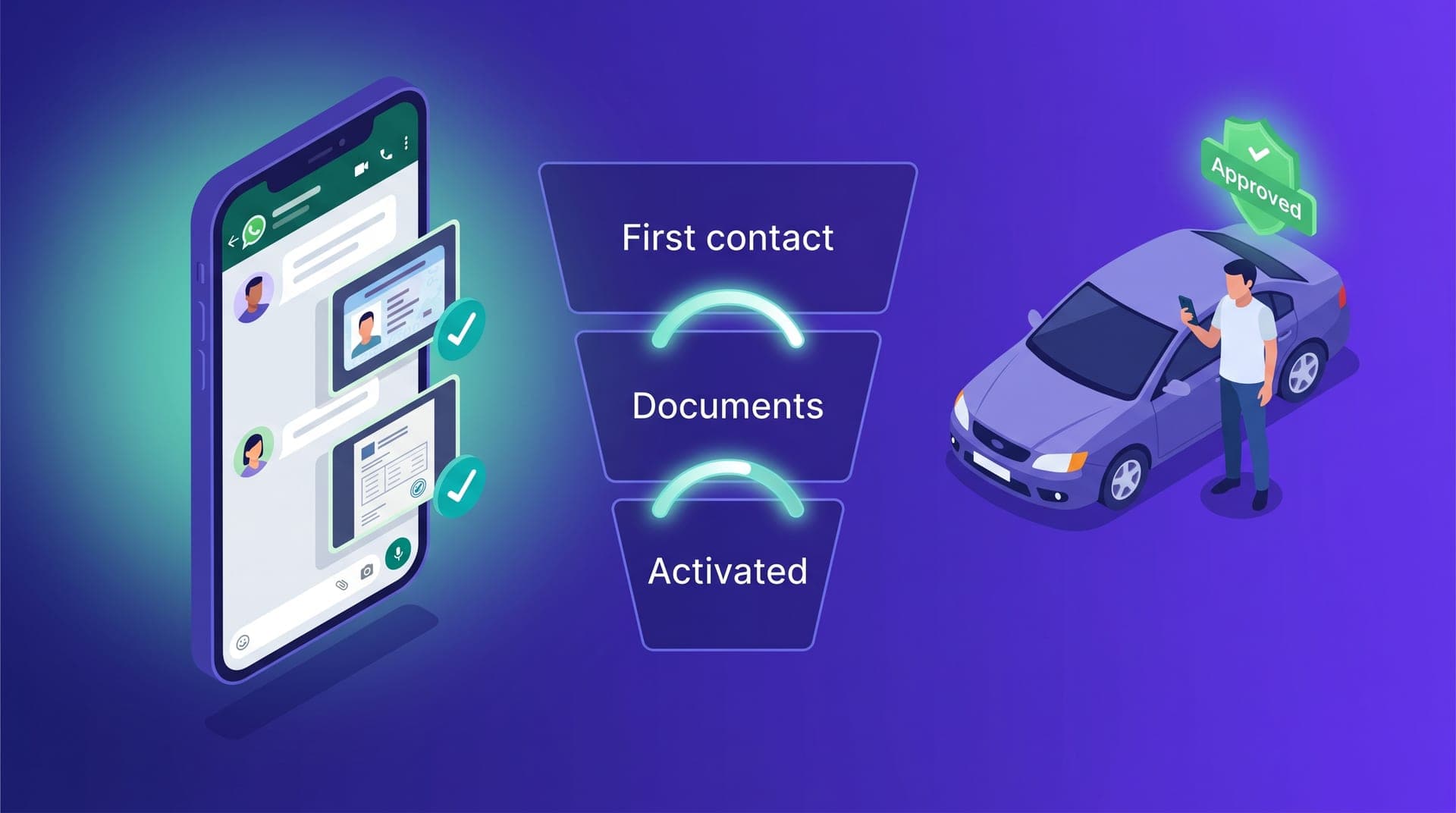
WhatsApp doesn't replace the document validation process — it replaces the channel where that process happens. The operational difference is that WhatsApp is an app the candidate already has installed, already knows how to use, and already trusts for sharing photos with family and friends. The onboarding flow that works in WhatsApp is not an informal conversation — it is a structured sequence of messages guiding the driver from first contact through document validation, with exactly the same information the portal requests, but in individual steps, in conversational language, and in the channel where response rates are structurally higher.
The opening message determines whether the candidate continues or abandons the process. An opening that says 'To register as a driver we need the following documents:' followed by a list of six items produces the same drop-off as the portal. A message that says 'Welcome. To get started, we just need one thing: a photo of your driver's license on both sides. When you have it, send it here and we'll respond in under 10 minutes' produces a response rate of 60% to 80% in most secondary LATAM markets where this flow has been implemented. The difference isn't technological — it's the structure of the request: one single action, with an explicit response time expectation.
Which documents to request and in which order to reduce drop-off
The order in which documents are requested determines how many candidates reach the end of the process. The rule is to start with the most accessible document and leave higher-friction documents for when the candidate already has investment in the process. A candidate who has already sent three documents has a concrete reason to send the fourth — abandoning now means losing the progress made. A candidate who just received a list of six items in the first message has nothing to lose by closing it.
- Photo of driver's license on both sides: the most accessible document for most candidates, almost always available immediately from the phone or kept in the vehicle
- Selfie next to the vehicle holding the keys: confirms vehicle access and provides the first visual contact with the candidate for basic identity validation
- Photo of the vehicle registration document: usually kept in the glovebox; requesting it after the selfie takes advantage of the moment the candidate is already next to the car
- Photo of the insurance policy or coverage certificate: the highest-variability document — some candidates have it digitally, others on paper, some must request it from their insurer
- Proof of address if the market requires it: frequently the most forgotten document and the one that causes the most delays — placing it last minimizes drop-off on all previous steps
The validation between steps is what keeps the candidate engaged. A message saying 'We received your license and are reviewing it. When you're ready, send us the selfie next to your vehicle' communicates progress and gives the next concrete instruction. That chain of micro-feedback — which doesn't exist in a registration portal because all fields are on the same screen — reduces drop-off at each step because the candidate senses an active counterpart and that the process is moving forward. The promised response time is part of the implicit contract: if the operator promises a 10-minute response and takes three hours, continuation rates drop.
WhatsApp's role after registration: activation and the first week
WhatsApp onboarding doesn't end when the driver is approved. The first week of activity determines whether the driver becomes a stable fleet asset or an activation that disappears before completing 10 trips. WhatsApp is the most effective channel for post-registration activation messages because open rates are significantly higher than for email or app push notifications — especially in the first 48 hours, when the driver hasn't yet developed the habit of checking driver app notifications.
- Day 0 (approval): welcome message with the direct download link for the driver app, a three-step guide for the first session, and a direct contact for technical questions during day one
- Day 1: brief check-in to confirm the app is installed and set up, with the direct question 'have you completed your first trip?' — the data point that most quickly validates whether onboarding succeeded
- Day 3: summary of the first days — how many trips completed, how much earned, and a note on the highest-demand time window in the city so the driver can plan their availability
- Day 7: reminder of the basic rating and cancellation policies, with the driver's week-one metrics and the bonus threshold if the platform has one active
That message sequence isn't support — it's the process that converts a formal activation into a driver who understands the platform before day eight. A driver who arrives at their second week with the first trips completed, a clear sense of the most productive time windows, and a direct contact channel in case of problems, has a significantly higher 30-day retention probability than a driver who received a welcome email with a PDF of usage instructions and had to figure out the rest on their own.
WhatsApp API or standard Business account: when to scale automation
WhatsApp Business operates in two modes with different operational implications. The WhatsApp Business app — free of cost — allows managing onboarding manually or semi-manually with predefined message templates. It's the right choice for operations with fewer than 25 monthly driver activations, where a team member can manage active conversations without being overwhelmed by volume. The WhatsApp Business API — which requires a certified integration provider and has a per-conversation cost for business-initiated messages — is necessary when activation volume exceeds what a small team can handle manually, or when integrating basic document validation with the platform's internal systems before human review.
The most common mistake is investing in the API before validating that the manual flow produces real activations. An operator with 15 monthly activations who automates WhatsApp before refining the message sequence will scale a flow that isn't optimized yet — producing a more structured experience but with the same drop-off rates as the portal because friction points weren't identified before automation. The correct order is manual flow first, sequence and language optimization second, automation third when volume justifies it.
The metrics that tell you whether the onboarding channel is working
The onboarding channel is evaluated with the same funnel in both cases: candidates who start the process, candidates who complete documentation, approved drivers, drivers who complete at least 10 trips in their first month. Each conversion rate between stages identifies where the largest drop-off occurs. For operations that have migrated from web portal to WhatsApp as the primary channel, the most common improvements in the first 60 days are: documentation completion rate rising from the 25%–40% range to 55%–70%, and average activation time — first contact to first trip — falling from 8–12 days to 3–5 days.
The metric that most surprises operators who run the comparison is activation time, not completion rate. A portal can be completed on the same day for a candidate who has all documents available — but in practice, candidates who don't have a document accessible at the exact moment they open the portal don't return. The WhatsApp flow keeps the conversation alive for two to three days because it allows the driver to send documents as they gather them, with an active counterpart who confirms progress at each step and doesn't let the process go cold.
We had 40 drivers registered in the portal but only 12 active after two months. When we reviewed the funnel, 62% of those who started the process dropped off at the vehicle document step. We migrated to WhatsApp: one document at a time, responses in under 20 minutes, and within four weeks we activated 18 new drivers with the same recruiting effort. The portal is still available for anyone who prefers it — but 80% of new drivers now come through WhatsApp.
The onboarding channel isn't an implementation detail — it's the first experience a driver has with the platform. A registration process that fails at the first or second step teaches the candidate that the platform is complicated before they have had the chance to discover that the income is real. WhatsApp doesn't solve a technical documentation problem — it solves a channel problem: the validation process happens in the same place where the candidate already spends 45 to 90 minutes a day, rather than in a web portal they have to visit specifically to complete a process that interrupts whatever they were doing.
An operator who invests in the correct launch commission, well-designed incentives, and a solid recruiting strategy, but keeps the web registration portal as the only onboarding channel, is losing between 40% and 65% of candidates before they reach their first active week. The correction requires no new technology and no additional budget: it requires moving the process to the channel where the candidate already is, one document at a time, with an explicit response time and someone who confirms progress at each step. That adjustment is what separates a fleet that recruits and activates from a fleet that recruits and waits.