The debate over building regional super-apps occupied much of 2024 and 2025: which services to add, in what sequence, how to manage operational expansion without losing quality in the mobility service that created the platform. That process continues in most mid-size LATAM cities. But a second transformation is happening in parallel, with less public debate and with direct impact on the operational efficiency of platforms at any scale: the integration of artificial intelligence agents that manage specific processes — driver onboarding, behavioral anomaly detection, natural-language support, demand pattern analysis — autonomously, in real time, without requiring a dedicated data team to implement them. In 2026, those agents are accessible to operators with 50 to 200 drivers, not only to global corporations with proprietary technology infrastructure.
This article is for operators with an active operation who are evaluating which parts of their management can be delegated to AI agents without compromising control over the decisions that define their competitive position. The core distinction is not technical — it is organizational: which tasks are repetitive, high-volume, and have clear decision criteria that an agent executes better than a human with many other things to think about, and which require contextual judgment, accumulated trust with drivers and clients, and the ability to handle exceptions no system can fully parametrize. The operator who understands that distinction builds an operation that can scale from 80 to 180 drivers without doubling the administrative team.
Driver onboarding as an agent process: 24 hours instead of five days
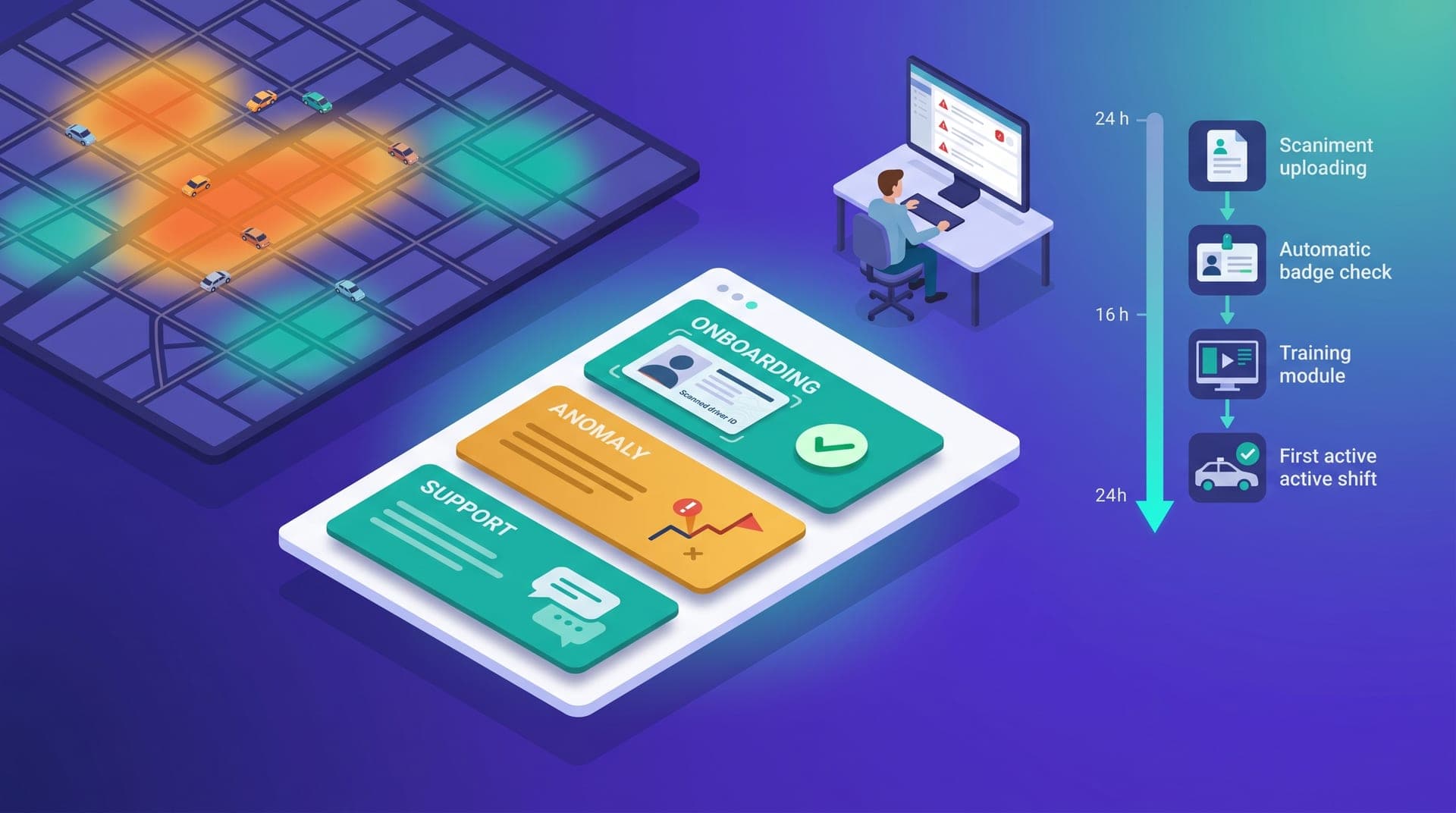
Onboarding a new driver in most regional LATAM operations involves a sequence that can take three to five business days: receiving documents via WhatsApp or in person, manually reviewing validity and expiration, running background checks through the country's available system, in-person or video training, and first platform access with initial guidance. Each of those steps has a human bottleneck that depends on someone on the team being available at the right moment. A well-configured AI agent can manage most of that sequence autonomously: it receives driver documents through a form flow, processes them with optical character recognition to extract relevant data, verifies expiration dates, sends formatted records to the background check system, and notifies the operator only when an exception requires human review — an invalid document, a data discrepancy, or a verification result requiring an admission decision.
The practical result of that flow is that onboarding time for a driver whose documentation is in order drops from three to five days to under 24 hours. For the operator, this has two direct consequences: they can respond to unexpected demand spikes by incorporating new drivers within the one-day cycle rather than waiting for the next available training block, and they can handle a higher volume of applications without increasing the administrative time spent on each case. The agent doesn't eliminate the admission decision — it concentrates it on cases where there is actually an exception requiring human judgment, rather than distributing manual attention across all cases even when documentation is perfectly in order.
Real-time anomaly detection: what the weekly review cannot catch
Fraud detection and out-of-pattern behavior in regional ride-hailing operations typically happens reactively: the operator reviews the weekly dashboard, spots anomalous metrics — a driver with a 30 percent cancellation rate in the past week, unusually long routes during certain shifts, low ratings concentrated on the same days — and investigates. That weekly review cycle has a blind window of five to seven days during which the problem may be expanding without intervention. An AI agent configured with real-time alert thresholds compresses that window to minutes: it can detect that a specific driver has cancelled 40 percent of assigned trips in the past two hours, that an active trip's route is deviating significantly from the expected path, or that a rating manipulation pattern is coming from accounts with similar behavior.
The difference between weekly reactive detection and real-time agent detection is not just speed — it is cost. A route fraud pattern detected 15 minutes after it starts affects one or two trips; the same pattern caught in the weekly review may have impacted 40 or 50 trips and generated driver and passenger disputes the team must resolve manually. The manual resolution cost of those disputes — operator time, refunds, loss of passenger trust — is consistently higher than the cost of implementing the agent that would have caught them before they accumulated. Real-time detection doesn't eliminate fraud, but it dramatically reduces the operational cost of each incident by intercepting it before it escalates.
Driver support at any hour: response without an overnight on-call team
Between 60 and 70 percent of driver support contacts in regional operations are questions that have standard answers: when the period payment arrives, how to update an expired document, what to do when a passenger doesn't show up, how to escalate a problem with a specific trip. Those questions happen during the driver's shift — including early morning hours in 24-hour operations. A human support team available at 3 AM carries a disproportionate operational cost relative to the volume of inquiries in that time window. An AI agent with access to the driver's history and the operation's knowledge base can answer those questions accurately and in the driver's language at any hour, without latency. For a driver on the night shift, getting an immediate answer at 2:30 AM rather than waiting until 9 AM has direct impact on their work experience and on their perception that the company supports them.
The most important parameter in support agent design is not which questions it can answer — it is which questions it escalates to the human team immediately. A driver in an active safety situation — an aggressive passenger, an accident, a payment issue preventing them from closing their shift — needs human contact, not an automated response. A well-configured agent recognizes those contexts and escalates through the most direct available channel, not through the standard ticket flow. The difference between a quality support agent and one that generates frustration lies precisely in that contextual escalation capability: the driver doesn't want to feel they're talking to a machine that can't help when the problem is urgent — they want the machine to handle it when the answer is standard and connect them to a person when it isn't.
Local demand analysis: the agent that learns your city's rhythm
Real-time demand analysis is the use case where AI agents have the clearest advantage over manual analysis: the volume of signals that must be processed simultaneously — demand history by zone and time window, real-time weather, confirmed local events, regional holidays, payment patterns by zone — exceeds what any small team can continuously analyze. An agent integrating those sources can generate fleet distribution recommendations for the next two hours with precision manual analysis cannot match, update zone alerts in real time when it detects accumulated demand without coverage, and propose dynamic pricing activation when the demand-supply ratio exceeds the operating threshold the operator has previously defined.
The value of that agent is not that it replaces the operator in the distribution decision — it is that it presents the decision with context already processed, rather than requiring the operator to process the context before being able to decide. The time difference is significant: the operator who has to review four data sources before deciding whether to activate dynamic pricing in the north zone invests 8 to 15 minutes in that analysis; the operator who receives an agent recommendation with context already processed makes the same decision in 30 seconds. Multiplied by the number of operational decisions requiring that analysis during a high-demand shift, the difference represents hours of cognitive capacity the operator can redirect to decisions the agent cannot make.
What the operator must not delegate to any agent
The temptation to automate everything that can be automated has a real operational limit: there are decisions an agent can technically execute but that produce poor results because they depend on context no system can fully parametrize. The most obvious is managing relationships with the most tenured drivers: a driver who has been in the operation for three years and is going through a low-performance period due to a personal situation needs a direct conversation with the operator, not an automated message from the alerts system. The agent can detect that performance dropped — but the decision of how to respond depends on relationship context the operator holds and the agent doesn't.
The five decisions no agent can replace in a regional operation:
- Negotiating corporate or institutional contracts with high-value clients that require personal trust
- Decisions about geographic expansion or adding new service verticals with strategic implications
- Retention conversations with key drivers at risk of leaving for non-economic reasons
- Managing public communication crises: accidents, viral complaints, or local reputation incidents
- Evaluating new vendors or strategic partners for the operation
The right order for implementing agents: what to configure first
The implementation sequence has practical importance: an operator who attempts to configure five agents simultaneously without any of them properly calibrated for their specific operation gets mediocre results across all of them. The sequence with the best track record in regional mobility operations starts with the agent of highest immediate impact with the lowest complex calibration requirement: the driver onboarding agent. The flow has clear decision criteria — documents valid or invalid, background clear or flagged — and the benefit is directly measurable in onboarding time. Once that agent is working well, the next with the best impact-to-implementation ratio is the basic driver support agent, because it handles a high volume of inquiries with responses that don't require subjective calibration.
The anomaly detection agent is third in the recommended sequence, not first, despite its high operational value. The reason is that calibrating its alert thresholds requires at least six to eight weeks of the operation's own data to avoid two common failures: excessive false alerts that the operator starts ignoring because they don't correspond to real problems, or thresholds so permissive that the agent misses behavior that is genuinely anomalous for that specific operation. Operation-specific calibration — based on its cancellation patterns, historical fraud rate, and driver profiles — is what turns that agent into a useful tool rather than additional noise. The demand analysis agent is fourth because it requires integration with external data sources — weather, local events, municipal holiday calendars — that have their own implementation complexity.
We implemented the first agent for onboarding eight months ago. At the time it took us four days to activate a new driver. Now it takes less than 20 hours for cases that are in order, and the team only reviews the ones with a problem — which is about 15 percent of cases. That allowed us to bring on 22 new drivers in three weeks during a high-demand season without hiring anyone for the administrative team. The agent didn't replace the team: it freed the team to do the work that actually requires judgment, which is exactly what we didn't want to lose.
The argument for incorporating AI agents into a regional mobility operation is not technological — it is about organizational capacity. An operation with 120 drivers and two people on the administrative team has an operational ceiling it cannot surpass without either doubling the team or automating the high-volume processes that consume most of their time. Well-implemented agents don't change who makes important decisions — they change how much time the team has to make them well, without being constantly absorbed by the volume of inquiries, verifications, and alerts that today interrupt the highest-value work. The operator who manages that transition correctly doesn't just scale more efficiently: they have a team working on tasks that genuinely require the human judgment no agent can replace.
The advantage of the regional operator who implements well-calibrated agents in 2026 is not temporary — it compounds over time. Each week of operation improves the anomaly detection agent's calibration. Each onboarding cycle adds data that makes the process more precise for the next driver. Each support agent interaction refines the responses to the specific query patterns of that operation and that city. The gap between an operation that starts implementing agents today and one that waits twelve months is not just time — it is calibration data the first operator already has and the second still has to build. In regional mobility, operational advantage is built by the operator who acts first, not by the one waiting for the technology to be more perfect.