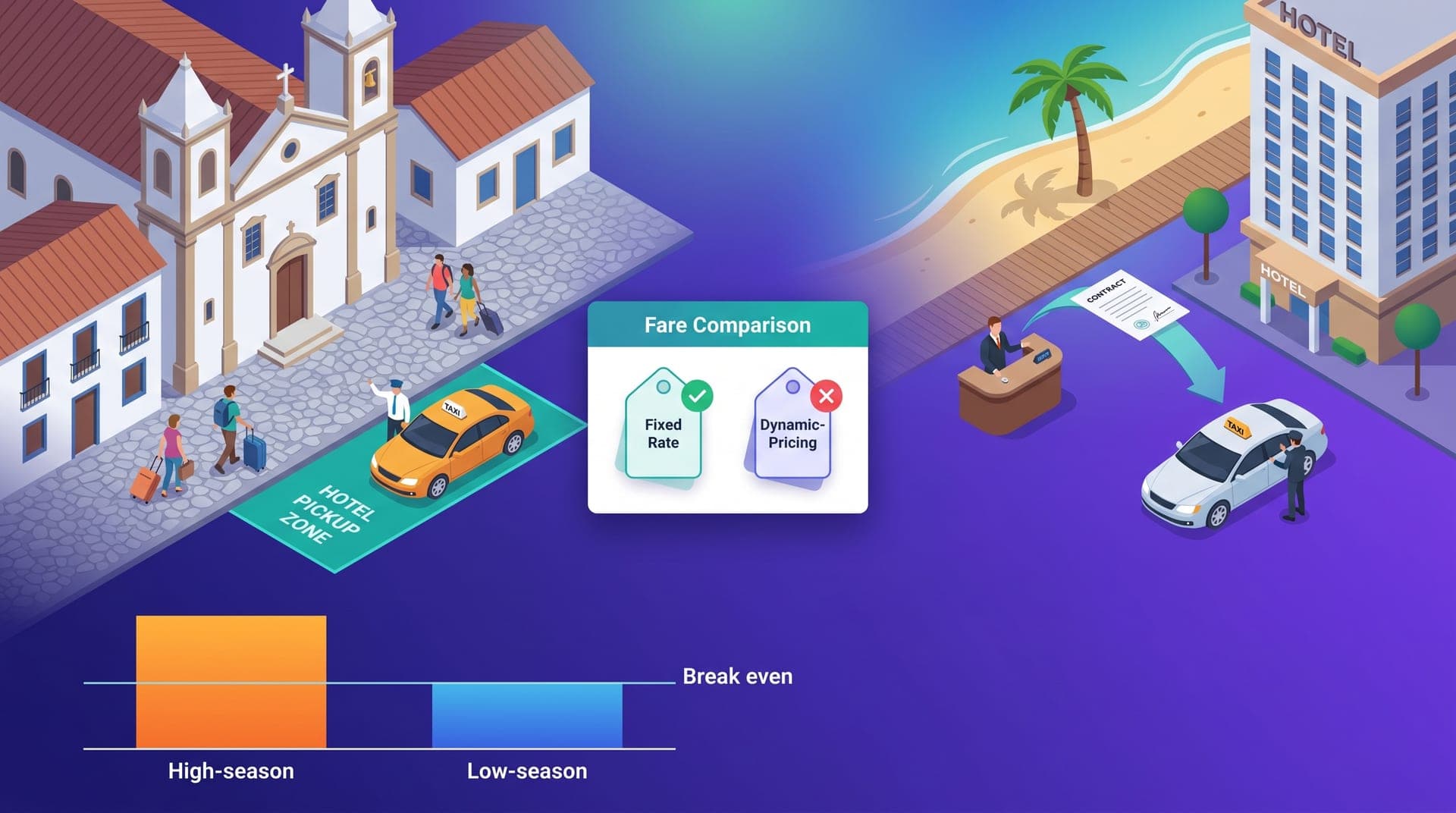
In 2026, the competition between local ride-hailing operators and global platforms in LATAM is not playing out the way most 2021 analyses predicted. The dominant narratives of that moment assumed Uber and Didi would consolidate their position in mid-size cities as passenger acquisition costs fell and their dispatch algorithms improved. What happened instead was different: the end of the mass subsidy model changed the pricing equation, and several factors labeled as structural weaknesses of local operators — limited scale, cash dependence, single-city focus — turned out to be real competitive advantages in specific contexts those analyses didn't weight correctly.
This article is for operators who already have an active operation in one or two mid-size LATAM cities and want to understand which of their current characteristics are real advantages in the new competitive environment. The argument is not that local operators are inherently superior to global platforms — it is that there are market segments, passenger types, and city conditions where the characteristics of a local operator produce better operational results than what large platforms can replicate with their current model. Knowing which those advantages are, and how to activate them deliberately, is what separates an operator gaining market share from one surviving without growing.
Trip fares no longer automatically favor the large platforms
Between 2020 and 2023, global platforms could offer fares below marginal cost in cities where they wanted to gain market share, absorbing the difference with investment capital. That strategy depended on two conditions that have significantly weakened: access to low-cost capital and investor tolerance for sustained operating losses in developing markets. With both conditions more restrictive in 2025-2026, global platform fares in mid-size LATAM cities have converged toward levels where a local operator with an efficient cost structure competes directly on price. The passenger who previously chose Uber because it was meaningfully cheaper now compares screens with similar fares — and in that comparison, other attributes start to matter.
The second effect of the end of subsidies is less visible but more structural: without the artificial price advantage, global platforms compete on attributes where local operators have their own strengths — assignment speed in cities where they know demand patterns well, driver availability in zones large platforms underserve for marginal profitability reasons, and payment flexibility that doesn't require passenger bank access. Those attributes are not new in 2026 — what is new is that they matter more now because they can no longer be equalized with a price that is low enough.
Commission rate as a driver attraction and retention advantage
The commission rate an operator charges drivers is the factor that most directly determines who drives on their platform. Global platforms operate with commissions between 25 and 35% in most LATAM markets. A well-run local operator can operate with commissions between 12 and 18% — not because they have lower technology costs, but because they don't carry the cost structure of a global company with centralized engineering, marketing teams for dozens of markets, and corporate overhead that only produces returns at a scale that a 200-driver market cannot fund. The difference between 15% and 30% commission is not small for a driver who does 40 trips per week: it is the difference between income sufficient to stay on the platform and leaving to find a better-paying alternative.
The compounding effect is that local operators with competitive commissions have more motivated, more loyal, and lower-turnover drivers. A driver who prefers your platform because they earn more per trip responds to requests more quickly, maintains a higher rating, and doesn't split their time across five apps — which has a direct effect on the availability metrics the passenger experiences. That driver advantage cannot be easily replicated from a global platform that has structural constraints on how far it can lower its commission rate without affecting business viability across the other markets where it operates.
Cash payment as a reach channel, not an operational problem
The narrative of recent years in fintech and mobility treated cash payment as a remnant of the past that would disappear as banking access increased. In 2026, that narrative runs into the reality of LATAM: between 40 and 60% of adults in economies like Guatemala, Honduras, and significant portions of Mexico and Colombia don't have regular access to an active debit or credit card. For that segment, a platform that only accepts digital payments is not more modern — it is simply inaccessible. The local operator who maintains cash as a payment option is not being conservative: they are serving a segment that platforms with digital-payment restrictions cannot monetize.
Cash payment has real operational costs — managing collection between passenger and driver, end-of-shift reconciliation, risk of incomplete collection. But it also has a reach effect that doesn't appear in analyses from platforms operating under the assumption of full banking access: in cities where cash is the predominant payment method, the operator that accepts it has access to a passenger pool that competitors with mandatory digital payments cannot reach. That reach differential is not a technical advantage — it is a market advantage that holds as long as the banking gap in LATAM stays where it is.
Municipal regulation as an entry barrier that protects you
The regulatory framework for passenger transport in LATAM is essentially local. Each municipality has different conditions — driver authorization requirements, zone restrictions, agreements with taxi guilds, procedures for modifying fares. For a global platform that operates with centralized legal processes, adapting to 50 different regulatory frameworks in mid-size cities of Mexico or Colombia is a structural cost that reduces the return from operating in those markets. For a local operator, municipal regulation is familiar territory: the operator who has been running in Morelia or Xalapa for three years has a relationship with the local Mobility Department, knows permit renewal timelines, and can respond to a regulatory change in days rather than weeks.
That regulatory knowledge has a direct effect on operational continuity. A local operator who receives a municipal authority notification about a new requirement has context to evaluate the real risk and implementation timeline. A global platform receiving the same notification routes it through a regional legal team managing dozens of cities with competing priorities, with response times that can stretch to weeks while the operation adjusts without legal clarity. For the passenger, that difference is invisible. For the local operator competing in that city, it is the difference between continuing to operate normally and facing a precautionary suspension while the global platform resolves the issue internally.
Local trust as a near-zero-cost acquisition channel
In mid-size LATAM cities, direct personal recommendation — in neighborhood WhatsApp groups, in conversations at school pickup, at work — is the passenger acquisition channel with the highest conversion rate and lowest cost per user. A person who receives a trusted recommendation that 'the local taxi is more reliable because the owner is from here' has a meaningfully higher first-download probability than someone who sees a digital ad. The local operator who has this reputation cannot buy it with a marketing budget — it is the result of years of operation, drivers known in the neighborhood, and a brand identity that residents associate with people from their community.
Local trust also affects retention. A passenger using the local operator is not evaluating in the same session whether to stay or switch to Uber — in many cases, the local platform is the app they have installed because a friend recommended it six months ago and they've never had a reason to change it. That loyalty was not built with points or perks — it was built with consistent service in the city where that passenger lives. For the local operator, maintaining that reputation is the lowest-cost, highest-impact retention strategy available, and the only one a global platform cannot replicate with budget.
What global platforms still do better
Analytical honesty requires naming what local operators still cannot replicate. Global platforms have proprietary mapping systems optimized to minimize assignment time under high demand, technical infrastructure that scales without human intervention when demand spikes 200% at a large event, and fraud detection models that require millions of trips to train correctly. A local operator with 200 drivers doesn't have access to that level of infrastructure, and pretending that difference doesn't exist would be a strategic mistake that leads to competing on the wrong fronts.
The second area where global platforms maintain a clear advantage is brand recognition among passengers new to the city. A tourist or visitor arriving in a mid-size city in Oaxaca opens Uber because it is the app they know — not because it is objectively better than the local operator in that market. For that segment — visitors with no history in the city — the local operator starts from zero on recognition. The operator who understands this distinction can focus acquisition investment on the frequent-use resident passenger, where return is highest, rather than trying to compete on brand recognition against a global budget they cannot match.
How to convert structural advantages into measurable results
Recognizing structural advantages doesn't produce results — acting on them does. The operator who has a competitive commission but doesn't communicate it explicitly in the driver recruitment process is not leveraging that advantage. The one who accepts cash but doesn't mention it in passenger acquisition materials is not converting that flexibility into active users. Structural advantages are necessary conditions, not sufficient ones — they require translation into specific messages and deliberate investment decisions.
The three indicators that measure whether a local operator is converting advantages into results are:
- 90-day driver retention rate: an operator with competitive commissions should keep at least 70% of their drivers active in that period — lower retention means either the commission advantage isn't landing or operational friction is canceling it out
- Percentage of trips completed in cash: if it is below 20% in a low-banking market, the operator is not effectively capturing that segment — cash acceptance exists but acquisition channels are not reaching that audience
- Percentage of new users from direct recommendation: if the operator invests in digital advertising without measuring what fraction of new users arrived through word-of-mouth, they are underinvesting in the highest-return channel available to a local operator
When Uber raised its fares in our city in 2025, we expected most users to stay with them for the brand. What we saw was different: 30% of the new passengers who arrived that quarter came from Uber and told us they stayed because drivers knew the neighborhood and because they could pay in cash. We didn't change anything — they changed the price, and that made visible what we had that they didn't.
The advantages described in this article — competitive commissions, cash payment flexibility, local regulatory knowledge, resident passenger trust — are not new for local operators. What changed in 2026 is the competitive context that makes them more valuable than before. The end of mass subsidies eliminated the main distortion that made those advantages invisible in the passenger's decision equation. Now that global platform fares have converged toward those of efficient local operators, passengers evaluate the remaining attributes — and on those attributes, the local operator starts from a stronger position than comparative scale analyses suggested.
The work for the local operator who wants to capitalize on this moment is not to copy global platform characteristics — it is to clearly activate the advantages they already have. That means communicating competitive commissions in driver recruitment, measuring the word-of-mouth channel with the same rigor as any other acquisition channel, and treating municipal regulation not as an obstacle to manage but as an entry barrier that protects you the same way it complicates things for you. Global platforms have scale, capital, and brand recognition. Local operators have context, flexibility, and built trust. In 2026, those two sets of assets are not as unbalanced as they appeared five years ago.