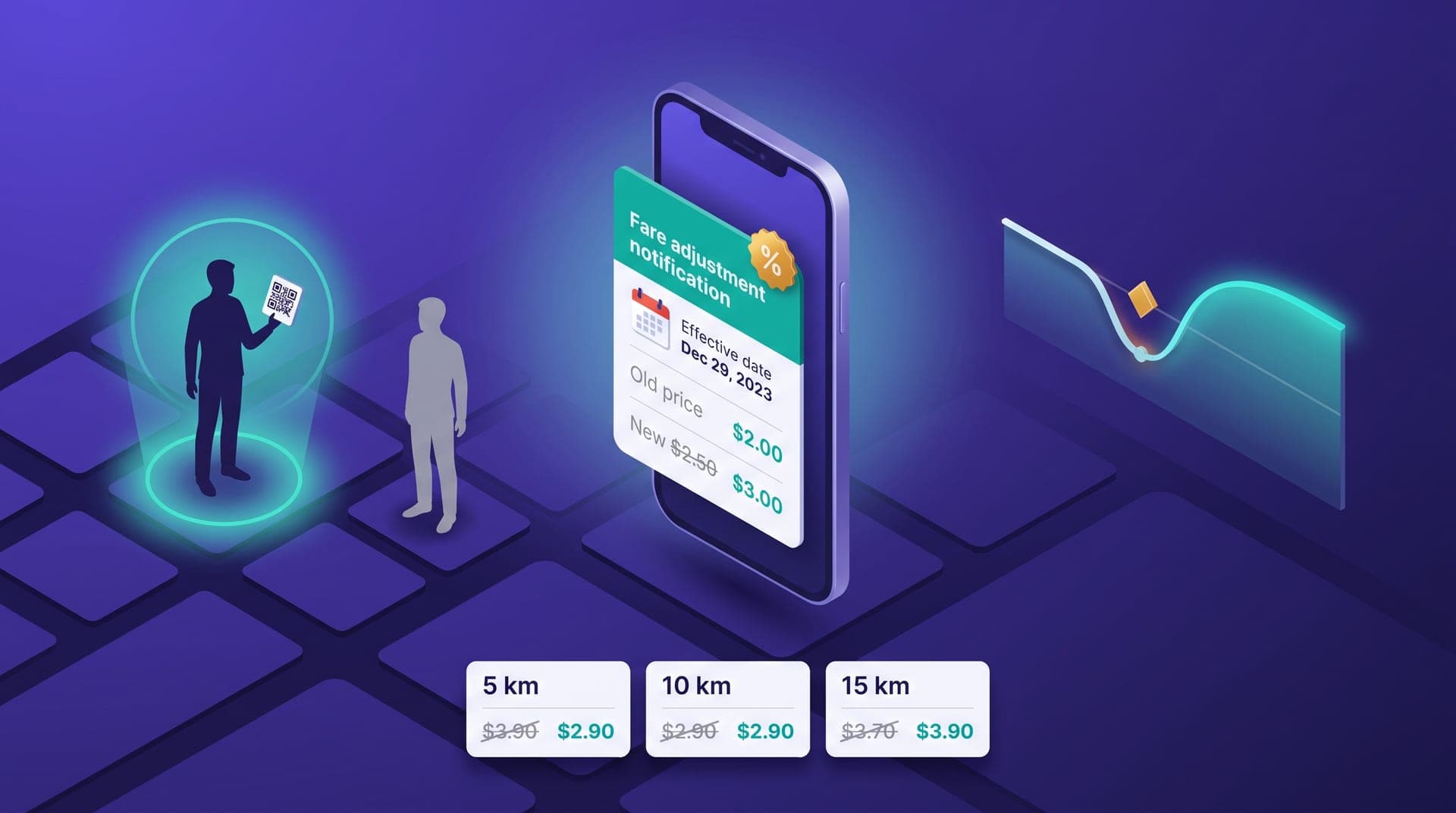
The operator who hasn't adjusted passenger fares in 18 months usually isn't holding back due to lack of margin — they're postponing because they fear the drivers' reaction. The logic is understandable: in a regional operation where retaining active drivers is one of the hardest indicators to sustain, moving fares looks like unnecessary risk. Data from operators in Mexico and Central America tells a different story. Operators who raised fares between 8 and 15% lost on average fewer drivers than those who made 3 to 5% adjustments without a structured communication protocol. The size of the change rarely determines the fleet's response — the communication protocol almost always does.
This article is for the operator who needs to adjust passenger fares, driver commission structure, or both, and wants to do it without the operation experiencing a degraded acceptance period while the fleet recalibrates. It covers preparation before the announcement, the design of the right message, fleet segmentation, the timing with lowest resistance, and the indicators the operator needs to monitor for the seven days after the change. The protocol described here applies equally to passenger fare adjustments and to commission structure modifications — the communication mechanics are the same even when the economic direction of the change is different.
Why the size of the change matters less than how it's announced
The reason drivers leave a platform after a fare change is almost never the size of the change itself — it's the experience of arbitrariness and surprise. A driver who discovers the rate changed because a passenger mentioned the price during a trip has a qualitatively different reaction than a driver who received a message three days earlier explaining that the fare was going to change, why, and what the change would do to their average hourly income. The difference between those two drivers isn't their tolerance for change — it's whether they feel they're in a business relationship or receiving conditions without context.
The three elements that produce driver desertion after a fare change are consistent across regional operations: surprise (the change happened without warning or with less than 24 hours' notice), lack of data-backed justification (the announcement included no income impact calculation for the driver), and no transition window (the change was immediate, with no adaptation period). The operator who eliminates all three before executing the change operates in a fundamentally different context — even if the adjustment is economically negative for the fleet in the short term, drivers who receive the announcement with those three elements covered are significantly less likely to escalate their reaction or actively leave the platform.
Segment the fleet before communicating: not every driver needs the same message
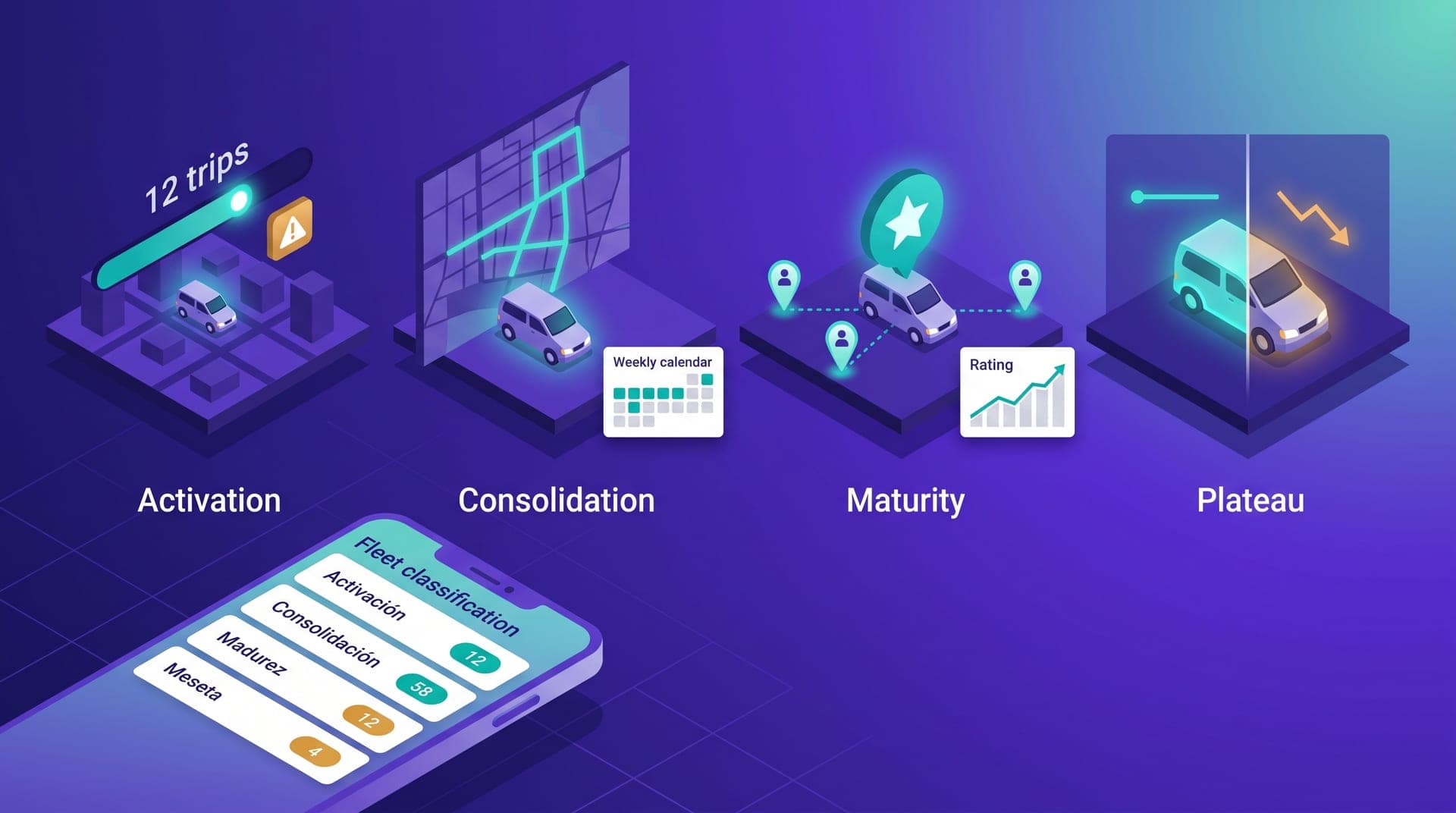
In an operation of 60 to 100 active drivers, there's a distribution that recurs with small variations: the top 15-20% of the fleet — between 10 and 20 drivers — concentrates 40 to 50% of the week's trips. Those drivers have a different relationship with the platform than a driver who makes four trips per week. When a fare change reduces average income per trip, the driver who completes eight trips per day has a radically different economic exposure than one who does four per week — and the right message for each is also different. The high-volume driver needs personalized communication with a specific calculation of their impact. The mid-activity driver needs the full data message. The low-activity driver can receive the group notification.
The segmentation that produces the best results uses two variables: average trips in the last 30 days and average acceptance rate. Drivers with more than 15 weekly trips and an acceptance rate above 80% are the highest-risk group for a commission change — they have real options to migrate to another operator or reduce their availability, and they're the drivers whose loss most impacts coverage. Drivers with 5-15 weekly trips represent the largest part of the fleet and form the collective opinion about the change — if half of them react negatively in the first three days, that tone spreads to the entire group. The operator who does this segmentation before drafting the first message has a precise picture of where to concentrate personalized communication effort and where the standard notification is sufficient.
The right message: income data first, decision second
The fare change announcement message has a structure that works consistently in regional markets: income data first, decision second, business context last. The right sequence is: open with what that driver is currently earning on average per hour or per trip — real data from the last 30 days —, show the projection at the new fare using an honest calculation, then announce the decision with the effective date and transition period. The operator who opens the message with the decision — "Starting Monday passenger fare is rising 12%" — generates an immediate evaluation reaction based on the first impression. The operator who opens with data — "In the last 30 days your average income per trip was $X" — creates a different evaluation context before the driver reads the decision.
Three elements that should not appear in the announcement message: comparisons with competitor fares (generates the wrong conversation), promises about unguaranteed future income ("this will allow you to earn more in the long run"), and justifications about the operator's operating costs that the driver can't verify. The effective message is under ten lines and contains exactly three data points: current average income, projected income, and effective date. A 200-word message with extensive justifications produces more reading and more resistance than an 80-word message with three concrete data points and an explicit transition window.
The timing that produces the least resistance: day, time, and transition window
The day and time of the announcement have a measurable impact on the fleet's reaction. Tuesdays and Wednesdays mid-morning — after the morning rush and before midday — consistently produce the best open rate and the most moderate reaction in regional operations where comparison has been possible. Drivers have just finished their morning session with recent results in mind: if the session was good, they're receptive. Friday afternoons are the worst time: drivers close their week carrying the emotional state of that week's balance, and a notification about an imminent change will land on that state, not on a fresh-week one. The same change announced Friday afternoon for Monday takes effect producing four to five times more negative responses than the same change announced Tuesday for the following Monday.
The minimum transition period is 48 hours between announcement and effective date — enough for drivers to process it without leaving the operation in a state of extended uncertainty. Operations that have tested longer periods — five to seven days — report that the additional processing time doesn't produce better acceptance; instead it generates more conversation time in guild groups and more opportunities for the change narrative to distort before it takes effect. A 48-72 hour window with a clear message consistently produces less friction than a long window with ambiguous communication. If the operator needs more time to individually address questions from high-volume drivers, those conversations should happen in the days before the group announcement — not as part of the transition window after it.
How the agent compresses preparation time for segmented communication
Preparing personalized messages for high-volume drivers is the most time-intensive part of the process for the operator: in a fleet of 80 drivers with three differentiated segments, drafting individual texts for the 12-15 priority drivers plus the group message for the two remaining segments represents two to three hours of work. With the right instruction to the agent, that time reduces to 30-45 minutes of review. The instruction that produces the best result: "Identify drivers with more than 15 average weekly trips in the last 30 days. For each, calculate their current average income per trip and their projected income with the new fare of $[amount]. Produce a personalized message draft under 80 words that opens with that specific driver's income data, announces the change effective [date], and closes with a line that acknowledges that driver's relationship with the operation."
The agent can also prepare the group message for mid- and low-activity segments, using each group's average income figures rather than individual data. The operator reviews and adjusts the tone of drafts before sending — the process should never be agent instruction followed by immediate sending without review. The agent's value in this process isn't to automate communication but to compress preparation time for the personalized versions, which is the part where the operator most often cuts corners due to time constraints and ends up sending a generic message to the entire fleet that generates most of the avoidable resistance.
The seven days after the change: what's normal variation and what's a warning signal
The first 48 hours after the fare takes effect always produce some observable variation in acceptance rate — between 1 and 3 percentage points of variation in either direction is operational noise, not signal. The warning signal is acceptance rate that continues declining past day three without stabilizing: in a healthy operation, the full fleet calibration cycle completes in 48-72 hours. If on day four the acceptance rate is 4 points below the pre-change average and shows no recovery trend, there's a driver or segment with a specific objection that the original message didn't resolve, and the right response is proactive contact — not waiting.
The five signals the operator needs to review in the first seven days post-change:
- **Daily acceptance rate vs. pre-change average**: the trend on days 3-5 is the most informative signal — if it hasn't recovered above –2pp by day five, there's an active problem.
- **High-volume drivers with no shift in the first two days**: not necessarily abandonment, but warrants proactive contact that same day before the absence solidifies.
- **Volume and tone of incoming messages in the support channel**: an increase in negatively-toned messages in the first 24 hours indicates the announcement left unanswered questions the operator can resolve with a brief follow-up.
- **Overnight shift coverage in the first three days**: low-demand shifts are the first that ambivalent drivers stop taking — their absence anticipates what will happen on high-demand shifts if no follow-up contact occurs.
- **Drivers active in the last 30 days who haven't activated for three days since the change**: the difference between a driver who took a break and one who is evaluating leaving the platform is determined with a direct question, not by waiting until next week.
We'd had the same passenger fare for 22 months. When we decided to raise it 12% we were afraid half the drivers would leave. What we did differently was send the fifteen most active drivers an individual message with their average income from the last 30 days and the projection at the new fare. Three days later 87% had taken normal shifts. Two weeks later the acceptance rate was two points higher than before the change — because passengers also responded well when more drivers were available during peak hours.
A well-communicated fare change isn't just a fleet management process — it's one of the moments where the operator demonstrates whether the relationship with their drivers is a real business relationship or an interchangeable platform one. Drivers who received a personalized message with their income data before a change that affected them have a different relationship history than those who received a group notification the day before. That difference doesn't show up in any dashboard indicator the week of the change — it shows up six months later, when two platforms in the city are offering similar structures and the driver decides which app to activate their shift on first. Communicating a fare change is one of the investments with the highest deferred return in long-term driver retention.
This process is one of the decisions that stays with the operator when daily coordination has been delegated — not for bureaucratic reasons but because it requires the credibility and judgment of the person who holds the full business perspective, not just the shift view. The coordinator can execute the message delivery, but the decision about what to change, how much, when, and how to explain it with real operational data is exactly the kind of strategic work the operator who exited the daily shift now has time to do well. That's the difference between a fare adjustment that strengthens the operation and one that weakens it — not the size of the change, but the operator's preparation to communicate it with the level of information the fleet needs to process the change and keep choosing to remain active.