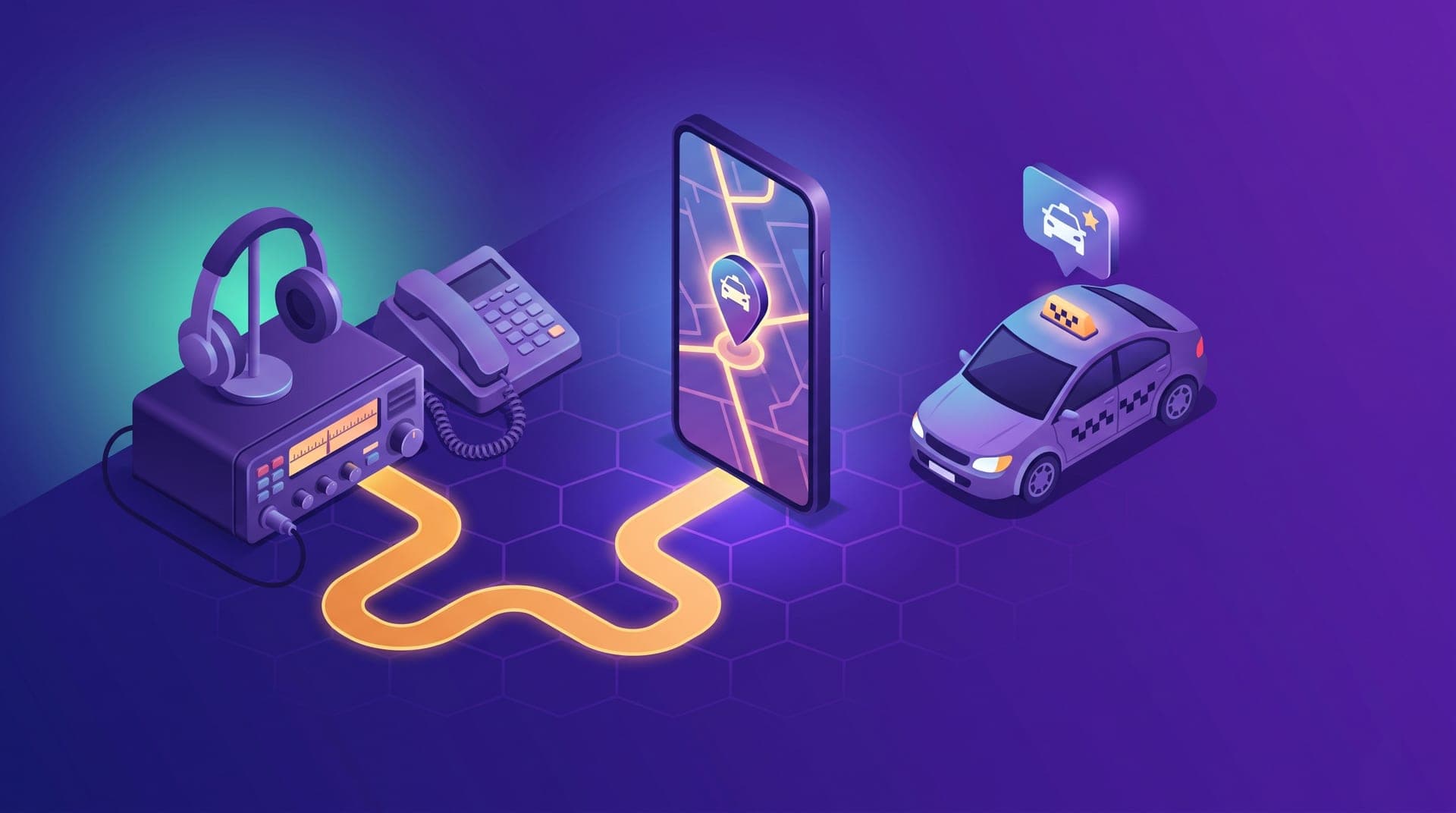
Many taxi fleets in regional cities still run on a phone dispatch centre: an operator answers, writes down the address and sends it by radio to whoever is closest. It works, and that is exactly why it is hard to change. The centre has customers of many years who trust a familiar voice, and any abrupt change feels like a risk of losing them.
The thesis of this article is simple: moving from a dispatch centre to an app is not switching off the phone and switching on the app. It is a staged transition in which both channels coexist for months, the phone feeds the app instead of competing with it, and drivers move before passengers do. We'll look at how to plan it, what to measure at each stage, and which mistakes send long-standing customers to another fleet.
Why you shouldn't switch the phone off overnight
A dispatch-centre customer is not the same as an app customer. They are usually someone who books the same trip several times a week, knows the drivers by name and values someone answering. Some of those customers will download the app without trouble; others never will, or will only do so once they see it solves something the phone doesn't.
If the phone stops working too early, those customers don't move to the app: they move to the other dispatch centre in town. That's why the rule of the transition is that the phone keeps answering as long as there is real demand through it, and that the app wins customers on its merits, not because their alternative was taken away.
There's also a reputational reason. In a regional city, word that "the centre doesn't answer anymore" travels fast, and a fleet with years of good standing can lose in weeks the trust it took a decade to build. Keeping the phone during the transition is, above all, a way of protecting that name.
The stages of an orderly transition
A transition that works for most regional fleets has four stages. What matters isn't the exact length of each one, but not moving on to the next until the previous one is stable:
- Drivers first: the whole fleet works with the driver app, even if trips still come in by phone.
- The centre dispatches from the dashboard: the operator enters every call as a trip and the assignment goes out through the app.
- Frequent passengers to the app: invite those who book most, with personal help to install it.
- The app as the main channel: the phone stays for those who need it and for incidents.
The second stage changes operations the most and is the least visible from outside. Customers keep calling as before, but every trip is recorded with origin, destination, driver and fare. From that moment the fleet has data the radio never gave it: arrival times, trips per driver, peak hours and the busiest zones.
Why drivers go first
Starting with drivers has a practical logic: they are fewer people, they work with the fleet every day, and their adoption can be supported closely. If drivers already receive trips in the app, any passenger who switches to it finds the service working from the very first ride.
Driver resistance usually comes from two doubts: whether they'll earn less and whether the app will watch them. It's worth answering both before they spread as rumours. Explain that the fleet still sets the fare, that the app doesn't charge a commission on each trip, and that location is used to assign the nearest driver, just as the operator did by radio, but without depending on someone answering in time.
Training works better in small groups at the base than by message. A short session in which each driver accepts a test trip, marks arrival, starts and finishes the ride clears up more doubts than a manual. Repeat it as often as needed and leave one reference driver per shift whom the others can ask.
The operator's role changes, it doesn't disappear
One of the most expensive mistakes of the transition is treating operators as a cost the app will eliminate. They are the people who know the customers, the difficult addresses and the problem drivers best. During the transition their job shifts from sending trips by radio to entering them in the dashboard, resolving incidents and helping frequent customers install the app.
That last task is the one that speeds up adoption the most. An operator telling a long-standing customer "next time you can book it from here and see where the car is" is more convincing than any campaign. And if the customer prefers to keep calling, the operator keeps serving them without pressure.
If the fleet already receives orders through WhatsApp, that channel can coexist with the phone and the app. For many dispatch-centre customers, sending a message is a more comfortable step than installing an app, and the trip is recorded just the same.
During this stage the operator should have a clear rule for difficult addresses: if the customer gives a landmark instead of a street, the landmark goes into the trip notes and the point is marked on the map. Those references, which used to live only in the centre's memory, become available to every driver.
What to measure to know whether the transition is moving forward
Without data, the transition gets decided by gut feeling and the latest complaint. These signals, reviewed every week, say more clearly whether to move to the next stage or wait:
- Share of trips coming in through the app versus the phone.
- Frequent customers who have already taken at least one trip through the app.
- Driver arrival time before and after app dispatch.
- Trips cancelled because no one took them.
- Calls still coming in during peak hours.
The most useful indicator is the second one. If the customers who book most have already tried the app, the base is secured even if the overall share is still low. If instead the app grows only with new customers while the regulars keep calling, the transition is gaining volume but not protecting the people who sustain the business.
For four months we had phone and app at the same time. The operators entered every call in the dashboard and showed the app to our regular customers. Today most people book through the app, but the phone still rings for those who don't want it, and we didn't lose a single long-standing customer.
Mistakes that make customers leave
Most failed transitions don't fail because of technology but because of operational decisions taken in a hurry. The most repeated mistakes are switching off the phone before frequent customers are on the app, changing fares at the same time as the channel, and leaving drivers with two systems at once for too long.
Changing fares and channel at the same time is especially damaging: customers can't tell what changed and associate the app with paying more. If prices need adjusting, do it before or after the transition, never in the middle. And the coexistence of radio and app on the driver side should last as little as possible, because two sources of trips create duplicate assignments and arguments about who got there first.
One last, less visible mistake: announcing the app as a replacement instead of as one more option. The message that works best with regular customers is that they can keep calling and that, if they want, they can now also book from their phone and watch the driver approach. The decision stays in their hands, and that's why they make it.
The dispatch centre as an advantage, not the past
A fleet that comes from a dispatch centre has something a global platform can't copy: a direct relationship with its customers and knowledge of the city. Moving to an app under its own brand doesn't erase that advantage; it makes it measurable and puts it on the customer's phone, with its colours, its fares and its usual number behind it.
Start with the smallest stage: get the whole fleet receiving trips in the driver app while the phone keeps ringing as always. Once that's stable, the operator can start entering calls in the dashboard, and from there every step is decided with data, not with the complaint of the day.