Most regional fleets don't have a driver problem, they have a problem communicating with drivers. Important notices get lost among hundreds of messages in a WhatsApp group, each driver learns the rules from a different colleague, and the operator ends up repeating the same thing ten times a day by private message. Nobody designed it that way: it simply grew without anyone deciding how it should work.
This article is for app-based taxi operators and established fleets that want to put that daily communication in order. We'll look at which channels are worth having and what each one is for, which kind of message goes in each channel, how often to communicate, how to listen to drivers without the channel turning into a complaints box, and how to measure whether the system is working.
Why one group for everything doesn't work
The single WhatsApp group is the most common way to talk to a fleet, and also the one that fails most as the fleet grows. It mixes operational notices, jokes, photos, complaints and personal questions in the same thread. When the operator posts something important, like a change in a zone or a road closure, it is buried within minutes by the conversation that follows.
The result is predictable: drivers stop reading the group carefully because almost everything that arrives is noise. And when a driver misses something, the usual answer is "I sent it to the group", which is technically true but solves nothing. The problem isn't the channel itself, it's that one channel is doing four different jobs.
Separating those jobs into different channels doesn't require complicated tools. It requires deciding what goes where and sticking to it, especially at the start, when habit pushes you to send everything to the usual group.
The channels worth having and what each one is for
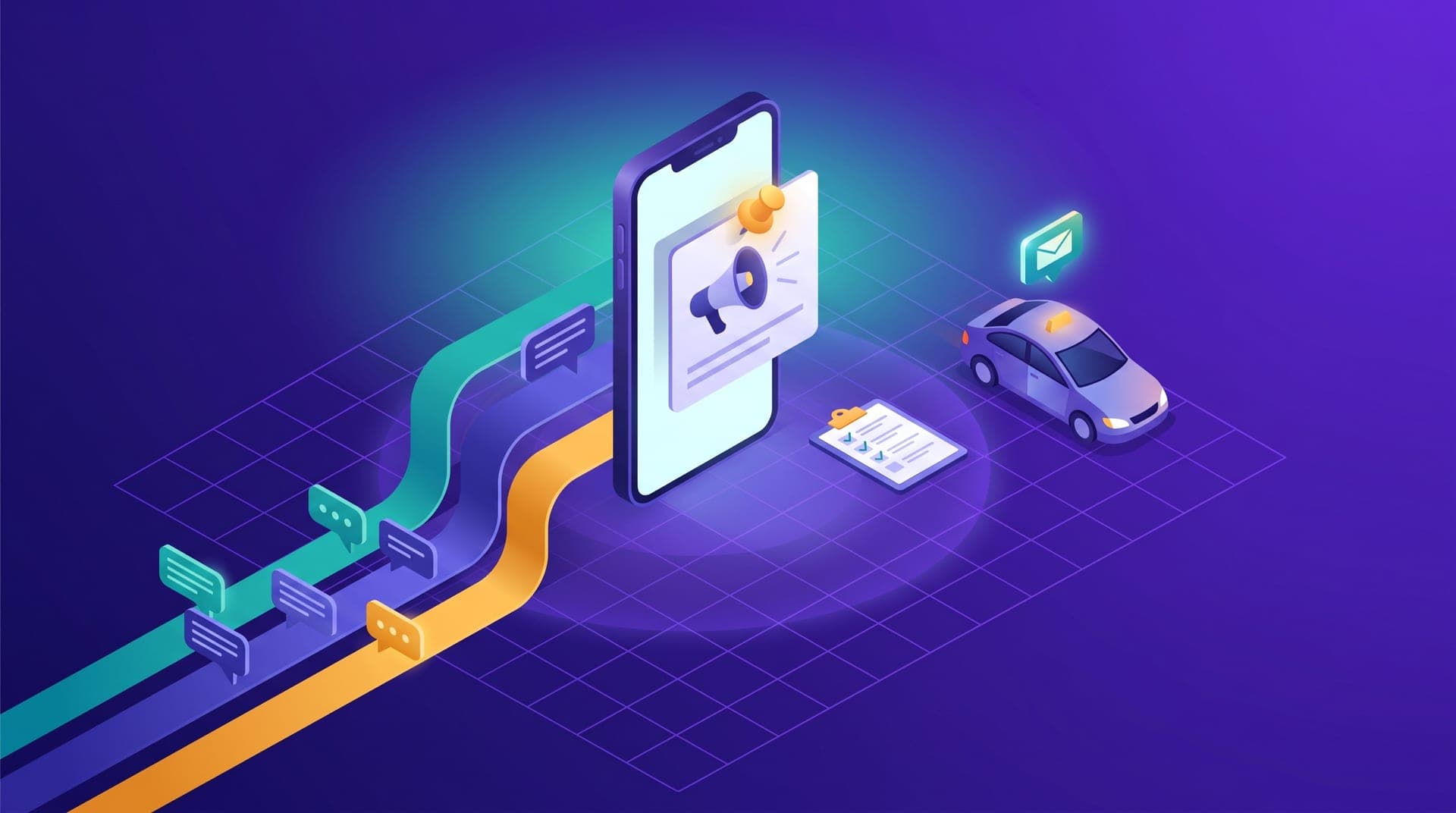
A structure that works well for most regional fleets has few channels, each with a clear purpose and a simple rule about who can write. What matters isn't the exact number, but that each driver knows where to look for each type of information:
- Official notices channel: only the operator writes, and only what matters.
- Conversation group: drivers talk among themselves, with minimal rules of respect.
- Direct chat with operations: each driver's individual questions and problems.
- Incidents channel: only for urgent situations during a trip.
- Fixed rules document: fares, zones and policies, always updated in a single place.
The official notices channel is the one that changes things most. If only what truly matters appears there, drivers learn that every message deserves to be read. In WhatsApp it can be done with a group where only admins can write or with a broadcast list; what makes it work is the discipline of not using it for just anything.
The fixed rules document prevents the most repeated question in any fleet: "how much do we charge in this zone?" or "what do I do if the passenger cancels?". Instead of answering it every time, you point to the document. And when a rule changes, you update the document and announce it in the official channel, not the other way round.
Which message goes in which channel
With the channels defined, the next step is deciding where each type of message goes. The most useful rule is to think about who needs to act: if every driver has to do something different from now on, it's an official notice; if it only affects one, it goes by direct chat; if nobody has to do anything, it probably doesn't need sending.
Official notices work best when they always follow the same shape: what changes, from when, and what the driver has to do. A notice like "from Monday the downtown zone has a different minimum fare, check it in the rules document" is understood in seconds. A long paragraph with explanations and apologies is half read, if it is read at all.
Individual problems, like a payout that doesn't add up or an expired document, should never be solved in the group. They expose the driver in front of colleagues, create debates that concern nobody else, and fill the group with individual cases. Always take them to the direct chat, even if the driver raised them in public.
If your operation receives orders or trips through WhatsApp Business, keep that number separate from the one you use to talk to the fleet. Mixing customers and drivers on the same number means an internal notice can end up being answered to a passenger, and a trip request can get lost among driver messages.
How much to communicate: the right frequency
Communicating too much is as harmful as communicating too little. An official channel that gets five notices a day trains drivers to mute it. One that says nothing for weeks means that when a notice finally arrives, nobody is looking. The right frequency depends on fleet size, but in general something like this works:
- A short weekly summary: what changed, what's coming and what went well.
- Operational notices only when something changes for everyone.
- Same-day alerts, such as rain or events, a few hours in advance.
- Occasional recognition, without turning it into empty routine.
The weekly summary serves a purpose few operators take advantage of: it gives drivers the sense that the operation has direction. A short Monday message about what was adjusted last week and what's expected next week is worth more than ten scattered notices, because it connects decisions with their reasons.
Watch the timing too. An operational notice sent at midnight is read by whoever is driving, which is exactly who shouldn't be looking at their phone. Schedule notices for quiet moments, such as mid-morning or early afternoon, unless it's an alert that can't wait.
Listening without the channel becoming a complaints box
Good communication doesn't only flow from the operator to the fleet. Drivers see things the operator doesn't: closed streets, zones with demand nobody covers, problematic passengers, app glitches. If there's no clear path for that information to arrive, it gets lost, or worse, turns into frustration that ends up exploding in the group.
The simplest way to organise it is to give each type of feedback a specific place: suggestions and app problems by direct chat with operations, trip incidents through the incidents channel, and general topics in a monthly conversation or a short survey. What matters is that the driver knows what they send gets read and, when appropriate, gets an answer.
Close the loop when a suggestion becomes a change. A notice saying "several drivers asked to adjust the north zone and from today it's adjusted" does more for fleet trust than any incentive, because it proves that speaking up is worth it.
We had a single group with more than a hundred drivers and nobody read anything. We split off a notices channel where only we write and a direct chat for each person's problems. Within a month they stopped asking us the same things, and when we send a notice, they read it.
How to tell whether your communication works
Fleet communication seems hard to measure, but there are concrete signals any operator can review every week without special tools. If any of them gets worse, there's almost always a channel that stopped respecting its purpose:
- How many repeated questions you get about rules that are already written down.
- How many drivers say they didn't hear about an announced change.
- How long operations takes to answer a direct chat.
- How many incidents are reported through the right channel.
Repeated questions are the best thermometer. If doubts keep arriving about something that's in the rules document, either the document isn't easy to find or it wasn't explained well. And if several drivers didn't hear about a change, the problem is in the official channel: either it's used for too many things or the notice lacked the clear shape it needed.
Communication as part of the operation
A well-informed fleet makes fewer mistakes, cancels fewer trips and stays longer. It isn't a matter of friendliness but of operations: a driver who knows exactly what's expected and where to find every answer works with less friction and gives passengers a better experience.
Start with the simplest step: set up a notices channel where only you write, gather the fixed rules in a single document and take every individual problem to direct chat. With those three pieces, communication stops depending on each driver reading the whole group and starts working on its own.