In cities of 100,000 to 400,000 residents, the mobility platform that becomes "the local app" develops a competitive advantage that price and technology alone cannot replicate. The social networks of a secondary city are denser than those of a metropolis: the driver who arrives in four minutes and greets passengers by name becomes the topic in the neighborhood WhatsApp group before the week is out; the platform that resolved a billing problem in 24 hours gets recommendations from that passenger for the next 18 months. In that environment, "brand" isn't a logo or an advertising campaign — it's the sum of specific experiences that circulate through the city's conversation circuits. The operator who builds that brand deliberately arrives at year three with an asset that a competitor entering at a lower price takes 12 to 18 months to attempt to replicate, and often doesn't succeed.
This article is for operators with 12 to 24 months of operation who have the platform running stably but feel the service is still perceived as interchangeable with any competitor that might arrive. It covers what "local brand" means in a secondary city versus a metropolis; the driver as brand ambassador in communities where everyone knows each other; partnerships with local businesses that multiply reach without a marketing budget; how to read and participate in neighborhood WhatsApp and Facebook networks without appearing corporate; the precise moment when communicating local identity is credible rather than hollow; and the operational signals that indicate whether the brand strategy is working before the operator needs to measure it formally. The thesis is direct: in a secondary city, brand is not built with budget — it's built with operational decisions that produce experiences people repeat.
What "local brand" actually means in a city of 200,000
In a city of 200,000 residents, "brand" is reputation in circulation. Operations that understand this deliberately create moments of memorable experience that become stories people share: the driver who waited five minutes while an elderly passenger slowly got in; the coordinator who called a passenger to let them know they'd left their phone in the car before the passenger noticed; the platform that posted on its local Facebook page that it donated a portion of Friday's trips to the neighborhood elementary school's fundraiser. Each of those stories — which are operational decisions, not marketing decisions — travels with a speed and credibility that no paid advertising can buy in that market.
The practical implication is that in a regional operation, the service quality decision and the brand decision are the same decision. The service level that produces positive conversations in a city of 200,000 requires consistency at every touchpoint: the driver who confirms the destination before departing, the wait time that matches the screen's promise, the coordinator who calls back when there's a problem. That consistency is no different to achieve with 30 drivers versus 60 — because in both cases the tool is individual follow-up and team culture, not scale. What does change with scale is the breadth of those stories' reach: with 60 active drivers and 800 monthly passengers, the platform already has enough critical mass of positive experiences circulating for the reputation to move autonomously.
The driver as brand ambassador in a city where everyone knows each other
A ride-hailing driver in a city of 100,000 to 300,000 residents isn't an anonymous face behind an app avatar: they are frequently a neighbor, an acquaintance, the cousin of someone who works in the same building as the passenger. That proximity has two effects on brand. The first is positive: the driver with a recognized presence in the community transmits a credibility to the service that no rating system can produce artificially. The second is a risk: the driver who has a negative neighborhood reputation — for reasons that may have nothing to do with the service — can transfer that burden to the platform's community perception. Operators who build strong local brands include this community-fit factor in their selection process, explicitly or implicitly.
Platforms with a consolidated local brand in cities of that scale typically have a core of 5 to 15 drivers who function as natural ambassadors. They aren't ambassadors by designation: they're the drivers who have frequent passengers who prefer them by name, who occasionally show up at local events while on shift, and whose ratings stay consistently above 4.8. The operator who identifies that core and designs incentives to keep them active — not just general fleet retention, but visible recognition that motivates them to stay in that ambassador position — has a brand asset that no budget can buy directly. The agent query that identifies this core in the operation: 'List drivers with an average rating above 4.8 in the last 90 days, more than 8 months of tenure, and more than 30% of their trips with passengers who have ridden with them at least three times. That group is the fleet's brand ambassador core.'
Partnerships with local businesses that already have your audience
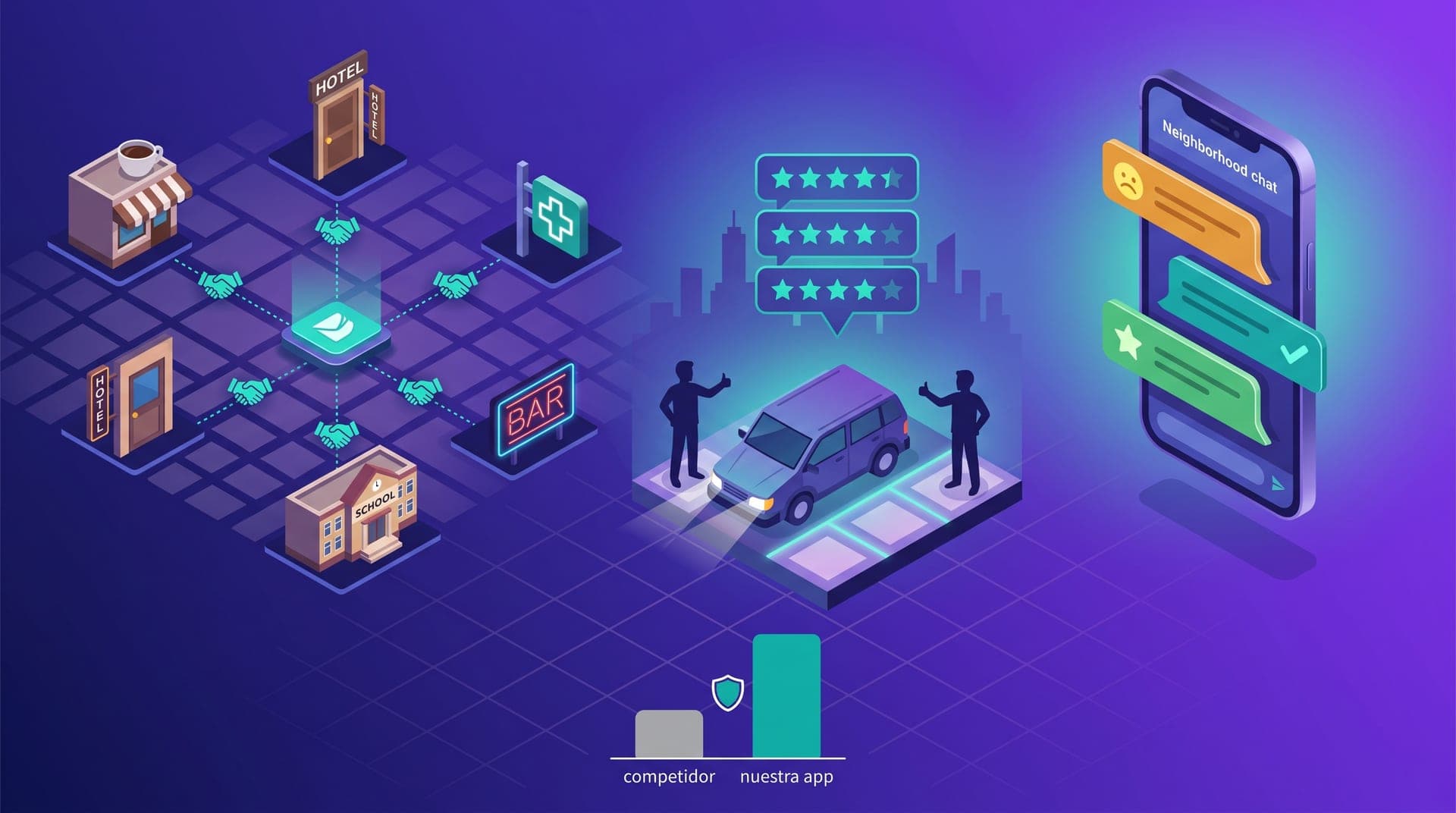
In a city of 150,000 residents, 6 to 8 partnerships with the right businesses can organically reach 20 to 30% of the potential market within the first 30 days of activation. Not because each partner has a large digital audience, but because in a city of that size, the businesses with the highest foot traffic from people who need transportation have natural recommendation moments. The partnership doesn't need to be monetary: in most cases it works through mutual visibility — the partner recommends the platform at the right moment, the operator mentions the partner in their communication with frequent passengers. The simplest format is a QR code card at the checkout counter that lets the passenger download the app or get their first trip with a welcome benefit; the partner business gets a mention in the operator's WhatsApp status when there's availability in that zone.
Businesses with a natural transportation recommendation moment and the highest effectiveness in regional operations:
- **Hotels and hostels**: guests who need airport transfers or local points of interest — recommendation moment at check-in and check-out, with higher value in business-tourism cities where the same guest returns.
- **Medical offices and clinics**: patients without their own vehicle, especially elderly patients with recurring appointments — moment at appointment confirmation, with high conversion because the transportation need is immediate and the schedule is fixed.
- **Pharmacies and distributors**: customers picking up high-value medication who prefer secure return transportation — moment at checkout, with a high-retention passenger profile because purchase frequency is regular.
- **Restaurants and nighttime venues**: diners who need safe return trips during hours when informal taxi availability is lower — moment at bill payment, with greater value on weekends when nighttime transportation demand exceeds supply.
- **Travel agencies and regional airlines**: passengers with early flights or late arrivals — moment at ticket purchase or itinerary confirmation, with high conversion because the passenger is already planning transportation logistics.
Neighborhood WhatsApp and Facebook groups: reputation built in the community's own voice
Neighborhood WhatsApp groups and community Facebook pages are the most influential reputation channels in secondary cities. A spontaneous positive mention in the neighborhood group carries more weight than any paid ad because it comes from someone the readers know and whose opinion already has credibility in that context. But these channels have specific rules: you don't invade, you don't advertise directly, and the operator who appears self-promotionally in a neighborhood group loses the credibility they were trying to build. The way to have presence in these networks is not through the company account — it's through the personal account of the coordinator or the operator themselves, answering questions, resolving problems publicly, and being visible as a person before being visible as a brand.
The protocol that works has three distinct moments. The first is active listening: the coordinator or operator is in the relevant groups and detects service mentions — positive and negative — without automatically intervening in each one. The second is rapid response to public complaints: when someone mentions a problem with the platform in the group, the operator's response in the same thread, within two hours, converts a complaint into a public demonstration of service commitment. That moment — the complaint resolved publicly — is the highest brand-impact moment because the rest of the group sees it and processes it as evidence that the company responds. The third is useful and occasional visibility: sharing genuinely useful information for the group — a local event affecting traffic, a coverage change, a notification about available drivers in the area — at moments when that information has real value for members. That presence builds the perception of 'they're part of here' organically and at no cost.
The right moment to say "we're from here" and have it be credible
Operators who made local identity a marketing argument from day one of operations — before they had consistent service quality to back it up — paid the cost of a claim that the passenger's experience disproved in the first week. "We're local" is a communication asset that only works when there is verifiable evidence of it available to anyone who tries the service. That evidence is built in the first 12 to 18 months: service that works predictably, drivers who know the city's shortcuts, a coordinator who answers calls by name. When that evidence exists, the claim "we're from here" amplifies something real. When it doesn't, it sounds like the same thing any national company says when it wants to sound approachable.
The right moment to make local identity explicit is when the passenger recurrence rate exceeds 30%, the average fleet rating is above 4.5, and the operator has at least 50 passengers with more than 6 trips in the last 30 days. At that point, a concrete and visible action — sponsoring a local event with moderate visibility, launching a "driver of the week" campaign with recognition in the city's local social networks, or creating a discount code specifically for the local sports club — has a real base of positive experiences that will back up the message in the conversation it generates. The hollow claim fades within 30 days; the one with evidence behind it becomes shared history that circulates in the same neighborhood groups for months.
The operational signals that show whether the brand is working
Without budget for brand research, the most reliable signals that the local strategy is working come from the operational data itself. They don't directly measure brand awareness — they measure the behaviors that are the consequence of a strong brand in a small community: higher quality in acquisition sources, greater user resistance when competitors enter, and greater driver willingness to represent the platform as something of their own. The quarterly agent query that produces the diagnostic: 'For the last 90 days, show me the percentage of new passenger activations without a promo code versus with a code; the percentage of new drivers who mentioned an active driver as a reference in their application; and the 60-day retention of passengers who had at least one incident resolved by the coordinator compared to passengers without incidents in the same period.'
The four most reliable operational signals that the local brand is generating real value:
- **Driver application source channel**: when more than 40% of new drivers activated in the quarter mention an active driver as the reason for their application — rather than having seen an ad — the service's reputation is working as a zero-cost recruitment asset.
- **Passenger activations without promo code**: if more than 50% of new activations in the period have no discount code attached, passengers are arriving through word-of-mouth referrals or active platform searches — not through price. That acquisition profile produces 1.8 to 2.5 times higher retention than promotional acquisition.
- **Post-incident retention**: if 70% or more of passengers who had a problem actively resolved by the coordinator are still active at 60 days, the visible handling of the error is building loyalty. A well-resolved complaint generates more commitment than the absence of incidents because it produces direct evidence that the platform responds.
- **Resistance to competitor entry**: when a competitor arrives with a lower price and the variation in trip volume from your veteran drivers in the first 4 weeks is less than 12%, the passenger base has a commitment to the service that the competitor's price cannot break quickly. That resistance is the most direct metric of brand value in regional markets.
When the competitor arrived at 15 pesos cheaper, several of my drivers warned me before I even detected them in the market. They told me some passengers were already asking about the new app. What I didn't expect was that my own drivers were recommending that passengers stay with us — not because I asked them to, but because they felt our platform was their platform too. That was when I understood that the brand I had built wasn't mine: it was theirs as well.
Local brand in a regional ride-hailing operation isn't a strategy separate from operations: it's what the operation produces when executed consistently well for long enough in a place where experiences circulate. The operator who understands this makes their quality decisions — who's in the fleet, how problems get resolved, which local businesses call them when they need transportation — knowing that each of those decisions has a brand value that gets capitalized in local conversation before it can be measured on a dashboard. The difference between an operation with 18 months of consistent quality that built brand and one with 18 months that only built trip volume is visible at month 24 when the first serious competitor arrives: one has drivers and passengers who defend it; the other has users who compare prices.
The set of decisions that determine local brand — which drivers you keep in the fleet, which partnerships you activated, how complaints get resolved visibly — generates data in the operation that the agent can diagnose when you ask the right questions. The three quarterly questions that produce a brand health diagnostic without a survey: what percentage of new drivers arrive through active driver referrals, what percentage of new passengers arrive without a promo code, and what is the 60-day retention of passengers with resolved incidents versus passengers without incidents. Those three numbers, read together, measure the concrete economic value of the reputation being built — and that value, reviewed quarterly, is the strongest argument a regional operator has for deciding how much time to invest in community presence versus other forms of growth.