The super-app promise in Latin America was a bet on breadth: a single application concentrating transportation, delivery, payments, and loyalty into one unified experience. That bet didn't pay off in most regional markets, and the reason wasn't lack of capital or operator willingness to adopt it. It was a causal direction failure: breadth without depth produces experiences too generic to win in any specific domain. What's taking shape in 2026 isn't a second attempt at the super-app — it's a model different in its underlying logic: the vertical agent, which doesn't bet on covering more categories but on going deeper in just one.
For a regional mobility operator, the distinction is practical before it's theoretical. The super-app demanded critical mass across several categories before any single one became genuinely useful: without delivery there wasn't enough usage frequency, without proprietary payments there was no margin, without regular app users there wasn't enough data to improve the product. The vertical agent operates on an opposite logic: it becomes more useful as it accumulates context within a single domain — more shifts processed, more decisions logged, more conventions of that specific operation documented — without requiring that domain to expand. This article examines why that model shift matters for regional operators and how to build position to benefit from it.
Why the super-app didn't win where depth mattered
The super-app model carried an implicit hypothesis: that cross-category usage frequency would generate the data needed to improve each one. The user who ordered a ride would also order food, and that second frequency would fund transportation product improvement. In LATAM regional markets, that hypothesis didn't hold in domains where local quality matters more than integration convenience. Platforms that tried to build super-apps in cities of 500,000 people found themselves competing in three mediocre categories instead of winning in one excellent one. The local operator who knew the specific market outperformed the regional platform in the only domain that mattered to the passenger: the ride arriving on time, at the right price, with the right driver.
The underlying problem was that breadth doesn't automatically produce depth — it produces depth on average, for the most common use case, in the largest market. A mobility operator in a secondary city in southeastern Mexico doesn't need the platform to be good across the average of all the cities it covers: they need it to be good in that specific city, with that operational climate, with those drivers, and with those demand patterns. The horizontal platform optimizes for the center of the distribution. The regional operator needs something that optimizes for their specific coordinate within that distribution — and that's exactly the problem the vertical agent solves differently.
What distinguishes a vertical agent from a horizontal integration
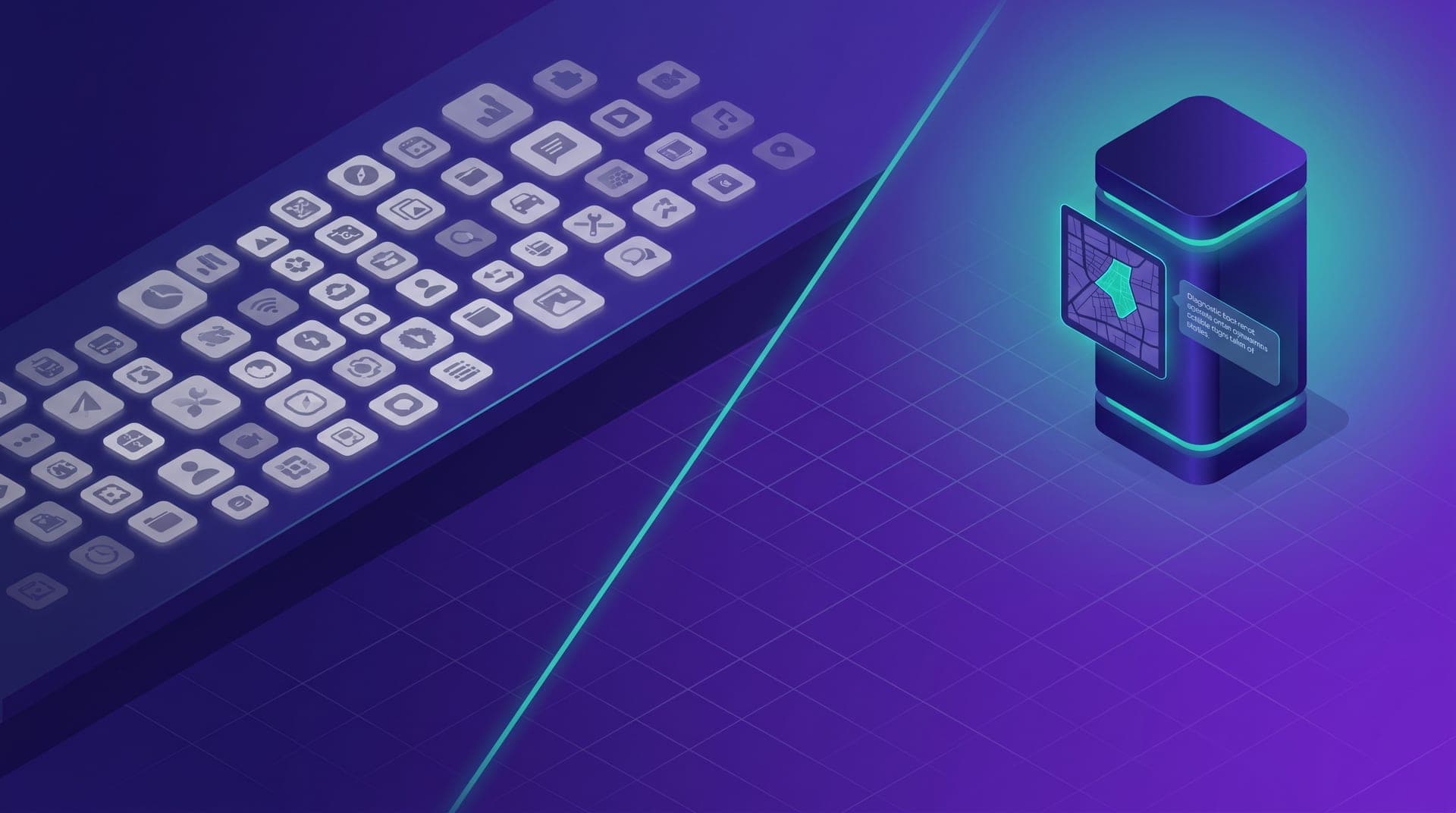
A super-app integrates services at the interface layer: one app, multiple tabs. A vertical agent integrates intelligence at the operational layer: depth of knowledge in one domain, with data from every interaction within it. When the platform exposes to the agent real-time access to driver availability, zone coverage, cancellation patterns, and trip history for a specific operation, that agent isn't gaining access to a new service category — it's gaining depth of context in the domain where the operator already operates. The value isn't 'you can now do more things from one place' — it's 'you can now do the same thing you already did with more specific intelligence.'
The architectural difference has a direct implication for how the system improves over time. The super-app improved by adding categories: more usage frequency, more data, better cross-category product. The vertical agent improves by adding context within the same category: more shifts processed, more decisions logged, more patterns of that specific operation the agent can recognize and use in the next query. The first trajectory requires the platform to grow horizontally so each category benefits. The second requires the specific operation to document and refine its own context layer — something the regional operator has more control to build than to wait for.
The regional operator advantage that large platforms can't replicate
Global platforms operate in thousands of cities. Their intelligence systems get broad data but shallow depth per city. A regional operator with 100-200 drivers across two or three cities has something those platforms can't replicate: deep knowledge of a specific market. The agent running on a vertical platform doesn't need to learn what 'normal' means in general — it needs to learn what 'normal' means in Mérida on a Friday during a convention or in Monterrey during match season. The operator who has worked that market for three years has that data. The vertical agent is the first tool that can actually use it to produce specific diagnostics instead of generic estimates applied to any city of similar size.
The advantage isn't in access to the technology — large platforms have more resources to develop it. It's in the local data that no horizontal platform can hold at the same granularity. The cancellation-by-zone-and-time history of a 150-driver operation in an industrial city in northern Mexico isn't a data point any global platform aggregates in its cross-market model. For that regional operator's agent, that history is exactly the context that turns a generic response into an actionable diagnostic. That local data asymmetry is a real competitive advantage, and the vertical agent allows it to be leveraged systematically for the first time.
Context depth as a compounding advantage over time
An agent with two months of history for a specific operation doesn't give the same answers as one freshly installed. The zone names the team uses internally, the availability thresholds that operator treats as an alert during off-season, the escalation decisions that worked in past incidents — that context accumulates in the operator layer and makes each subsequent query more specific than the previous one. The difference between an agent with six months of operational context and a generic one isn't model quality — it's data depth in the right domain. That gap can't be purchased: it's built shift by shift.
That creates a type of competitive advantage regional operations hadn't been able to build before: deep operational context converted into specific, actionable intelligence. Operations that have been documenting their context layer — zones, thresholds, driver behavior patterns, stored resolutions for recurring incidents — hold an asset that isn't in the platform's code and that a competitor starting from zero takes months to build. The depth of that context compounded over time is what makes the vertical agent fundamentally different from the super-app: it's not a platform to which users are added, it's a system that improves by adding precision, and precision comes from the operator who knows their territory.
The cost structure shift: from distribution to intelligence
The super-app was a distribution cost model: the platform paid to be on the phone and the operator paid the platform to reach passengers. The vertical agent is an intelligence cost model: the operator pays to access specialized tools, and the value isn't distribution but decision quality. Better surge decisions, better driver incentive timing, better coverage distribution before it drops below critical threshold — those benefits have a measurable direct economic impact. An operation of 100 drivers that catches coverage gaps two hours earlier than it would without the agent potentially recovers between 8% and 15% of trips that would have been lost. That's a different ROI equation than paying for distribution.
The shift also means the operator has more control over the cost-value relationship. In the super-app model, the fee the platform charged depended on overall volume and contract terms, and the operator had little room to adjust how much value they extracted from that cost. In the vertical agent model, depth of use directly determines response quality: an operator who builds a rich context layer and makes specific queries gets proportionally more value than one who uses the agent superficially. The return isn't in the platform — it's in how the operator uses it, and that variable is entirely internal to each operation.
What changed when the agent actually had my operation's context wasn't that it gave me better answers — it was that the answers arrived already anchored to my city, my zones, my drivers. I stopped reading generic responses and started reading specific diagnostics.
How to build position for the vertical agent era in 2026
Preparing for the vertical agent isn't a technology project — it's an operational habit shift. Three practices determine whether the operation is accumulating the context advantage or letting it pass:
- **Naming consistency**: the team uses the same names for zones and configurations the system records — every name ambiguity the agent has to resolve before answering degrades response specificity and consumes useful context
- **Documented thresholds**: what availability is acceptable at what time, what cancellation rate is an alert in this specific city — without an operation-specific reference point the agent treats every variation as equivalent, which is worse than having imprecise reference data
- **Logged resolutions**: decisions that changed an operational outcome and the reasoning behind each one — when the agent recognizes the pattern and has the resolution in context, the query ends in a direct answer rather than a fresh diagnosis from scratch
These three practices don't require system changes — they require a change in how the team documents what it already knows. The operation that builds these habits today is accumulating a context asset that in 12-18 months translates into high-quality diagnostics from the first query of each shift. The window to build it is open, but it narrows as other operators also begin doing it: the value of local context competes against the competition's local context, not against the agent model itself.
The era of vertical agents isn't a model where automation replaces the operator — it's a model where the regional operator gains for the first time the kind of leverage that only a large operations team could previously provide. A specialist with deep knowledge of one city and one vertical, aided by an agent with equally deep knowledge of that specific operation, can outperform a generalist platform on every dimension that matters in that market: response time, coverage quality, driver relationship, local pricing intuition. The competitive advantage isn't in access to the technology — it's in the depth of context that turns that technology into something specific to that territory.
The shift isn't hypothetical for operators already running on platforms with agent integration. It's happening now in operations where the first context layers were built and the first diagnostic sessions replaced what was previously a manual morning review. The difference between those operators and those who haven't started yet isn't technological — it's temporal. The super-app was a race to breadth that favored whoever arrived first with the most capital. The vertical agent era is a race to depth, and in that race regional specialists have the most advantageous starting point: they already know the territory better than anyone else.