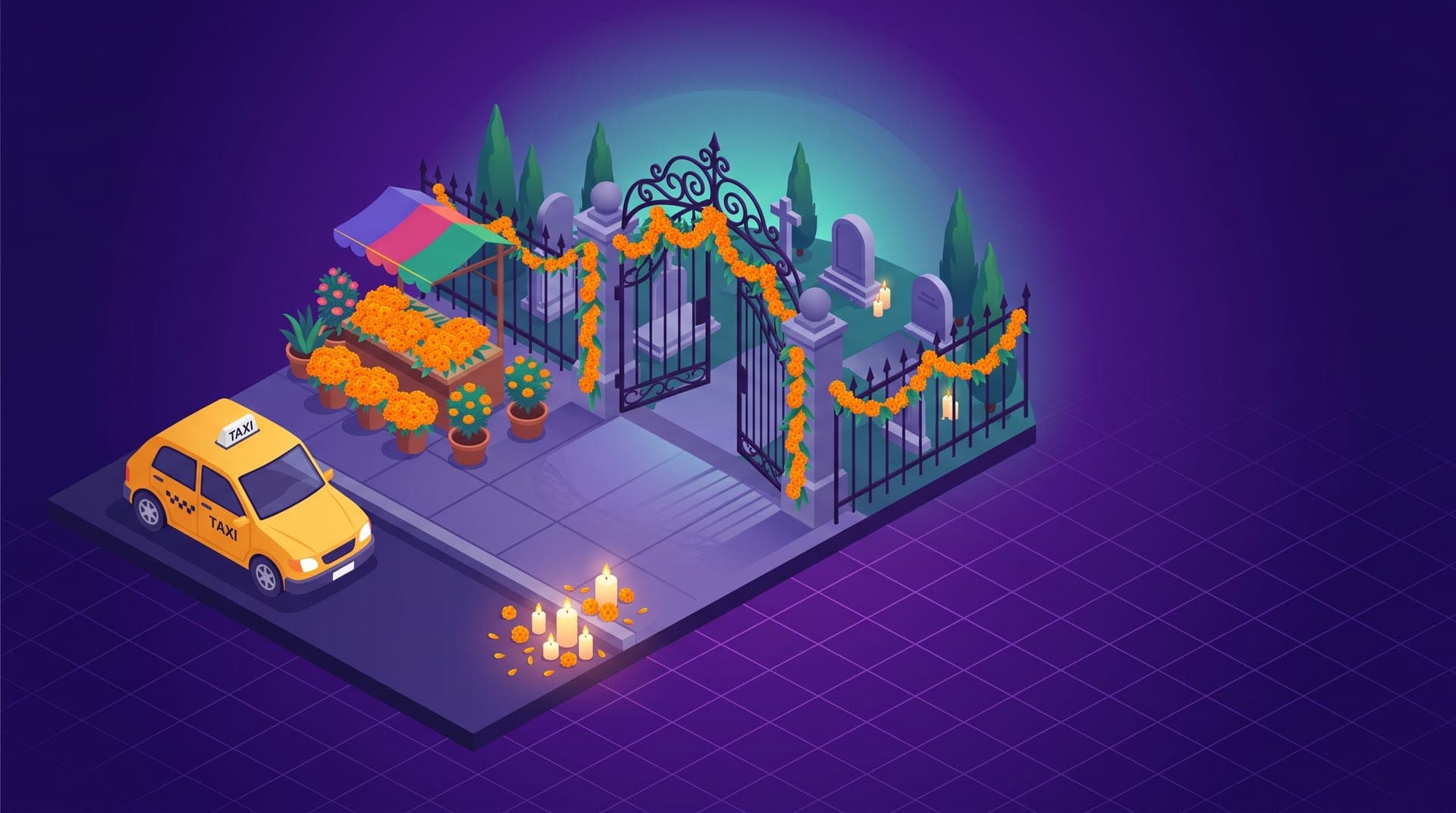
In late October and early November, in Mexico and much of Latin America, the city changes pace. Markets fill with marigolds, candles and pan de muerto; families visit cemeteries to clean and decorate graves, and many people travel to their grandparents' town to spend those days with family. In Guatemala, Bolivia, Ecuador and other countries, the All Saints' and All Souls' celebrations generate very similar movements.
The thesis of this article is that the Day of the Dead is a predictable demand peak, with very specific places and times, that many fleets treat as just another weekend. Cemeteries, markets and the roads out of town concentrate trips on days that are known a year in advance. We'll look at where and when demand appears, how to operate around cemeteries, what happens with markets and shopping, how to serve passengers on these days and how to prepare the fleet a week ahead.
Where and when demand appears
Demand on these days isn't spread evenly across the city: it concentrates in a few types of place and at fairly clear times. Knowing them lets you have drivers in the right place before the requests arrive. These are the spots that generate the most activity:
- Municipal and private cemeteries, especially on 1 and 2 November.
- Flower markets and municipal markets, in the days before.
- Shops and bakeries, for pan de muerto and what's needed for the altar.
- The bus station, for those travelling to their home town.
- Squares and historic centres with altars, parades or festivals.
- Churches, for masses for the dead.
On the calendar, the pattern also repeats every year. In the days before, between 28 and 31 October, shopping rises at markets and shops. The 1st and 2nd of November are the big days for cemeteries, with a lot of activity from early morning and another peak in the afternoon, when families head home. In many cities, the night from the 1st to the 2nd brings vigils at the cemeteries, with early-morning trips not seen the rest of the year.
The best source for refining this map is your own history. If your fleet operated last year, review the trips from those days: which cemeteries they started from, at what times and where they went. That information is worth more than any assumption, because every city has its own customs and its most visited cemetery.
Operating around cemeteries
Cemeteries are the hardest spot on these days. The surrounding streets fill with flower stalls, vendors, double-parked cars and families walking with buckets, ladders and floral arrangements. The authorities often close streets or change traffic flow, and what is normally an easy entrance becomes a traffic jam. A driver who tries to get right to the gate can be stuck for half an hour.
That's why it's worth defining pickup points in advance one or two blocks from each large cemetery, on streets where traffic can still move. Dispatch can point them out to passengers when they book and to drivers when they accept. That way the passenger walks a little, but the trip starts in minutes rather than half an hour. It also helps to check whether the municipality publishes road closures for those days and share them with every driver.
Outward trips have their own particularities too. Families often bring flowers, buckets of water, tools for cleaning the grave and sometimes food to spend the day. A free boot and a driver who helps arrange things make a big difference. And it's worth remembering that many passengers on these days are older people going to visit their partner or their parents: patience and respectful treatment matter especially.
Markets, shopping and altars
Before the big days, demand moves towards the markets. Families buy marigolds, cockscomb, candles, copal, papel picado, fruit and bread for the altar, and many of those purchases are bulky: armfuls of flowers, boxes of fruit, large arrangements. The trip home from the market with all of that is exactly the kind of trip public transport doesn't handle well.
For the fleet, this means having drivers near the flower markets in the mornings of the days before, with an empty boot and a willingness to help with the load. Flowers shed water and soil, so a tarp or a large bag in the boot keeps the driver from ending the day with a dirty car. If the fleet charges extra for bulky loads, it must be stated before the trip is accepted, never on arrival.
The 1st of November is one of our busiest days of the year, and we used to experience it as chaos. Now, from 28 October, we put drivers at the flower market in the mornings and choose a pickup point at each cemetery. Families know where to wait and drivers don't lose the afternoon stuck in traffic.
Serving passengers on these days
The Day of the Dead is a celebration, but it's also a time of remembrance and, for many families, of recent grief. A driver taking a widow to the cemetery for the first time since she lost her husband isn't making just any trip. Kind treatment, without hurry and without inappropriate comments, is what that person will remember, and what makes the family book the service again.
There are practical situations as well. Many passengers ask the driver to wait while they leave the flowers, or to come back for them in an hour. It's worth the fleet having a clear rule for those cases: whether waiting is charged, how the return time is agreed and what happens if the passenger takes longer. The simplest approach is usually for the passenger to book a new trip when they're done, but if the fleet offers waiting, the price must be clear from the start.
Finally, the night of the vigils calls for extra care. Some passengers leave the cemetery in the early hours, sometimes after a long night, and the streets are full of people walking in the dark. Driving slowly near cemeteries and having drivers available at those hours, even if only a few, is part of providing a good service on these days.
The bus station and trips to home towns
For many families, the Day of the Dead means going back to their home town to visit their dead in the community cemetery. That creates a wave of trips to the bus station in the days before, especially on 30 and 31 October, and another wave back on 2 and 3 November. These are trips with a fixed time, with suitcases, bags of food and sometimes flowers bought in the city to take to the town.
As with any trip to the bus station, punctuality is what matters: plan backwards from the bus departure time and leave a margin for the heavier traffic of those days. Returns, on the other hand, concentrate in the afternoons and evenings, when buses arrive from the towns. Having drivers near the bus station at those times keeps passengers from ending their journey waiting in the street with all their luggage.
Preparing the fleet a week in advance
The advantage of the Day of the Dead is that nobody finds out late: the date is the same every year. That makes it possible to prepare the fleet calmly. A week before, it's worth getting drivers together, or sending them a clear message, with the essentials: which days and times will be busiest, what the pickup points are at each cemetery, which streets will be closed and what's expected of them in how they treat passengers.
It's also the time to think about availability. Many drivers will want to visit their own cemetery or travel to their home town, and that's normal. Asking in advance who will work each day avoids discovering on 1 November that half the fleet is away. If needed, you can consider some incentive for those who work at the busiest times, always with clear rules communicated beforehand.
A tradition that is also demand
The Day of the Dead combines tradition, remembrance and movement. For a regional fleet, these are days when thousands of families need to get to the cemetery, the market or the bus station, carrying flowers and memories. The fleet that knows those places, chooses sensible pickup points, prepares its drivers and treats its passengers with respect turns the most intense week of autumn into an opportunity to earn the city's trust.
If you want to start today, list the cemeteries and markets in your city, review last year's trips on those dates and ask your drivers who will work on 1 and 2 November. With that you already have the basis of the plan. And with Cabgo you can launch your own branded taxi app so the families in your city find you on these days and the rest of the year.