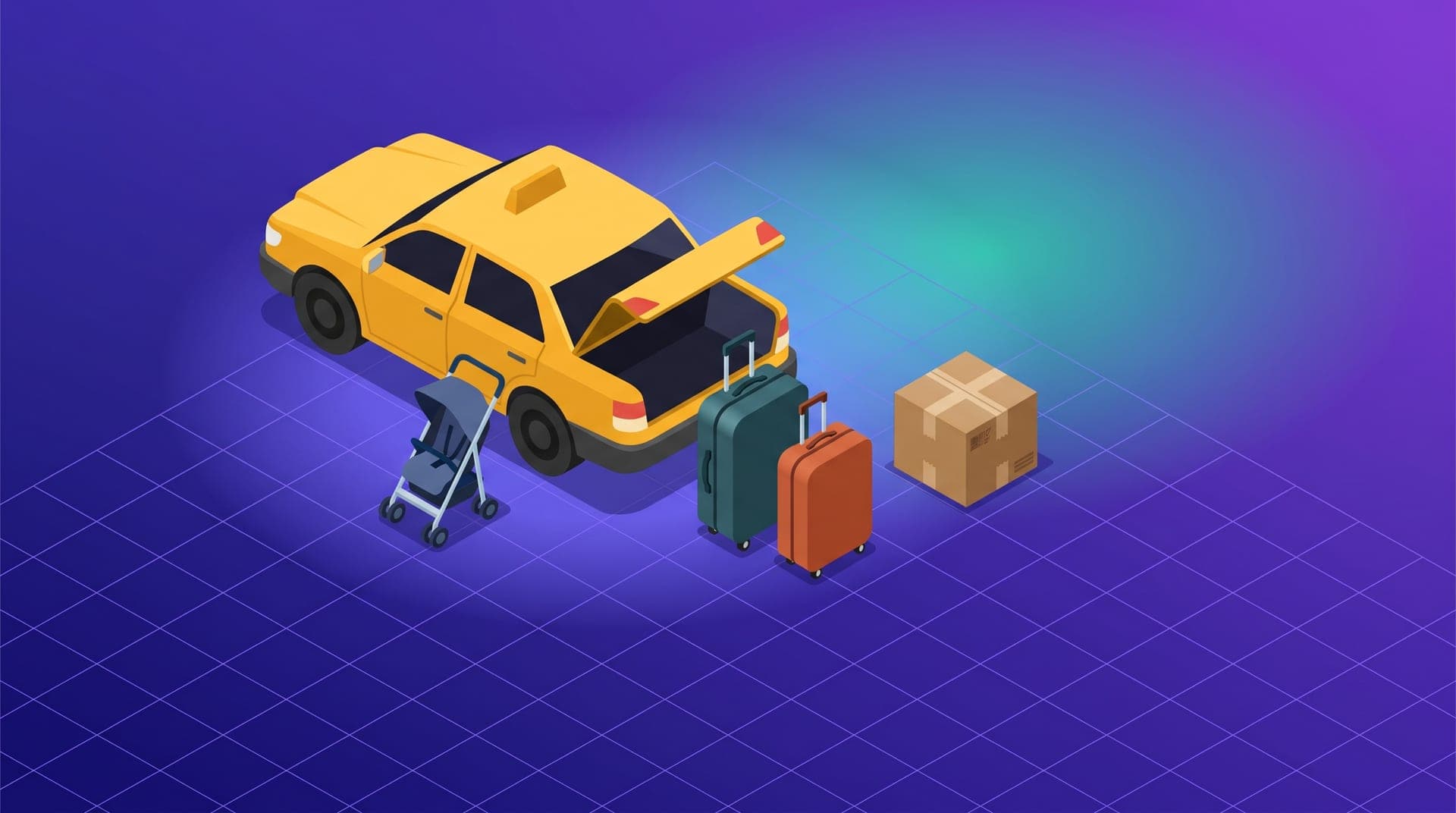
The passenger requests a taxi to go to the bus station. A small saloon car arrives, and on the pavement two large suitcases, a box and a pushchair are waiting. The driver opens the boot, sees that it won't all fit and the argument begins: they should have said, that costs more, better order another. The trip ends up cancelled, the passenger is left on the street in a hurry and the driver wasted the time it took to get there.
The thesis of this article is that luggage isn't an on-the-spot problem but something the fleet can anticipate with clear rules and the right service types. We'll look at which luggage situations repeat most, how to help the passenger choose the right vehicle, what charging rule makes sense for bulky items, how the driver should act on arrival and what to do with the cases that don't fit in any car.
The luggage situations that repeat most
Almost every fleet sees the same cases again and again. Some depend on the destination, others on the season and others on the type of passenger. Knowing them helps prepare the answers before the complaint arrives:
- Trips to the airport or bus station with several large suitcases.
- Large supermarket or market shops that fill the boot.
- Families with a pushchair, a baby seat and bags.
- Small moves: boxes, a television, a chair or a thin mattress.
- Musical instruments, folding bikes or sports equipment.
- Pets in a carrier along with their luggage.
In all these cases the problem is the same: the passenger didn't know whether the vehicle would be big enough, and the driver didn't know what they'd find on arrival. The lack of information on both sides is what turns a normal load into a conflict.
Helping the passenger choose the right vehicle
The best way to avoid the problem is for the passenger to choose from the start a vehicle where what they carry will fit. For that, the service types in your app need to be well described. It isn't enough to write "Saloon" and "Van": the passenger needs to know how many people and how many suitcases fit in each.
A useful description is short and concrete, for example: "Saloon: up to 4 passengers and 2 medium suitcases" or "Van: up to 6 passengers or 4 large suitcases". With that information, the passenger going to the airport with three suitcases chooses the van by themselves, and the saloon driver doesn't get the surprise.
If your fleet doesn't yet have a large-vehicle service, it's worth reviewing how many trips are cancelled for lack of space. Often a few drivers with vans, available at the times with most departures to the airport or the bus station, are enough to solve most cases.
It's also worth making each service type's name say something useful. "Van" or "XL" is clearer than a made-up name. And if you have drivers with roomy boots even though their cars are saloons, you can group them into a service of their own for trips with luggage, with a clear description and its own fare.
Is luggage charged? A clear rule
Charging for luggage is one of the topics that causes most arguments, because every driver has their own idea. Some charge for each suitcase, others only for large ones and others charge nothing. For the passenger, that variation feels arbitrary, and for the fleet it's a source of complaints.
There are two reasonable paths. The first is not charging for normal luggage and letting the price be set by the vehicle type: whoever carries a lot chooses the van, which already has a higher fare. The second is charging a fixed fee only for special items, such as bikes, small moves or very bulky articles. What's best avoided is improvised charging on the pavement, because it's the one that produces most complaints.
Whichever path you choose, it has to be written down and published where the passenger sees it before requesting, and all drivers have to apply it the same way. A rule each driver interprets their own way is almost the same as having no rule.
It also helps if the luggage rule appears in the answers the dispatch centre gives when a passenger asks by message. If whoever answers knows exactly what to say about suitcases, boxes and bikes, the passenger always gets the same answer, and the driver doesn't have to negotiate anything on arrival.
What the driver does on arrival
Even when the rules are clear, there will always be passengers who choose the wrong vehicle. At that moment, the driver's attitude decides whether the customer comes back or not. What works best is a simple, friendly sequence:
- Greet the passenger and help load the luggage before giving an opinion.
- Calmly test whether everything fits, using the boot and any free seat.
- If it doesn't fit, explain it without blaming the passenger.
- Offer a solution: request a larger vehicle or split the load.
- Tell the dispatch centre so it can help find the right vehicle.
- Never leave the passenger alone on the pavement without an alternative.
An important detail is safety. Luggage must never block the rear view or travel loose on the seat where it could hit someone during sudden braking. If making everything fit means putting safety at risk, the right answer is a bigger vehicle.
We had lots of cancellations on trips to the bus station because small cars were arriving for people with lots of luggage. We changed the service descriptions to say how many suitcases fit in each one and put more vans on Fridays and Sundays. Cancellations on that route dropped a lot.
After each difficult case, it's worth the driver telling the dispatch centre about it in one line: what the passenger was carrying, which vehicle they requested and how it was resolved. With a few weeks of those notes, the fleet knows which routes and times need large vehicles and can adjust without guessing.
Preparing for the seasons and destinations with most luggage
Luggage isn't spread evenly through the year. Summer holidays, Easter, the end of the year and long weekends fill airports and bus stations with passengers carrying suitcases. The same happens at the start and end of school terms, when students move with boxes and bags, and on paydays, when large supermarket shops multiply.
If you know those dates, you can get ahead of them. Tell drivers with vans to be online at the times with most departures, remind the fleet of the luggage rule a few days before and, if your app allows it, highlight the large-vehicle service on routes to the airport and the bus station. Also review, after each season, how many trips were cancelled for lack of space: that number tells you whether you need more large vehicles next time.
What doesn't fit in any taxi
Some loads simply aren't for a taxi: a fridge, a sofa, a full house move or building materials. In those cases, the honest thing is to say so from the start and not try to force the load in, because it damages the vehicle and puts safety at risk.
If these requests come up often in your city, it may be an opportunity. Some fleets add a separate freight or small-move service with suitable vehicles and its own fare. There's no need to start big: it's enough to detect whether the demand exists, by reviewing how many passengers ask for this type of trip, before investing.
Meanwhile, what any fleet can do is keep a couple of trusted freight or removal contacts handy to recommend. The passenger appreciates not being left without an option, and that recommendation also builds the image of a service that solves problems.
What to take away
Luggage conflicts almost always come from a lack of information: the passenger doesn't know which vehicle suits them and the driver doesn't know what they'll find. With well-described service types, a written charging rule, a friendly sequence on arrival and clarity about what doesn't fit, most of those conflicts disappear.
If your fleet runs on its own app, review today how your service types are described and whether the passenger can easily choose a bigger vehicle when they need one. A passenger who reaches their destination with all their suitcases and without arguments has many more reasons to request a trip with you again.