Expanding to a second city has a fixed cost most ride-hailing operators treat as automatic: a dedicated coordinator. The reasoning is straightforward — a new city means someone needs to learn the zones, map the demand patterns, identify which incidents recur and how to resolve them, and develop the local judgment that enables correct decisions during the shift's most demanding moments. That learning process takes 60 to 90 days in any new city, and while it's underway, that coordinator can't also manage another city without degrading both. This logic held before genuine agent integration changed the coordination equation.
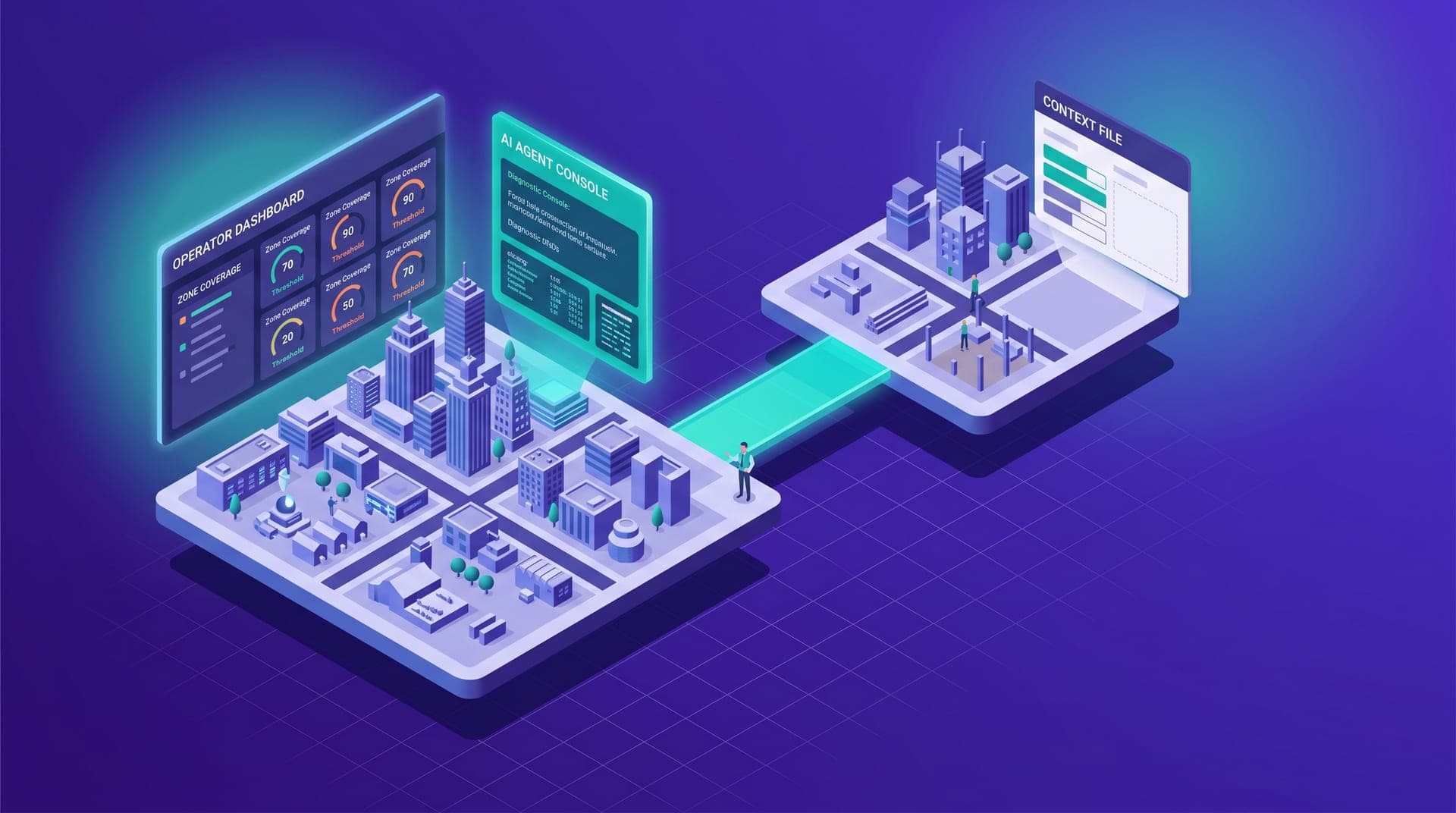
The operator who has spent 90 days with the agent genuinely embedded in their first city has built two things that change the expansion math: a working context file and the habit of using it. The context file documents the operational structure — zones, thresholds, recurring incidents and their resolutions — in a format the agent can use to produce diagnostics without the coordinator having to manually check every zone every shift. The habit means the coordinator knows when to consult the agent, how to phrase questions to get actionable diagnostics, and how to update the context when something changes. Both of those things transfer to a second city in a way that a new coordinator's tacit knowledge simply doesn't.
Why the second city costs more than the first without an integrated agent
Without an integrated agent, expanding to a second city is essentially the same launch operation as the first one, with the added constraint that the operator is already running city one. A new coordinator needs four to eight weeks just to learn the zones well enough to make coverage decisions with confidence — how many drivers are needed in which zone, during which time windows, and when a number starts signaling a problem. While that learning is happening, coverage errors are more frequent and more costly. The coordinator without local experience activates incentives late because they don't yet recognize the early fall-off signals, or distributes drivers poorly at shift start because the demand pattern for that city isn't yet internalized.
The real cost of that learning period isn't just the new coordinator's salary — it's the operational inefficiencies in the new city paid through worse metrics during that window: more cancellations, less consistent coverage, less precise incentive timing. For an operator with 80-120 drivers in a second city, that ramp-up can cost $1,800-$3,500 USD in less efficient incentives and in passengers who cancel before the coordinator identifies the problem. This cost is built into the standard expansion model. What changes when the agent is genuinely integrated is that a significant portion of that learning period can be replaced with a context file that already exists.
What the first city's context file already contains that accelerates the second
The operator context file has two layers: one that's specific to the first city, and one that's structural and transfers directly. The specific layer — zone names, coverage thresholds, hour-by-hour and day-by-day demand patterns, recurring incidents with documented resolutions — doesn't transfer, because it corresponds to that city's particular geography and demand patterns. But the structural layer does: the format for documenting thresholds, the way incidents are described using four fields, the convention for naming zones and mapping them to system identifiers, and the general logic of how the agent uses that context to produce specific diagnostics.
This means that when the operator opens the second city's context file, they don't start from zero — they start with an established structure and the knowledge of what type of information needs to be documented for the agent to be useful from the first shifts. The coordinator doesn't have to discover empirically what the agent needs; they already know because they lived it in the first city. That single difference reduces the time to build a working context file for the second city from two to three weeks down to three to five days — because the question isn't "what does the agent need?" but "what are the specific thresholds for these particular zones in this city?"
What to adapt and what to rebuild when entering the second city
The first task when opening the second city's context file is distinguishing what can be reused directly from what must be built from scratch. What transfers directly: the threshold documentation format, the four-field incident format, the convention for mapping internal zone names to system identifiers, and recurring event patterns the agent uses as reference — if the second city shares the same event types (local fairs, payday-week patterns, end-of-school-term peaks). What has to be built from scratch is everything geographically specific: zone names, precise thresholds by time window, the high-demand nodes particular to that city, and incidents characteristic of that market and geography.
The fastest way to build that specific layer is the same method that worked in the first city: export the zone list from the panel, ask the agent to formulate the threshold questions it needs answered, and document those answers in the established format. The agent knows what to ask because the operator already calibrated that process in the first city. A functional base context file for the second city can be ready in four to six hours of work distributed across the first three operating shifts — not as a theoretical document but as a working record that grows with each shift where something worth documenting happens.
The decision workflow that makes one coordinator viable across two cities
The key to a one-coordinator, two-city model isn't that the coordinator does twice the work — it's that the agent with active context in both cities reduces the continuous monitoring load the coordinator would otherwise have to handle manually. In an operation without an agent, the coordinator has to actively review each zone each shift to catch coverage drops, anomalous cancellation patterns, and emerging incidents. With the agent integrated, that continuous monitoring load moves to the agent, which can simultaneously track both cities' status and flag alerts when any indicator falls below the thresholds documented in each city's context.
The coordinator's role in this model is supervisory and decisional, not active monitoring. In practice: the coordinator starts each shift by reviewing both cities' status with the agent — ten to fifteen minutes total — delegates normal pattern monitoring to the agent during the shift, and concentrates attention on whichever city shows more anomalies that particular shift. The agent flags when any documented threshold triggers in either city; the coordinator evaluates the alert and makes the call. This workflow functions when each city's context file has thresholds precise enough for alerts to be actionable rather than merely informational.
When we opened in the second city I thought I'd need to hire someone immediately. Instead I used the same context format I'd built for the first city and started documenting the zones and thresholds from shift one. By week three the agent was already identifying the second city's patterns with enough specificity that I could manage both without either one degrading.
The critical period: the first 60 days in the second city
The first 60 days in the second city are the period of highest operational risk for the one-coordinator, two-city model. The second city's context file is under construction — it has the right structure but still few thresholds precisely documented and few incidents logged with their resolutions. The agent in this phase produces more generic diagnostics than in the first city, because it's missing the specific context accumulated over months of real operation. The coordinator needs to be more hands-on in the second city during this window: verify more alerts personally, document each relevant incident in full four-field format immediately after resolving it, and calibrate the file's thresholds as the first real data from that city reveals what levels are normal for its zones.
The signal that the second city's context file is functional is the same as in the first: incident diagnostic time falls from ten to twelve minutes to two to three minutes. When that happens, it means the agent has enough city-specific context to retrieve documented resolutions rather than building diagnostics from scratch. That threshold is typically reached between week six and week ten of real operation, depending on how consistently the coordinator documents incidents as they occur during the shift rather than reconstructing them from memory days later.
When the second city needs its own dedicated coordinator
The one-coordinator, two-city model with integrated agent isn't permanent — it's a launch phase with a specific operational duration. The signals that indicate the second city needs its own coordinator are different from signals that the operation is going wrong: the fact that hiring becomes necessary doesn't mean the previous model failed, it means the second city's volume and complexity have grown to the point where the supervisory load exceeds what one coordinator can handle well even with agent support.
The three concrete signals: average response time to second-city alerts consistently exceeds ten minutes during peak-demand shifts, because the coordinator is attending to city one; the second city surpasses 120 active drivers during peak hours and its incidents are becoming less predictable and more varied than what the context file covers with documented resolutions; the second city requires local strategic decisions — negotiations with authorities, coverage zone adjustments, pricing structure changes — that the first-city coordinator can't attend to without compromising the quality of one of the two. At that point, the context file the agent has accumulated for that city is the most complete onboarding document the new coordinator could receive.
Expanding to a second city with an integrated agent doesn't eliminate the need for human coordination — it changes when that coordination needs to be dedicated. The operator who arrives at the second city with a well-structured context file and the habit of embedding it in the shift workflow can operate both cities with one coordinator during a period that would typically require two, without that team compression translating into worse metrics. The agent takes on the continuous monitoring load that makes managing two cities simultaneously unworkable without it — not by replacing the coordinator's judgment, but by freeing the coordinator's time to concentrate it where human judgment produces the most value.
What the first city builds in 90 days of genuine integration isn't just a context file for that city — it's the methodology for building the file, the format that works, and the usage habits that produce actionable diagnostics rather than generic responses. Those are the assets that transfer to the second city and reduce the most expensive phase of any launch: the time until the agent has enough city-specific context to produce alerts the coordinator can act on without manually pre-checking every zone. The second city reaches the same integration level as the first in significantly less time, because the operator already knows the path.