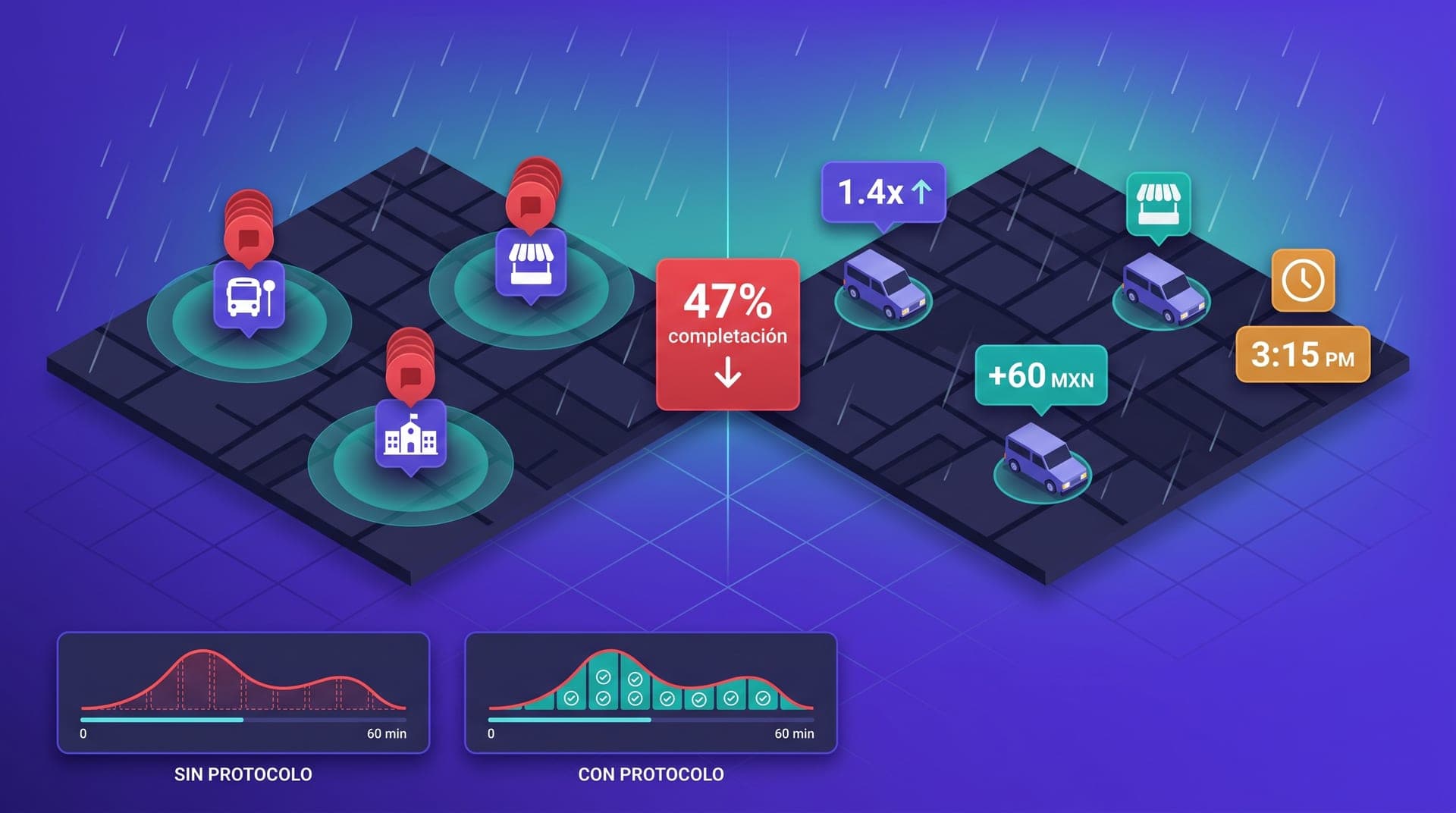
In a regional ride-hailing operation, rain is the most predictable demand event there is. A storm starting at 3 PM on a Tuesday concentrates 40 to 80% more requests in a 45-to-90-minute window than the same dry Tuesday at the same hour. Unlike a holiday or a mass event, rain has no fixed date on the calendar: it can happen any day. But it has something operators without a protocol consistently miss: in most regional markets in Mexico and Central America, there is a 30-to-90-minute window between a reliable rain forecast and the start of the downpour. The operator who has a rain protocol activated before the first drop captures 70 to 85% of the demand spike the storm generates. The one without a protocol captures 40 to 55%, because drivers aren't positioned in the right zones, prices don't compensate for the additional cost of working in rain, and the first burst of unserved requests produces cascading cancellations before anyone can react.
This article is for operators with 20 to 80 active drivers whose completion rate during rain is 20 to 30 percentage points below the same time slot on dry days, without a clear protocol to anticipate the event. It covers why rain simultaneously increases demand and contracts supply in opposite directions; what the 30-to-90-minute pre-rain window is and how to use it operationally; where rain demand concentrates geographically and why it differs from the same time slot without rain; what pricing structure works in rain without destroying conversion; how to communicate with drivers before the event — not during — to achieve preventive positioning; how demand decays after rain stops and how to manage exiting the protocol; and what agent query produces the rain spike capture diagnostic in the weekly review. The thesis is practical: rain is not an unpredictable event — it is the most predictable event in regional operations if you have access to a 60-minute forecast. The operator who builds a protocol around that forecast turns a missed demand peak into the best per-active-hour revenue window of the week for the drivers who work it.
Why rain raises demand and shrinks supply simultaneously
Rain's effect on a ride-hailing operation involves two mechanisms working in parallel but in opposite directions. On the demand side: passengers who would normally walk 3 to 5 blocks or wait for public transit open the app when rain starts. In regional markets, that marginal passenger — who only uses the platform when walking or waiting has a high cost — can represent 35 to 55% of the spike in requests during a downpour. The profile is specific: short trips of 1 to 2.5 km from commercial zones or public transit nodes toward residential destinations, with high price tolerance but low wait tolerance — if there's no assignment in the first 3 minutes, they make another decision because the rain is already advancing. Rain demand concentrates in zones where the alternative of walking in a downpour carries the highest perceived cost: wholesale markets, bus stops, school zones at dismissal time, and commercial corridors without covered parking.
On the supply side, drivers react to rain in the opposite direction. Between 15 and 30% of the drivers connected before the downpour disconnect within the first 15 to 20 minutes. The reasons are cost and perception: reduced visibility and slower traffic increase vehicle wear and per-trip time, the perceived accident risk is higher, and drivers who have already met their daily income target choose not to work if the base rate doesn't change. The operational result is a double gap: more requests and fewer available drivers, happening in the same 30-to-60-minute window. In a fleet of 40 active drivers, if the rain peak generates 48 requests in 30 minutes — compared to the usual 26 in the same dry slot — while 10 drivers simultaneously disconnect, completion rate can fall from the usual 88% to 50 to 58%, not due to any structural fleet problem, but because neither mechanism was anticipated. That is exactly the gap a rain protocol closes.
The 30-to-90-minute window: the operational time before the first drop
In most cities of 150,000 to 500,000 residents in Mexico and Central America, free forecast applications — Windy, AccuWeather, Weather.com — have 45-to-90-minute accuracy for local rain predictions within a ±5 km coverage margin. That means an operator who checks the forecast at 2:30 PM can know with reasonable confidence whether it will rain at 3:15 PM in their zone. The window isn't perfect — fast convection rains can arrive in 20 minutes with no prior signal — but for afternoon storms, which are the most frequent in tropical and subtropical markets from May through October, the 45-to-90-minute window is the norm. The operator who establishes a 3-minute forecast review routine once each afternoon, between 2:30 and 3:00 PM during rain season, converts that window into operational time to activate the protocol before the first passenger opens the app in the downpour.
The 30-to-90-minute window before rain starts has two distinct operational uses. The first is driver communication: sending the positioning message 30 to 40 minutes in advance — with specific zone, estimated event duration, and applicable compensation — is the difference between having 8 drivers positioned in the right zones when the first request arrives or having 2 or 3. A driver who receives the message when it's already raining may be 7 km from the highest-demand corridor, making them irrelevant for the first 60% of the spike. The second use is pricing activation: switching on the rain surcharge 15 minutes before the first downpour — not as a reaction to the first cancellations — produces the economic signal that keeps connected the drivers who would otherwise disconnect upon seeing rain. A surcharge activated 20 minutes after rain began arrives after the first cycle of unserved requests has already generated cancellations and already built in those passengers the impression that the platform doesn't work when they need it most.
Preventive positioning in rain: where to concentrate the fleet before the storm
The geographic distribution of rain demand is predictable and different from the same time slot without rain. On dry days, demand from 3 PM to 5 PM in a city of 280,000 residents comes from a broad mix of residential, commercial, and service zones. Under rain, that same slot concentrates 65 to 80% of the additional demand in 3 to 5 specific zones. Those nodes are not random: the operator who identifies them in their city once can build the rain map that guides the positioning instruction for all future events.
The four zones that concentrate rain demand in most regional cities and the trip profile each generates:
- **Public transit stops and terminals**: the highest-concentration rain demand zone in virtually every regional market. The passenger waiting for a bus in the rain is the marginal passenger most activated by the event. Generates short trips of 1 to 2 km, high urgency, low cancellation rate with fast assignment. In cities with an intercity bus terminal, that terminal concentrates rain demand regardless of the time slot.
- **Wholesale markets and popular market zones**: the second most frequent rain demand zone. Open-air activity — stalls, street vendors, shoppers — stops abruptly during a downpour and those who arrived without a vehicle seek immediate transport. Trips are 1 to 3 km, concentrated in the first 20 minutes of the downpour.
- **School zones at dismissal time**: in cities where schools dismiss at 3 PM to 3:30 PM, heavy rain coinciding with school dismissal generates a 15-to-25-minute request burst where 80% of trips go to residential destinations within a 2-to-4 km radius. That zone has the highest negative price elasticity during rain: the parent picking up their child in the downpour accepts almost any fare.
- **Commercial corridors without covered parking**: zones with shops, banks, and offices where customers arrived without a vehicle and cannot wait on the street in the rain. Generate more time-distributed demand — 30 to 60 minutes — with trips of 1.5 to 4 km and lower urgency than transit stops or schools, but with sustained volume throughout the downpour.
Rain pricing: the surcharge that works and the one that kills conversion
Rain pricing has a wider tolerance window than night pricing because the cost of the alternative — waiting under the downpour, getting wet en route — is qualitatively worse than in normal conditions. In regional markets, prices of 1.3x to 1.6x over base rate during rain produce a reduction in request volume of 8 to 15%: significantly smaller than the reduction the same rate produces in standard daytime operations. Elasticity varies by origin zone: the passenger at a transit stop in the rain has lower price elasticity than the passenger at home who could wait for it to pass. A uniform surcharge of 1.4x activates the right signal for drivers — visible compensation for the additional cost of working in rain — without destroying conversion in the high-urgency segment that constitutes the core of rain demand. Rates above 1.7x begin destroying conversion in the optional-trip segment without producing a proportional improvement in driver income, because request volume falls before the driver completes enough trips to justify the high rate.
Driver communication before rain: the message that produces positioning
The rain message to drivers has different logic than the daily operational instruction. The driver who receives a message at 3:00 PM saying heavy rain is expected from 3:30 to 5:00 PM is processing economic opportunity information: if there is high demand and a higher rate, positioning in the right zone improves their shift income. The effective message includes four components: the expected event with approximate timing and affected zones, the applicable rate during the block — surcharge activated from 15 minutes before the expected hour — a concrete zone instruction — 'position yourself at the main Benito Juárez market transit stop, 4-block radius' — and an optional additional bonus if the operator wants to accelerate positioning — 50 to 70 MXN bonus for completing at least 3 trips during the rain block. That message takes 3 minutes to write and 30 seconds to send. The driver who receives it 30 minutes before the rain has time to position. The driver who receives it when it's already raining does not.
The frequent error is sending the rain message as a reaction to rising demand, not as anticipation of the event. If the operator sees on the dashboard that requests are unusually elevated — which is typically the moment they think of activating the protocol — 10 to 20 minutes have already passed since rain began. Drivers who disconnected already did so. Drivers who were in low-demand zones already have trips in progress in those zones. Reactive positioning doesn't have the same effect as preventive positioning, because a driver receiving the instruction when the peak is already occurring takes 8 to 15 minutes to reach the right zone — and an afternoon rain peak in tropical markets lasts 45 to 90 minutes. By the time that driver arrives positioned, 60 to 70% of the peak is already in its descending second half. The difference between preventive and reactive protocol is not the operator's intention: it is the activation moment.
After the rain: how demand decays and when to deactivate the protocol
The post-rain period has a specific demand pattern that most operators don't calibrate. When rain stops, demand doesn't immediately fall back to prior levels: there is a 15-to-30-minute queue phase where passengers who waited under shelter for the rain to pass generate concentrated requests. That queue phase produces a second peak — smaller than the main peak — between 10 and 25 minutes after rain ends. Trips in that second peak are often the longest of the event: the passenger who waited 30 to 45 minutes under a market awning or transit stop canopy before requesting is more inclined to pay a higher rate and less tolerant of driver rejection. Deactivating the surcharge the moment rain stops deprives the driver of the benefit of that final phase. The correct structure is to maintain the surcharge during rain plus 20 additional minutes after it stops, followed by a gradual return to base rate. That captures the second peak without artificially extending the high-rate window beyond where the passenger accepts it.
The weekly review: how to evaluate whether you captured the rain peak or missed it
The agent query that produces the rain spike capture diagnostic for the prior week: 'For the last 7 days, identify the time slots where request volume was at least 35% above the average for the same day of week and time slot in the prior 4 weeks. For each of those slots — which likely correspond to rain events — show: total requests, completed requests, completion rate, median wait time before assignment, number of drivers connected in that slot versus the usual average for that same slot on non-spike days, and driver rejection rate. Compare the completion rate of those slots with the completion rate of the same time slot on non-spike days that same week. Indicate what percentage of the spike's additional volume was completed.' That diagnostic doesn't require the operator to label which days it rained: abnormal rain demand is visible as a statistical spike in request volume that the agent can identify without external weather data.
The rain capture review produces two practical indicators: the spike capture rate — completed requests divided by total requests in the spike slot — and the supply gap in that slot — available drivers minus those needed to serve the request rate with rain-adjusted average trip time. If the demand spike capture rate for the week was below 65%, there is a positioning or supply gap. If the rejection rate in those slots was more than 15 percentage points higher than in the same time slot on non-spike days, there is a compensation problem — the surcharge wasn't active or wasn't high enough to keep drivers connected. The operator who runs this query every Monday during rain season has the diagnostic for whether the protocol worked in 5 minutes, without needing to cross-reference external weather data: the demand spike is itself the signal that an event occurred that the protocol should have captured.
My first summer with the platform I had Tuesdays and Wednesdays at 4 PM with 55 requests in 30 minutes and 18 drivers rejecting. I didn't understand what was happening until a driver told me it was because it was raining. I started checking Windy every morning during rain season. When I saw rain forecast for the afternoon, I sent the positioning message to the 12 most active drivers in that slot, activated 1.4x starting 15 minutes before the expected hour, and offered 60 pesos for completing 3 trips in the block. During the most intense rain peak that summer — 45 minutes of heavy downpour on a Wednesday at 3:45 PM — I had an 83% completion rate. The prior summer, without a protocol, I had 46% in a similar storm.
Rain is the only demand event in a regional ride-hailing operation that has three unique characteristics simultaneously: it is predictable 30 to 90 minutes in advance, generates an inelastic demand spike where passengers accept higher fares, and simultaneously produces a supply contraction that no other type of high demand generates. That combination makes the rain protocol the highest-return preparation investment in the operator's toolkit: it requires 3 minutes of forecast review and 5 minutes of activation, and the difference between having a protocol and not having one is 25 to 35 percentage points in completion rate during the peak. An operator with 35 active drivers who captures 80% of requests during a 60-minute rain peak completes 18 to 24 trips that without a protocol would have been unserved requests. For drivers working that block, income per active hour in rain frequently exceeds that of any other block in the week — shorter trips but sustained volume and an active rate surcharge.
The rain protocol requires no additional technology or extra drivers. It requires a 3-minute afternoon process during rain season, a positioning message ready to send, and a pricing configuration that activates 15 minutes before the event. The weekly agent review identifies whether each demand spike of the week was captured or missed, without needing to cross-reference external weather records: the spike is its own signal. The operator who builds that cycle — check forecast, activate protocol, measure capture — converts rain from a source of lost requests into the best per-active-hour revenue block of the week for the drivers who work it. The same drivers who would voluntarily disconnect at the first raindrop — without a surcharge, without a bonus, without zone instruction — are the ones who consistently cover the rain block when economic compensation and positioning information arrive before the downpour starts.