Healthcare facilities in LATAM spend between $4,000 and $15,000 USD per month on specialized transport of biological samples, medications, and clinical documentation — and most of that budget goes to courier services that only partially meet the protocols hospitals need. For a regional ride-hailing operator with 60 or more active drivers, this is a B2B market their existing infrastructure can serve with three specific adjustments: drivers who know the biological sample handling protocol, a chain-of-custody documentation system that labs can audit, and service-level agreements with delivery windows ranging from 45 minutes to four hours depending on sample type. The barrier is not technical and doesn't require specialized vehicles for most workflows: it is operational, and consists of understanding which variables make healthcare pay more for a logistics provider and why those variables are within reach of a well-run regional operator.
This article is for operators with an active operation in cities that have private hospitals, mid-size diagnostic laboratories, or pharmacy chains with internal distribution. The natural market is not large public hospitals — which operate through annual tender processes that take months — but private clinics with 50 to 300 beds, labs processing 200 to 800 samples per day, and specialty pharmacies with home delivery of temperature-controlled medications. For those clients, the decision is made by the logistics director or medical director without a formal procurement process, and the contracting cycle runs 60 to 90 days from first contact to signed contract. The operator who understands the technical requirements and can document compliance has a realistic path to closing that contract within the quarter.
Why conventional couriers fail at hospital logistics
The main problem with applying conventional courier services to hospital logistics is not price or general availability — it is inconsistency in the specific attributes healthcare needs. A biological sample for a blood count or culture has a stability window ranging from two to six hours depending on sample type and storage conditions. A delayed delivery is not just an operational inconvenience: it can invalidate the sample and require a second extraction with the cost and patient discomfort that entails. The conventional courier who delivers a document envelope in the same shift as a bag of biological samples has neither the training nor the protocol to distinguish which of those two packages carries a clinically relevant time constraint.
The second failure point is chain-of-custody documentation. A clinical laboratory working with a health insurer needs to demonstrate that the sample it analyzes is the same one the physician extracted, that it stayed within the required temperature range from collection to processing, and that there were no gaps in the delivery chain. Conventional courier tracking systems record pickup and delivery, but not intermediate temperature, not waiting time before collection, not the driver's identity by name and license number. For an accredited lab operating under ISO 15189 standards, that documentation is not optional: it is an audit requirement that a logistics provider without a documented protocol cannot consistently meet.
The three flows that produce recurring contracts
The medical logistics contracts with the highest recurring potential for a regional operator are:
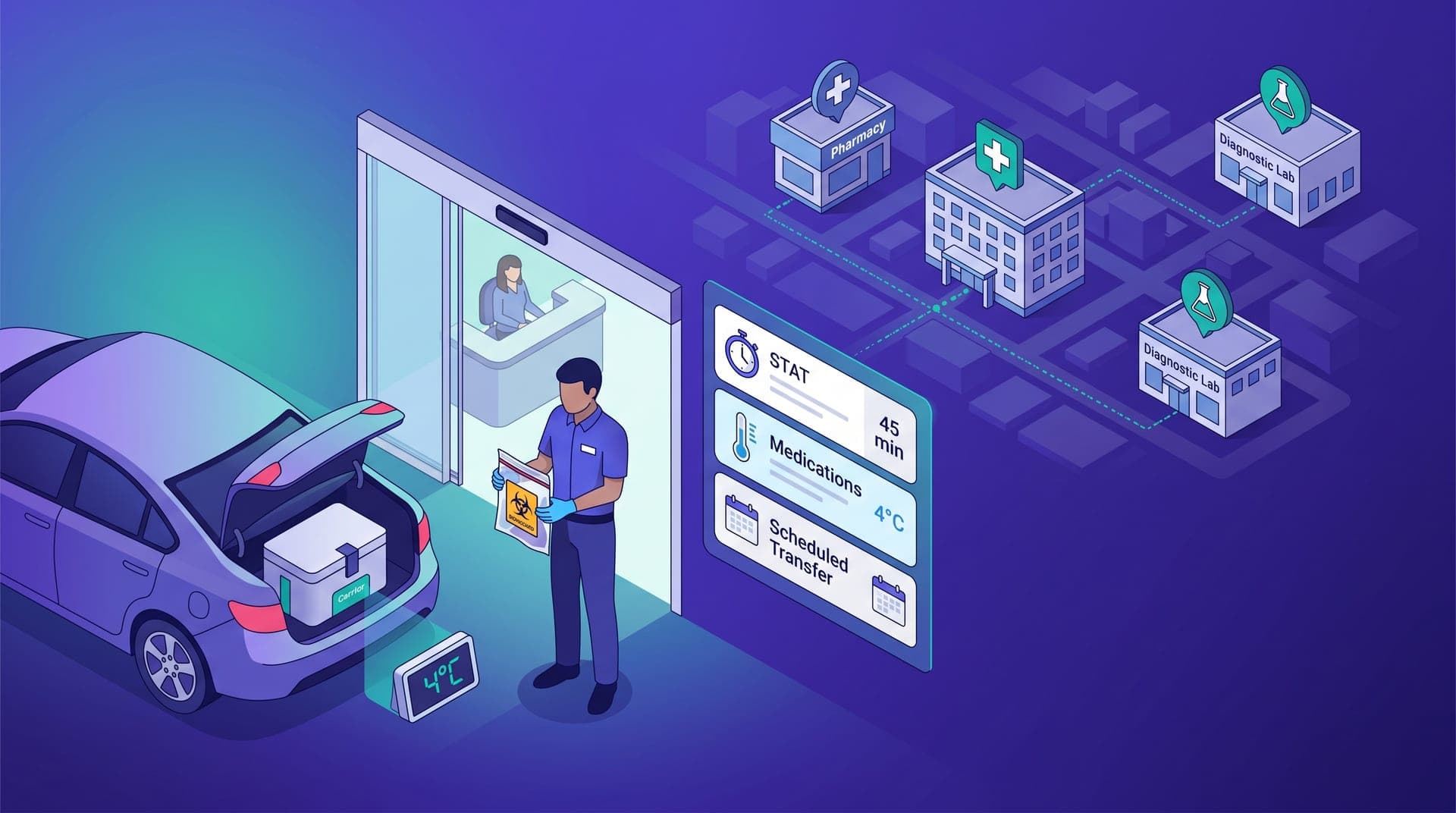
- Biological sample transport between collection points — doctor's offices, satellite clinics, collection centers — and the central processing laboratory: daily frequency, 45-to-90-minute windows for STAT samples and up to four hours for routine samples
- Medication distribution from hospital or specialty pharmacy to home patients: with or without cold chain depending on medication type, with potential for monthly volume contracts and direct billing to the clinic
- Transfer of supplies, documentation, and low-risk equipment between facilities of the same hospital group: no cold chain requirements but with documented delivery and authorized-recipient reception records
The difference between these three flows in operational complexity is significant. Biological sample transport is the most restrictive: it requires correct container handling, strict timing, and temperature control for certain sample types. Medication logistics is variable: most general-use medications don't require cold chain, but insulins, biologics, and some reagents have temperature constraints the operator must manage. Supply and documentation transfers are the least technically restrictive but equally relevant as a recurring revenue source: a hospital group with four locations in the same city may have 20 to 60 such daily deliveries, currently handled through internal messengers or conventional couriers without formal tracking.
Cold chain: what the driver needs and what the platform must record
Cold chain in hospital logistics does not always mean active refrigeration. For routine biological samples — blood counts, biochemistry, urinalysis — the requirement is transport at controlled ambient temperature, between 15 and 25 °C, without direct sun exposure or abrupt temperature shifts. This is achieved with a standard polyethylene insulated container — the equivalent of a camping cooler without ice — and clear instructions to the driver on what to do and not do during the transfer. The equipment investment for this handling level runs $800 to $2,000 pesos per driver and requires no refrigerated vehicle. For medications that do require cold (2-8 °C), a medical transport box with certified cold packs and a digital temperature logger is needed — which raises equipment cost but also the price point of the service that driver can offer.
The record the platform needs to provide goes beyond pickup and delivery timestamps. The lab or pharmacy auditing the service will need at minimum: driver identification (name and license number), exact pickup and delivery time, temperature at start and end of transfer for controlled samples, and the name and role of whoever handed over and received the package. That record can be managed with a digital form on the driver's phone — it requires no specialized technology, only a standardized protocol the driver executes at the start and end of each medical delivery. The operator who has that protocol documented and can show it as a live demo to a clinic's logistics coordinator has an immediate advantage over the courier who has been doing the work informally for years with no auditable record.
Clinically defined delivery windows: why healthcare doesn't accept 'as soon as possible'
In on-demand ride-hailing, 'as soon as possible' is an acceptable answer for most trips. In hospital logistics, that answer is insufficient because delivery windows are clinical requirements, not convenience preferences. A urine sample for bacteriological culture has a two-hour stability window from extraction. A blood sample for arterial blood gas has a 30-minute window. If the lab receives a sample outside its window, it has two options: process it with a warning note to the requesting physician about possible loss of diagnostic validity, or reject it and request a new extraction. Neither option is acceptable to the physician or patient, and both represent a logistics provider failure the lab coordinator will log in that provider's performance record.
The operator who wants to win hospital logistics contracts needs to structure service agreements with explicit time windows per sample category, not generic fast-delivery commitments. In practice, the windows private labs in mid-size LATAM cities accept as standard are: STAT (urgent, highest priority) — delivery within 60 minutes of the collection point; high-priority routine — delivery within two hours; standard routine — delivery within the same shift, morning or afternoon. Those three categories allow differentiated resource assignment: STAT trips carry a premium price and immediate dispatch, shift-routine trips can be batched into multi-pickup routes that improve driver efficiency. That urgency-based segmentation logic is exactly the same the operator already uses in on-demand — applied to a context where the consequences are clinical rather than commercial.
Chain-of-custody documentation: the non-negotiable minimums
A hospital logistics contract that doesn't include a documented chain-of-custody protocol is not a contract an accredited laboratory can sign. The minimum standard the operator must meet has five elements: verified identity of the person handing over at the collection point (name and employee number), verified identity of the recipient at the lab, timestamp of each transfer, condition of the package at delivery — intact or with visible damage — and recorded temperature where applicable. That record must be retrievable for at least 12 months, as accredited labs are subject to periodic audits of their sample handling standards.
The good news for the operator is that this level of documentation requires no specialized laboratory software. It requires the driver to fill in a five-field digital form before and after each medical delivery, and the operator to store that record in an organized way. A form in the driver's app with additional fields enabled for medical service type is sufficient for most private labs in LATAM. Labs with ISO 15189 accreditation or contracts with large insurers will ask for a more robust system — but those clients are not the entry point for an operator new to the segment. The private lab that currently uses informal couriers and wants to improve its compliance is the client the operator can start with, and to whom they can deliver sufficient documentation from the first month.
How to price a medical logistics service
The pricing model in hospital logistics is not dynamic distance-based fares — it is fixed pricing by service type with surcharges for urgency and cold chain requirements. A routine sample transfer between a doctor's office and a lab within a five-kilometer radius in a mid-size LATAM city has a market price of $80 to $180 pesos, depending on city and sample type. A STAT service in the same range can charge $200 to $350 pesos for priority dispatch. A certified cold-chain medication delivery can run $300 to $600 pesos per delivery, with a minimum of ten deliveries per month to justify the driver's temperature equipment investment. The operator who structures those price tiers explicitly in the proposal makes internal approval easier for the lab, which needs to present the cost to its management with clear categories.
The contract model that produces the most stable income is the monthly volume contract with the lab or clinic: the client commits to a minimum number of transfers per month — for example, 60 routine samples and 10 STAT — the operator guarantees availability in defined time slots, and bills a fixed monthly fee plus a surcharge for transfers above the minimum. That model eliminates variability for both parties: the lab knows what it will pay, the operator knows how many trips are guaranteed. A contract of this type with a lab processing 400 daily samples can represent $18,000 to $45,000 pesos per month in recurring revenue with a near-zero cancellation rate, because samples arrive every business day regardless of on-demand platform volume.
The validation process before your first medical contract
The sales cycle in hospital logistics is longer than in conventional corporate accounts. The logistics director of a private hospital or accredited lab will run a three-stage evaluation before signing. The first is operator documentation review: vehicle liability insurance, criminal background checks for the drivers assigned to the service, proof of biological sample handling training — a four-hour course is sufficient for the basic level — and a description of the chain-of-custody system the operator will use. The second stage is a two-to-four-week pilot where the operator handles real transfers but the lab evaluates performance on low-risk services while keeping its current provider for critical transfers.
The third stage — which not every lab makes explicit but which determines whether the contract advances — is the pilot incident review. The logistics coordinator will verify whether any transfers were outside window, whether documentation was complete in every case, and whether the driver responded correctly to the exception situation that typically occurs in those two weeks: a delivery to an incorrect address, an unexpected traffic delay, a driver who arrived without the right container. The operator who clears the pilot with clean documentation and no major incidents has a strong position to negotiate the annual contract. The one who tries to skip that stage with promises of undocumented capabilities will lose the contract at the lab's first internal audit — along with the reference for the next healthcare client.
The first medical logistics contract we signed was with a lab that had been with the same conventional courier for two years. They told me the reason for the switch wasn't price — it was that the courier had lost chain-of-custody documentation twice in six months and the lab couldn't respond to an insurer audit. We ran the pilot, showed them how we record temperature and reception at every delivery, and signed in six weeks. That operation today represents 18% of our monthly revenue with a cancellation rate of zero.
Hospital logistics does not require the operator to abandon the ride-hailing model or invest in specialized fleet for most workflows. It requires three concrete things: drivers with basic biological sample handling training, a chain-of-custody recording system the lab can audit, and service agreements with specific delivery windows instead of generic fast-delivery commitments. With those three elements documented, the operator has the minimum credential to present a proposal to any private lab or clinic currently outsourcing its logistics to conventional couriers. The market size in mid-size LATAM cities justifies the investment: a single well-managed lab contract generates $18,000 to $45,000 pesos per month in recurring revenue with marginal operating costs once the pilot is calibrated.
The first step is not walking into the largest hospital in the city — it is identifying the private diagnostic lab processing 200 to 400 samples per day with the most accessible logistics director and documented problems with its current courier. That lab exists in almost any mid-size LATAM city, and the combination of clean documentation, competitive pricing, and a low-risk pilot is exactly the proposal it needs. The operator who has that conversation in June 2026 can have their first medical logistics contract active before the end of Q3 — with recurring revenue, low cancellation, and the reference needed to approach the next healthcare client with a track record the conventional courier cannot show.