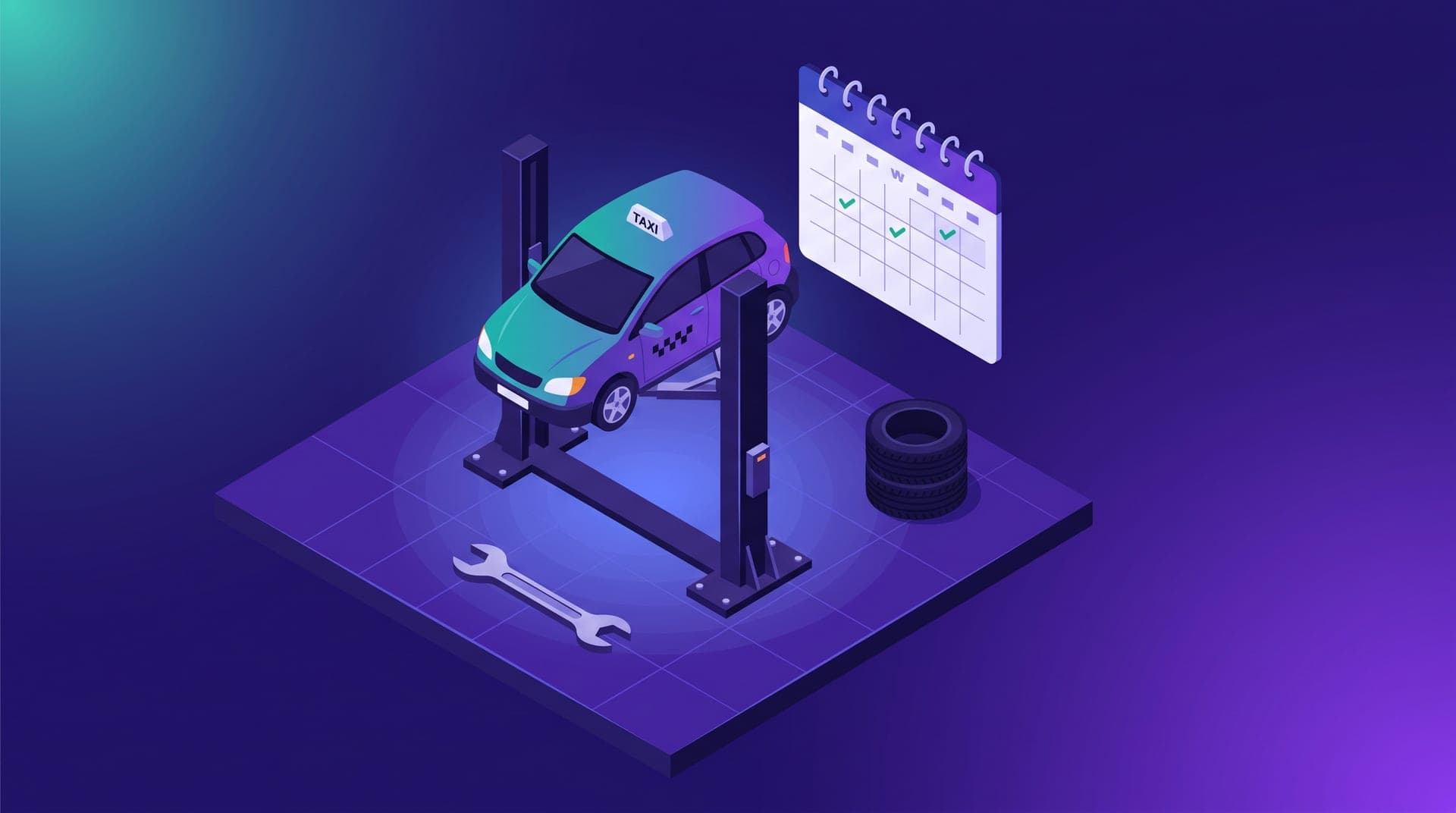
In an app-based taxi fleet, the vehicle that costs the most isn't the most expensive one to buy: it's the one that breaks down on a Friday night. That car stops earning exactly during peak demand, leaves a passenger waiting for a tow truck, forces the driver to lose days of income while finding the spare part and, very often, ends up with a repair more expensive than the one a timely brake-pad change would have avoided. And almost always, when you look at what happened, the failure had been announced weeks earlier.
The thesis of this article is that preventive maintenance isn't the driver's expense alone, nor a subject the fleet can ignore: it's part of operations, just like shifts or fares. Regional fleets that organise it with a simple schedule lose fewer service hours, receive fewer complaints and retain their drivers better. We'll look at why corrective repair costs more, what to check and how often, how to organise it depending on who owns the vehicle, how to schedule workshop visits without leaving gaps in operations and which records are worth keeping.
Why corrective repair always costs more
When a vehicle breaks down in service, the cost isn't just the repair. You have to add the hours the car stops working, the trip that was interrupted, the review left by the passenger stranded halfway and, in many cases, the tow truck. On top of that, a failure that isn't dealt with in time usually drags other parts down with it: worn brake pads end up scoring the discs, a belt that wasn't replaced damages the water pump, overdue oil speeds up engine wear.
Preventive maintenance reverses that logic. It's done at a chosen moment, usually during low-demand hours, with the spare part already in hand and no passenger waiting. It costs less, it's planned and it doesn't appear as a surprise at the worst time of day. For the driver, who lives off the hours their vehicle spends on the street, that predictability is worth as much as the money saved.
What to check and how often
A taxi covers in one month what a private car covers in several, so maintenance intervals arrive much sooner than the driver is used to. The most practical approach is to measure by kilometres, not by months, and always rely on the manufacturer's manual for each model. These are the checks almost every fleet ends up including in its schedule:
- Oil and filter change at the mileage the manufacturer specifies.
- Brake check: pads, discs and fluid.
- Tyre pressure, wear and rotation.
- Coolant, steering fluid and washer fluid levels.
- Lights, indicators and horn.
- Air conditioning, which in many cities is part of the service.
- Suspension and alignment, especially on streets with potholes.
Some of these checks the driver can do in two minutes at the start of the shift, such as tyre pressure, lights or fluid levels. Others need a workshop. Separating the two avoids both excess, sending the car to the workshop for something that can be checked at the kerb, and neglect, trusting the driver to spot a worn brake disc at a glance.
The signs the driver notices first
The driver spends eight or ten hours a day inside the vehicle, so they're almost always the first to notice that something isn't right: a new noise when braking, a vibration in the steering wheel at a certain speed, a warning light on the dashboard, air conditioning that no longer cools the same. The problem is that often they don't report it, because they fear losing days of work or because nobody has told them whom to tell.
It's worth setting up a simple channel for these alerts, such as a message to dispatch with a photo or a short voice note, and always replying with a decision: keep working and check it at the next appointment, or go to the workshop today. A driver who sees their alert handled without penalty will report again next time, and that is the best early warning a fleet can have.
Who takes care of it depending on who owns the car
How you organise maintenance depends on the fleet model. When the vehicles belong to the company, the fleet sets the schedule, chooses the workshop and pays for the parts; the driver only has to bring the car in when it's due and report any strange noise. It's the easiest model to control, but also the one that puts the most administrative load on the operator.
When the vehicle belongs to the affiliated driver, maintenance is their responsibility and their expense, but the fleet still has an interest in it being done: a broken-down car is one fewer driver on the street and a risk to the passenger. In this model the fleet doesn't impose the workshop, but it can set minimum standards, send reminders before services fall due, negotiate discounts with local workshops for all its affiliates and ask for proof of the important checks, such as brakes and tyres.
In mixed models, where one owner has several cars worked by different drivers, it's worth putting in writing who reports faults, who takes the car to the workshop and who pays for what. Most conflicts between owners and drivers aren't about the cost of a repair but about not having agreed in advance whose job it was.
We had two or three cars off the road every week for things you could see coming: brakes, tyres, a belt. We started asking drivers for their mileage every Monday and reminding them when their service was due. We made a deal with a workshop to see them early, before the shift. Within a few months we almost never had cars off the road on a Friday again.
Scheduling workshop visits without leaving operational gaps
The worst time to send a car to the workshop is one chosen without looking at demand. If three drivers happen to have their service on a Friday afternoon, the fleet loses capacity exactly when it needs it most. Ideally, services are spread across the week and concentrated in off-peak hours: mid-morning on weekdays, or early before the shift begins.
An agreement with one or two trusted workshops helps a lot. If the workshop knows it will receive several cars a month, it will usually accept early appointments, keep spare parts for the most common models in the fleet on hand and offer a preferential price. In exchange, the fleet guarantees volume and gives advance notice. For the driver, knowing the service takes two hours rather than a whole day changes their willingness to do it.
It's also worth planning what happens when a car is held up longer than expected. Some fleets with their own vehicles keep a spare car; others rearrange shifts so the affected driver shares a vehicle with a colleague in the meantime. What matters is that the decision isn't improvised on the day it happens.
What to record so you don't depend on memory
You don't need a complicated system to keep track of maintenance. A spreadsheet with one row per vehicle is enough for most regional fleets, as long as it's kept up to date. The data that helps most is limited:
- Vehicle plate, model and year.
- Mileage at the last weekly reading.
- Date and mileage of the last service.
- Mileage of the next service.
- Unscheduled repairs and their cause.
The last column is the most valuable in the medium term. If a particular model always has suspension problems, or if one driver racks up more repairs than the rest with the same car, the record shows it. With that data the fleet can make better decisions about which models to accept in future, which drivers need a conversation about their driving and which workshops give the best results.
A car stopped on time doesn't stop at the wrong time
Preventive maintenance doesn't require special technology or a big budget. It requires a schedule by mileage, one weekly figure per vehicle, a clear agreement on who takes care of what and one or two workshops that work during low-demand hours. With that, most of the breakdowns that appear as surprises today become scheduled appointments.
If your fleet keeps no records today, start this week with the simplest step: ask for every car's mileage on Monday, write it down next to the date of the last oil change and warn whoever is close to their next service. In a month you'll know which vehicles worry you and you'll have fewer surprises on your busiest nights.