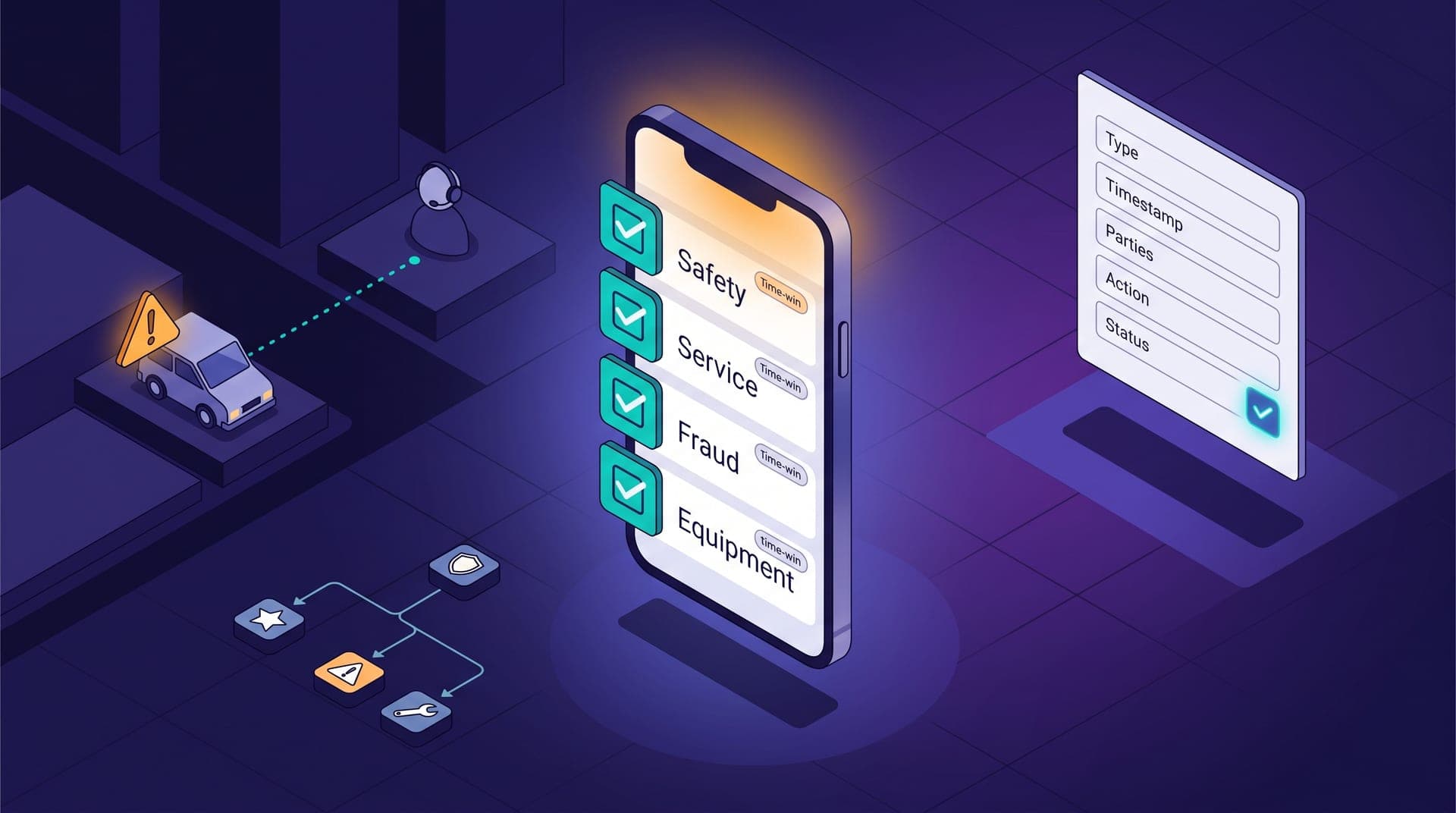
A phone left on the back seat is not a lost-and-found problem: it is the most direct test of whether your platform can be trusted. The passenger who loses it does not remember the fare or the car model; they remember whether someone answered in the first few minutes, whether the driver returned the phone intact, and whether they had to beg to get it back. In a regional operation, where reputation travels by word of mouth faster than any campaign, that memory weighs more than ten flawless trips.
This article is for app-based taxi operators and regional fleets that already run hundreds of trips a week and still handle forgotten items case by case, over WhatsApp and from memory. We will build a simple protocol: what to do in the first two hours, how to involve the driver without dumping the responsibility on them, where to keep what nobody claims, and what that log tells you about the health of your operation.
Why a forgotten item is a trust moment, not a nuisance
In an operation running 1,000 to 3,000 trips a week it is normal to receive between 5 and 15 forgotten-item reports a week. Phones, keys, glasses, school backpacks, grocery bags, folders full of documents. Most operators treat them as interruptions: the coordinator hunts down the driver, the driver says they will check after their shift, and the passenger waits without knowing anything. Every one of those waits is small proof that your service looks more like an anonymous taxi than like a brand with a name and a phone number.
The difference from a street taxi is that you actually know who drove whom, at what time and in which vehicle. That traceability is your competitive edge, but only if you turn it into a fast response. A passenger who gets their phone back in under three hours often becomes one of the most loyal users in your base, because they lived the difference between ordering a car through your app and hopping into any car.
The first two hours: the five-step recovery protocol
The odds of recovering an item drop quickly with every subsequent trip: another passenger may take it, the driver may not spot it until night, or it may end up on the floor under a mat. That is why the protocol is measured in hours, not days.
- Confirm the trip: ask the passenger for the approximate time, origin and destination, and find it in your trip history to know which driver and which vehicle were involved.
- Contact the driver within 15 minutes with a concrete description of the item, not a vague "did you see anything?".
- Ask the driver to check at their next safe stop, not while moving, and to reply with a photo of the item.
- Agree on the handover point: the driver's next trip toward that area, a fixed operation point, or a delivery paid by the passenger.
- Close the case in writing with the passenger: what was found, where it was handed over and at what time.
The step most often skipped is the last one. Without a written close, any later dispute — "there was money missing from the wallet", "the screen wasn't cracked" — turns into one word against another. With a photo and a record, the conversation is settled in a minute.
The driver's role: an incentive, not a moral obligation
Most drivers return what they find. The problem is not honesty, it is cost: a 20-minute detour to return a set of keys is time without trips. If the only reward is a "thank you", the driver learns to check the back seat less carefully. A clear scheme removes that friction: a return fee paid by the passenger, usually equal to a short trip in the city, handed over in full to the driver.
Communicate that fee from the first contact with the passenger, not at the end. Hardly anyone complains about paying the equivalent of a trip to recover a phone worth a hundred times more; what annoys people is learning about the charge when they thought the matter was closed. And in driver onboarding, include a quick back-seat check at the end of every trip as a habit, just like checking mirrors before pulling away.
Custody and handover: where the item is kept and who signs
When the passenger cannot receive the item the same day, the driver should not carry it around in their car for a week. Define a custody point: the operation's office, the coordinator's home, or a partner shop with long opening hours. The item is dropped off there with a photo and logged in a simple sheet.
The sheet needs five columns, no more:
- Trip date and time, and the date the item was reported.
- Driver and vehicle that found it.
- Description and photo of the item on receipt.
- Custody location and person responsible.
- Handover date, who received it and how they were identified.
Choose the custody point with the passenger in mind, not the operation's convenience. A central location, with opening hours that include weekends and someone who answers the phone, cuts down on round trips and keeps the item from passing through three pairs of hands before reaching its owner. If you operate across several parts of the city, two custody points are usually enough; more than three complicate the log and multiply the places where something can go missing.
Set a holding period — 30 to 60 days is reasonable — and write it into your terms of service. After that period, unclaimed items are donated or discarded depending on their type, and the sheet keeps the record. Without a written period, you end up with a box of umbrellas and chargers nobody dares throw away.
High-risk items: documents, cash, medication and phones
Not all items weigh the same. A grocery bag can wait until the next day; a passport, a prescription or a wallet with cash cannot. For these cases the protocol speeds up: the coordinator asks the driver to pause the next trip if needed, and the handover is scheduled for that same day.
With cash and wallets, the rule is to open and count nothing. The driver photographs the closed item and hands it over as is. Any counting is done by the passenger in front of whoever delivers it. That rule protects the driver as much as the passenger: most accusations of missing money come from items that were opened "to see whose it was".
What the item log tells you about your operation
After three months, the forgotten-item sheet stops being paperwork and becomes an indicator. If the recovery rate is below 70%, the problem is almost always the speed of the first contact with the driver. If the same driver keeps showing up returning items, you have someone who checks their car carefully and deserves recognition. If one driver never "finds" anything while their peers do, a conversation is worth having.
It also reveals demand patterns: Friday nights and event exits concentrate forgotten items, just as they concentrate trips by tired or rushed passengers. Knowing this lets you remind drivers about the back-seat check right on those shifts.
Review the sheet once a month alongside the rest of your indicators. Three numbers are enough: how many items were reported, how many were recovered, and how long it took on average between the report and the handover. When the average time drops from a day to a few hours, you notice it elsewhere too: fewer public complaints, fewer angry social media messages, and more passengers mentioning the return when they recommend your service to others.
We used to lose passengers over every phone that never showed up, even when it was nobody's fault. Now the coordinator reaches the driver in ten minutes, the passenger pays a flat return fee and the driver keeps all of it. In a year we recovered almost nine out of ten items, and several of those passengers are now among our most frequent riders.
How to turn a return into a loyal passenger
The forgotten-item protocol is not a customer-service chore: it is a way to prove, at the passenger's worst moment, that there is an operation behind your app that answers. Five steps, a clear fee for the driver, a custody point and a five-column sheet are enough to go from improvising each case to resolving them all to the same standard.
Start this week with the simplest part: decide who answers the reports and how quickly, and tell your drivers about the return fee. Everything else — the custody point, the holding period, the analysis of the sheet — is built on top of that first fast response.