The term 'offline-first' comes up in almost every ride-hailing platform evaluation in LATAM, and it almost always means different things to the operator and to the technical team proposing the solution. For the operator, it means the app cannot stop working when a driver enters a building with poor signal or when the 3G network collapses during a large event. For an engineering team, it can mean anything from a three-second automatic retry to a full local-state sync architecture that adds months of development and an ongoing maintenance burden. The gap between those two interpretations is the origin of most offline-first projects that end up costing more than they solve: the operator asked for resilience at the critical moments of the trip, and the technical team built synchronization infrastructure for the entire application. The result is complexity nobody maintains well and critical moments that still fail in different ways.
This article is for operators evaluating platform technology in markets with variable connectivity — mid-size cities in Mexico, Guatemala, Colombia, Honduras — where signal coverage is not uniform and where drivers operate in zones with inconsistent coverage during parts of their shift. The central argument is that offline-first in ride-hailing does not require the entire application to work without internet: it requires the three moments in the flow where losing connectivity breaks the trip to be resilient, and the rest of the system to fail gracefully without stopping the operation. Knowing which three moments those are — and how to evaluate them in a platform you are considering — turns the generic requirement of 'offline-first' into a specific technical criterion you can verify before signing.
What variable connectivity breaks in practice — and what it doesn't
Not all points in the ride-hailing flow are equally sensitive to signal loss. The basic flow has four phases: the passenger requests a trip, the driver accepts it, the trip is completed with real-time tracking, and the system closes the trip and processes payment. Connectivity matters differently at each phase and for each actor. For the driver, the highest-risk moments are receiving and confirming the trip request, and closing the trip with a complete distance record. For the passenger, the critical moment is tracking the driver's location during the wait. Other parts of the system — trip history, marketing notifications, earnings statistics, profile settings — have no real offline requirement because their failure does not interrupt any trip in progress.
The most common error in offline-first projects for ride-hailing is treating all parts of the system with the same level of technical priority. A platform that caches the complete trip history locally so it is accessible without internet solves a problem that virtually no driver reports as critical, while if that same engineering budget had gone into trip-acceptance resilience it would have directly reduced the percentage of requests lost to disconnection at the dispatch moment. Priorities matter because development budgets are finite, and full offline-first has a high ongoing maintenance cost — in managing local-state conflicts, in cross-version compatibility, and in testing — that is paid not once but on every platform release.
The first critical moment: trip acceptance when the driver loses signal
Trip acceptance is the highest-connectivity-risk point in the entire operation. Dispatch — assigning a passenger request to an available driver — happens on the server. The notification reaches the driver's phone via push or polling. The driver sees the request and taps 'accept.' That tap generates a request to the server confirming the assignment. If at any of those steps there is a connectivity loss, the request can enter an inconsistent state: the driver believes they accepted, the server never received the confirmation, and the passenger is still waiting for an assignment. That inconsistent state generates the hardest type of support to resolve — the driver insisting they accepted the trip, the passenger who was assigned two drivers at the same time, or the trip that appears in the driver's history but not the passenger's.
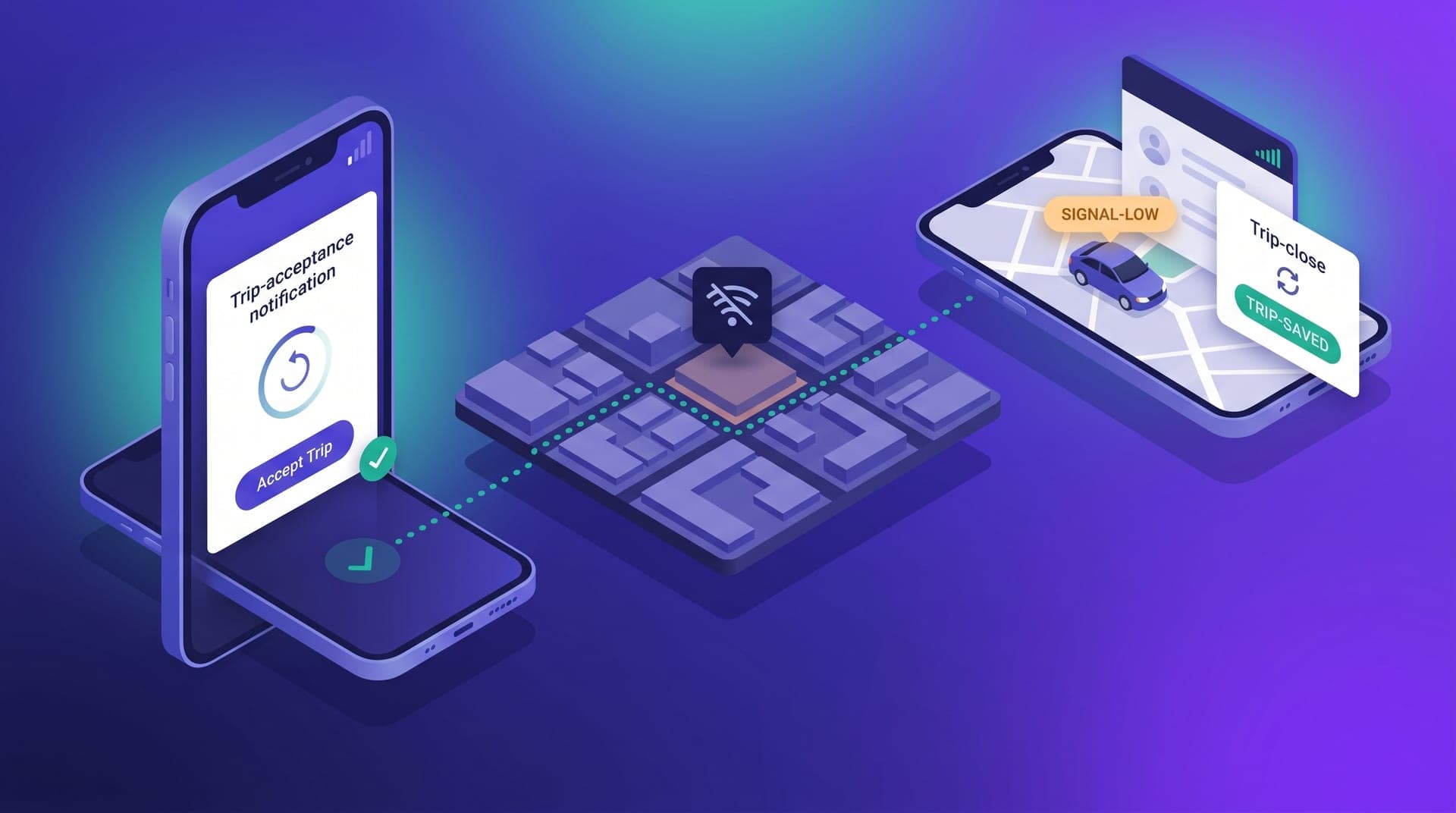
The robust solution at this point does not require complex offline architecture: it requires a short retry cycle with a 2-4 second window between attempts, explicit visual confirmation to the driver that the server received their response, and a server-side timeout that reassigns the request if no confirmation arrives within 10-15 seconds. Many platforms implement the dispatch notification but do not implement the full confirmation-with-retry cycle — which produces exactly the ghost-request problem. The practical test for evaluating this point in any platform is direct: put the driver's phone in airplane mode just after receiving a request, re-enable connectivity three seconds later, and observe whether the system confirms acceptance or leaves the trip in an indeterminate state. Platforms that handle it well confirm state as soon as signal returns. Those that don't create an unassigned trip on the server even though the driver saw the confirmation screen.
The second critical moment: driver location during the trip
Location tracking during the trip is critical for the passenger: it is what lets them see in real time whether the driver is approaching the pickup point and estimate how much time they have to step outside. Real-time location transmission requires continuous connectivity that cannot be guaranteed in all environments — particularly in low-coverage urban zones, inside buildings, or in industrial areas with signal interference. The solution is not to guarantee constant transmission but to handle absence periods well: if the driver has not transmitted position for 20-30 seconds, the passenger map must show the last known position with a visual intermittent-signal indicator, not a pin that disappears and generates total uncertainty about whether the driver cancelled, had an accident, or the app simply stopped working.
The local position buffer — where the driver app stores coordinates every 3-5 seconds and transmits them to the server when connectivity is restored — is the most widely used pattern for handling location interruptions. With a buffer of 20-30 locally stored position points, the driver can maintain trip-track coherence even after a 60-90 second interruption in a low-coverage zone. This pattern also has a direct operational benefit: it produces a more complete record of kilometers traveled, which affects the final fare calculation in distance-priced platforms. A driver who crosses a low-signal zone without a local buffer can lose up to 2-3 km of recorded route per trip — a difference the operator must resolve manually through fare adjustments, or that the driver absorbs as a direct income loss on every long trip.
The third critical moment: closing the trip when there is no internet
Trip close is the moment of highest financial consequence in the flow. The driver arrives at the destination, the system must record the arrival point, calculate the final fare based on distance and time, and process payment. If connectivity fails at exactly this moment — a frequent situation when the driver arrives at a destination inside a building or in a marginal coverage zone — the trip can remain in 'in progress' status on the server while the driver and passenger have already finished physically. The passenger tries to open the app to see the fare and cannot because the trip technically hasn't ended. The driver tries to close it from their phone and the system is unresponsive. Both generate a support contact the operator must resolve manually, with the complexity of reconstructing the actual route from available logs.
The solution at this point has two components that must be implemented together. The first is allowing the driver to close the trip locally when there is no active connection — storing the arrival timestamp and GPS position on the device — and having the server sync happen automatically when signal returns, typically in under a minute. The second component is showing the passenger an explicit 'processing trip close' message with a progress indicator, rather than leaving the app frozen without feedback. Platforms that implement only the first component without the second still generate unnecessary support contacts because the passenger doesn't know the system is waiting to sync and assumes something went wrong. Those that implement both reduce support load at this point to marginal cases.
Why building too much offline adds debt without solving the real problem
There is a category of features that technical teams frequently include in the offline-first scope without the operator having asked for them: the driver's full trip history, weekly earnings statistics, the catalog of active zones, the status of current incentives. None of these points affect a trip in progress. If the driver cannot see their history for 90 seconds because they are in a low-signal zone, no trip is lost. Caching those features locally has a real cost: the app size on device grows, the sync logic becomes more complex, and every time there is a change in server data structure — a new fare, an additional field in the trip model — you must manage the migration of the local state on every active driver's device that hasn't updated their version.
The real cost of an excessive offline-first scope is not in the initial build — it is in maintenance. Every platform release that introduces a new field in the data model must account for compatibility with locally cached states on devices that haven't updated the app. That problem — known as local-state version conflict — is responsible for a category of hard-to-reproduce bugs that surface when a driver has an old version, has been offline for hours, and reconnects with a local state that doesn't match the current server state. The technical solution exists, but it adds testing and support complexity that generates no operational return if the feature that created it was a statistics screen the driver uses once a week when off shift. That is the cost of building offline-first without first defining which parts of the flow actually need that resilience.
How to evaluate connectivity resilience when choosing a platform
When comparing ride-hailing platforms for an operation in markets with variable connectivity, productive questions are not 'does the app work offline?' but specific questions about the three critical moments. The answer to 'is it offline-first?' is always yes — any vendor capable of selling in LATAM has that checkbox marked in their sales presentation. The answer to 'what exactly happens to the trip if the driver loses signal during acceptance?' distinguishes between a platform with real resilience at the points that matter and one with a generic offline-first architecture that handles the easy cases but leaves the critical ones with the same problem.
The specific questions for evaluating a platform's connectivity resilience are:
- What happens to the trip if the driver loses signal during the 10 seconds after receiving the request? The answer must include an explicit retry mechanism and a server-side timeout that reassigns if no confirmation arrives — not just 'it retries automatically'
- Can the driver close the trip locally when offline, with automatic server sync when signal returns? Ask for a live demonstration on a test device, not just documentation of the feature
- What does the passenger map show when the driver doesn't transmit location for 30 seconds due to low signal? A robust system shows the last known position with a visual indicator — it does not make the pin disappear or freeze the map without feedback
- Does the driver app use a local GPS position buffer during the trip, and are those positions recovered and synced if there is a 60-90 second interruption? This directly affects distance-based fare calculation in variable-coverage zones
- Can the operations system automatically identify and resolve trips in an inconsistent state — accepted on the driver device but unconfirmed on the server — without the operator having to intervene manually in each case?
When we launched in our city, the network drops every Friday afternoon because data demand in the neighborhoods where we operate is very high at that hour. We were losing three to five trips per hour where the driver had accepted but the system never recorded it — the driver insisting they had taken it, the passenger saying no one ever arrived. We fixed it with a three-attempt retry on the acceptance confirmation and a clear 'confirming trip' message that gives the driver certainty the system received their response. Trips with inconsistent state dropped from five per shift to under one per week. The change wasn't making the app offline — it was making that specific point in the flow more resilient.
Connectivity resilience in ride-hailing is a concrete problem with concrete solutions. Platforms that solve it well don't build a universal offline system — they identify the three moments in the flow where a connectivity loss produces a lost trip, an incomplete route, or a failed close, and they build the retry, buffer, and deferred-confirmation layers at exactly those points. Everything else can fail gracefully without any active trip being lost. That distinction — selective resilience at the critical points, not offline-first for everything — is what converts a technical promise into an operation that works when the driver goes underground to pick up a passenger in a neighborhood with inconsistent signal.
For the operator evaluating a platform, or already operating and seeing specific connectivity failures, the practical takeaway is that the right criterion is not whether the app 'works without internet' but how it behaves at those three specific points where signal determines whether the trip happens or not. Operators who ask those questions before contracting have an operation with a lower percentage of trips lost to technical issues from day one. Those who assume offline-first is a generic checkbox discover the problem when a driver calls at eleven at night to report they accepted a trip the system never confirmed — and that trip appears in nobody's history: not the driver's, not the passenger's, not the operator's.