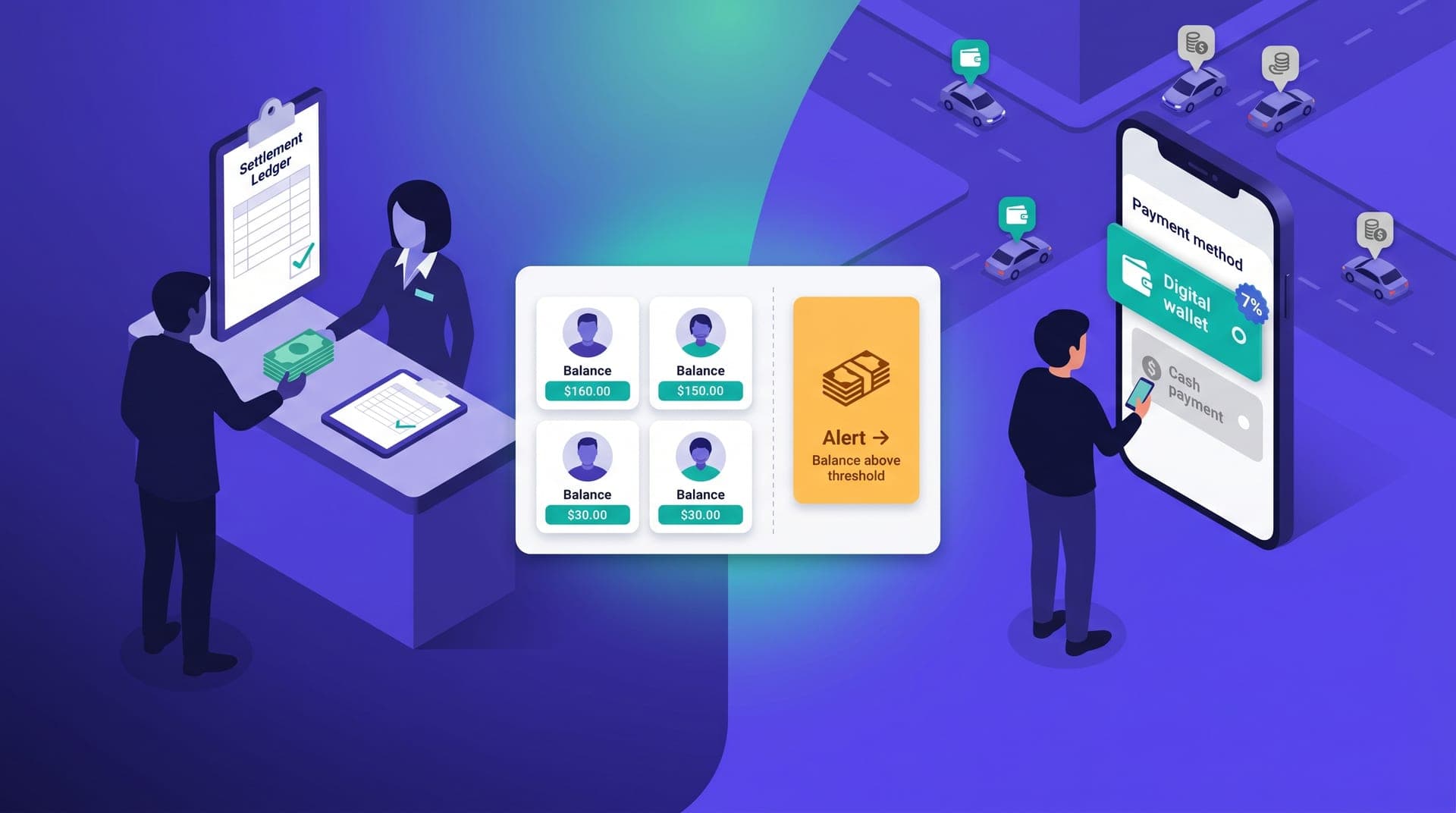
In most mid-size cities in Mexico, Colombia, Peru, and the rest of Latin America, between 70 and 85 percent of taxi or ride-hailing trips are still paid in cash. This is not a temporary anomaly that will fade as digital payment adoption grows — it is the market condition in the short and medium term, and will remain dominant in many secondary markets for the next three to five years. The regional operator who builds their operation expecting that proportion to change soon is working from a faulty assumption. The problem is not that passengers use cash: the problem is when the operation lacks the processes to manage that cash in a way that avoids hidden losses, driver conflicts, or a cash flow that nobody can audit with confidence.
This article is for operators with 40 to 150 active drivers who collect both cash and digital payments and don't yet have a formal process for reconciliation, balance control, and anomaly detection. The thesis is not that digital payments are better — it is that a mixed-payment operation without a formal cash management process produces losses the operator doesn't see because they're not measuring them. Building that process doesn't require additional technology or more staff: it requires three operational design decisions that most regional operators haven't made explicitly.
Cash in LATAM is not a transitional state — it is a market characteristic
Most ride-hailing platforms designed with a global focus assume cash is temporary: it fades as digital payment penetration increases. That assumption is reasonable in highly banked markets where credit cards are the default payment method. In Latin America, where the percentage of adults with a bank account ranges from 40 to 70 percent depending on the country, and where a significant share of account holders don't have an active debit or credit card for online payments, cash is not a transitional state — it is the market condition.
In regional operations with 80 to 130 active drivers, this means 55 to 110 of those drivers are handling cash on every shift. If the operator doesn't have a process defining how often that cash is settled, what maximum balance can remain outstanding, when an accumulation is an alert versus a normal variation, and how discrepancies are recorded, the money circulating in the fleet is not an operational asset — it is a latent liability the operator cannot control or quantify. The absence of process is not neutral: it produces losses by default.
The driver-platform settlement cycle: three options and their real implications
The first operational design decision in a fleet with mixed payments is the settlement cycle frequency: how often the driver hands over the cash accumulated from trips paid in that method. There are three options with distinct implications. Daily settlement eliminates accumulation and makes every discrepancy immediately visible, but carries a high operational cost: it requires the driver to present themselves for settlement or have an accessible payment point every day, which in geographically dispersed operations or with part-time drivers produces logistical friction and recurring excuses. In fleets of more than 60 drivers, mandatory daily settlement produces operational absenteeism — the driver who can't make it to settle prefers not to work that day.
Weekly settlement is the most common and reduces logistical friction, but allows a driver to accumulate between $150 and $400 USD before the cutoff, which increases the risk of temporary personal use of those funds. Settlement by balance threshold — when the driver's accumulated cash exceeds a defined amount, such as $80 to $120 USD — is the balance that works best for most mid-size operations: it reduces accumulation without requiring daily settlement and makes the maximum authorized outstanding balance predictable. The exact threshold depends on average fare and trip volume per driver: in markets with average fares of $3 to $6 USD and 20 to 30 daily trips, a $100 to $120 USD threshold implies settling roughly every 1 to 2 days of cash work — the cycle with the best balance between control and friction.
Where leakage appears — and the signals that reveal it
Cash the operator doesn't measure precisely produces leakage that doesn't appear in a casual review of platform revenue. The most common patterns in regional ride-hailing operations have specific signals the operator can detect without complex audits:
- Completed trips without digital record: the driver collects the trip in cash and doesn't register it on the platform — either by marking the trip as cancelled before completing it or arranging the fare directly with the passenger outside the app. The signal is a gap between the trip count per hour reported by the driver's GPS and the completed trips recorded on the platform in that same window
- Outstanding balance that doesn't decrease between settlements: a driver whose outstanding balance doesn't consistently drop between one cycle and the next is using the cash as a personal float. The signal is an end-of-cycle balance consistently similar to or higher than the start-of-cycle balance, even though the driver reported trips in that period
- Small recurring discrepancies: differences of $2 to $8 USD across multiple successive settlements are less visible than a large shortfall, but across 30 settlements produce losses of $60 to $240 USD that the operator doesn't detect because each individual difference falls within the margin attributable to rounding
- Tip retention on corporate account trips: in markets where institutional account passengers leave cash tips, drivers who retain that amount without reporting it don't generate a discrepancy in the trip record, but produce unaccounted revenue that should have fed the settlement
None of these patterns require explicit malicious intent to occur — most are the result of operational ambiguity. If the operator didn't clearly communicate that trips must be registered before collection, that corporate tips are included in settlement, or that the outstanding balance has a maximum with concrete consequences, the driver operates in a rule vacuum that produces leakage by default. Process design is the primary control: more effective and less confrontational than any subsequent audit.
Outstanding balances and operating credit: the design that maintains control without stalling the fleet
The second design decision is the outstanding balance limit: how much platform cash a driver can have in their possession at any given moment before the system flags it as an anomaly. Without this defined limit, accumulated balances have no alert signal — the operator doesn't know when a balance is normal and when it's a problem. The range that works in operations with threshold-based settlement is a limit of $80 to $120 USD per driver for a week of work with a normal cash-digital mix. Above that threshold, the coordinator receives an alert and makes direct contact with the driver to confirm settlement is in process. That contact doesn't need to be confrontational — the most effective approach is proactive: 'I saw you have X accumulated in cash from this week, when can you do the cutoff?' The driver who receives that message before the balance becomes a problem interprets it as normal management, not as an accusation.
The third decision is the blocking policy: what happens to driver availability when the outstanding balance exceeds the limit. Operations without this policy face the problem of drivers with high balances who keep accumulating cash without any incentive to settle. An effective policy establishes that when the balance exceeds the maximum threshold, the driver stops receiving new assignments until they complete settlement. That rule creates the right incentive without requiring direct confrontation: the driver who wants to keep working settles, and the operator doesn't have to chase the payment under pressure. The key for the policy to work without producing conflict is that it be documented in the driver contract from the start — not applied as an unexpected consequence once the balance is already a problem.
We ran weekly settlement with no balance limit. Six months in, we had four drivers with outstanding balances of 600 to 1,200 pesos sitting unpaid for weeks. When we implemented the 800-peso limit and assignment blocking, all four balances cleared in the first week. What looked like an honesty problem was actually a rules problem: nobody had explained what the maximum was or what would happen if they didn't settle. Once it was clear, behavior changed on its own.
The digital payment transition that works: nudges that don't pressure
The regional operator who wants to increase the percentage of digital payments in their fleet has two available approaches. The first is mandatory: eliminating cash as an option or strongly limiting trips available to cash-paying passengers. That approach works in highly banked markets where the passenger has the option of paying digitally — in the rest, it produces abandonment by the portion of the market that cannot or doesn't want to pay by card. In cities of 150,000 to 400,000 people in LATAM, that segment can be 40 to 60 percent of the potential passenger base. Forcing out cash in that context is not a product decision — it is a market-size decision.
The second approach is progressive incentive: making digital payment the convenient option without eliminating cash. Interventions that produce voluntary migration include a 5 to 10 percent discount for digital payment without changing the cash price, preferential driver assignment to digital-paying passengers during high-demand periods, and elimination of rounding on exact amounts when payment is digital. Those interventions make digital the obvious choice for the passenger who can use it, without closing the door to the passenger who has no alternative. The migration this approach produces is slower than forced elimination, but it retains the base — and every passenger who migrates voluntarily does so with a formed habit, not under pressure.
The four design errors that generate invisible cash losses
Cash management in a regional ride-hailing operation accumulates specific errors that reappear across different operations with predictable consequences:
- Not recording discrepancies because they seem minor: each unrecorded difference establishes a precedent of tolerance. A driver who knows a $5 USD variation won't be noted or discussed has an implicit threshold for future discrepancies. Over three months, that threshold becomes the operation's de facto norm
- Using platform cash as a business float before reconciliation: the operator who takes cash from the platform's till to cover operating expenses before completing driver reconciliation produces confusion in the records and loses the ability to audit discrepancies accurately. This is the most common error in operations that mix the platform's cash with the business's operating float
- Letting outstanding balances accumulate without a regular closing: operations that don't consistently close the settlement cycle accumulate balances that are difficult to reconcile after three or four weeks, and that produce conflicts with drivers about what amount is outstanding. The absence of frequent recording turns a $20 USD discrepancy into a disputed $200 USD three weeks later
- Not including cash rules in the driver onboarding contract: drivers who learned the policies verbally have more room to interpret ambiguity in their favor. The operator who incorporates the settlement cycle, the maximum balance threshold, and the blocking policy into the driver contract or welcome document has a clear reference point when a discrepancy arises — and reduces conflict because the rule has existed since day one
Cash will not disappear from regional ride-hailing operations in LATAM in the short term, and the operator who builds their process around that reality — rather than waiting for the market to change — has a more auditable operation, fewer driver conflicts, and a stronger foundation from which to encourage digital adoption without pressure. The process doesn't need to be sophisticated: it needs three clear elements — a settlement cycle with a balance threshold, an outstanding balance limit with automatic alert and blocking, and a discrepancy policy written and communicated from driver onboarding. With those three elements, cash stops being a variable the operator assumes and becomes one they can measure.
The migration to digital payment that happens durably in regional markets is not the result of eliminating cash — it is the result of making digital convenient for the passenger who can choose it, while cash remains reliable for the one who has no alternative. The operator who builds that bridge doesn't just reduce the cash percentage in their operation over time: they reduce the cost of administering it, reduce friction with drivers, and paradoxically gain more operational confidence in cash while it lasts — because for the first time they are measuring it rather than assuming it.