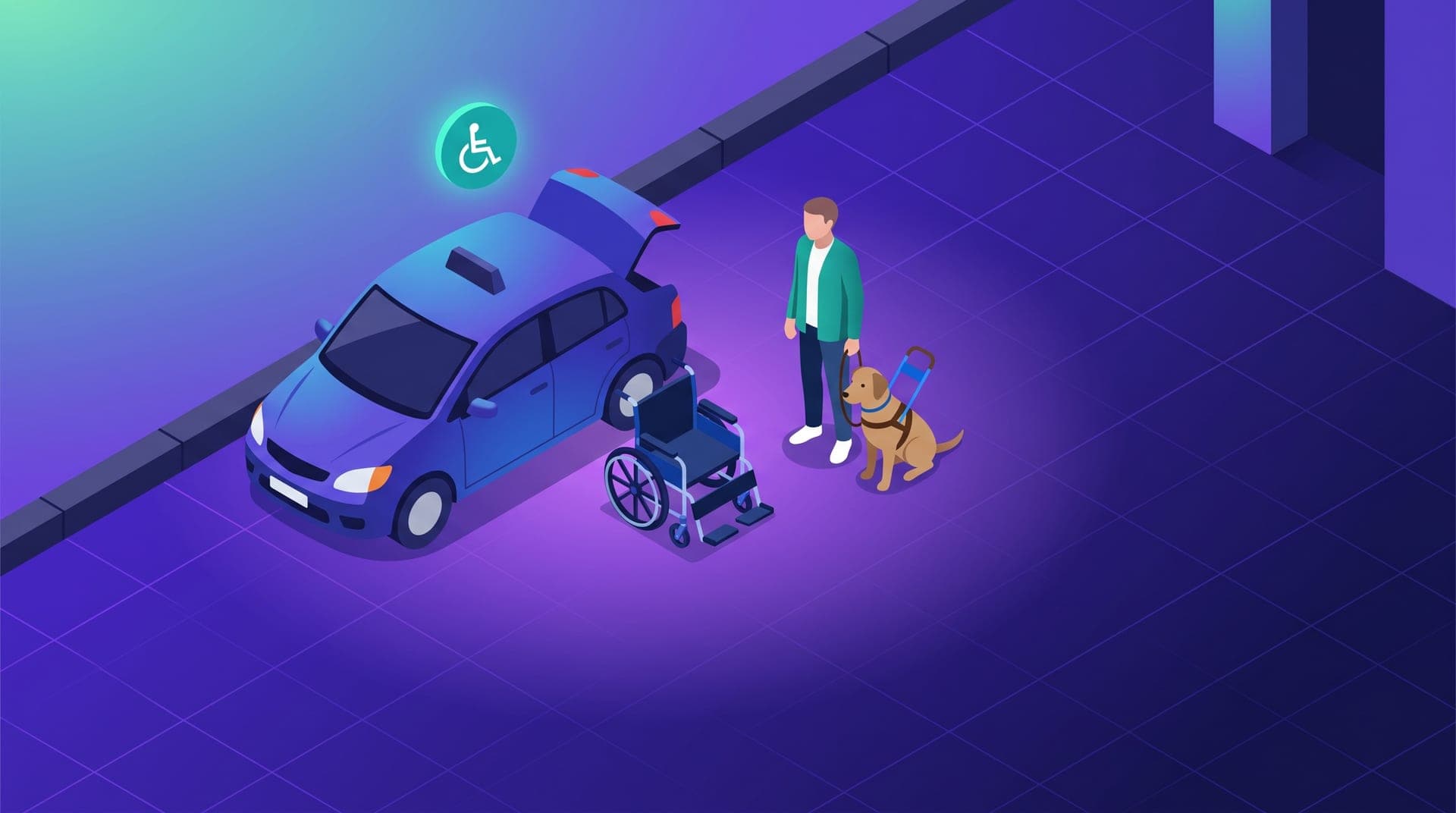
For a person in a wheelchair, with low vision or with difficulty walking, a taxi isn't a convenience: it's often the only way to get to the doctor, to work or to see their family. In regional cities, where public transport is rarely adapted, that trip depends almost entirely on a driver being willing and prepared to serve them. And when they aren't, the person doesn't just lose a trip: they learn that the service isn't for them.
The thesis of this article is that accessibility in a taxi fleet depends far less on technology or special vehicles than on drivers' preparation and attitude. With clear rules, a short briefing and a simple way to ask for help, any regional fleet can serve passengers with disabilities well and win a group of loyal customers whom almost nobody serves with care today. We'll look at why it matters, what different passengers need, how to prepare drivers, how to organise the booking and which mistakes to avoid.
Why accessibility matters for a regional fleet
People with disabilities, together with their families, make up a much larger group of passengers than is usually thought, and they travel often: to therapy, appointments, work and school. They also tend to be very loyal customers. When they find a service they trust, they rarely switch, because they know how hard it is to find another. And they recommend it, to other families, to their association and to their doctor.
There's also a reputational reason and, in many places, a compliance one. Rules on how people with disabilities must be treated in transport vary from one country and city to another, but almost everywhere refusing a service because of a disability is frowned upon and, in many cases, prohibited. A fleet that gets it right doesn't just avoid problems: it earns an image of a serious service that other passengers notice too.
What each passenger needs
There is no single "passenger with a disability". Needs vary a lot from person to person, and the best rule is to ask before helping. Even so, there are situations that come up again and again and are worth keeping in mind:
- Users of folding wheelchairs, who need boot space and sometimes help stowing it.
- People with reduced mobility who take longer to get in and out and need the car to stop close to the door.
- Blind or low-vision people, who need the driver to identify themselves aloud on arrival.
- Deaf or hard-of-hearing people, who prefer to communicate by text message.
- Passengers travelling with an assistance dog, which must always be accepted.
- People with intellectual disabilities or on the autism spectrum, who may need calmer treatment and clear explanations.
Most of these needs are met with time and attitude, not special equipment. Waiting a couple of extra minutes, parking as close as possible, offering help without imposing it and communicating through the passenger's preferred channel solves almost every case.
The passenger often travels with a companion, and the driver should take that into account: they may need an extra seat, room for a bag of medicines or time to help the person settle in. Knowing it from the booking avoids surprises and makes it possible to assign a vehicle with enough room for both.
How to prepare drivers
The most common mistake doesn't come from bad intentions but from not knowing what to do. A driver who has never stowed a wheelchair may hesitate, rush or cancel for fear of doing it wrong. A short briefing of half an hour, with concrete examples, changes that reaction a lot. If your city has an association of people with disabilities, inviting it to give that briefing has double value: drivers learn from people with lived experience and the association gets to know your service.
There are some basic rules every driver should know: always ask "how can I help you?" before touching the person or their belongings; speak directly to the passenger and not to their companion; don't touch or distract an assistance dog; and say aloud what you're about to do, such as opening the boot or setting off. These are simple gestures that make the difference between a dignified trip and an uncomfortable one.
It also helps to know what vehicles the fleet has. A folding wheelchair fits in the boot of many saloons and almost all SUVs, but not in every compact car. If dispatch knows which drivers have roomier vehicles and are willing to take these trips, it can assign them without improvising.
Organising the booking so it works
Many problems can be avoided at the booking stage. If the passenger or their relative can indicate when booking that they travel with a wheelchair, an assistance dog or need help getting in, the driver arrives prepared and dispatch can assign the right vehicle. A comment on the trip or a message to dispatch is enough; what matters is that the information reaches the driver before they accept.
For frequent passengers, such as someone going to therapy three times a week, it's worth going further: keeping a note of their preferences, trying to assign the same drivers every time and confirming the trip the day before. For someone who depends on a taxi for their health, knowing the same trusted driver will arrive at the agreed time is worth as much as the trip itself.
Price deserves clarity too. The extra time a driver spends helping a passenger in or stowing a wheelchair is part of the service, and charging for it separately is usually experienced as a penalty for the disability. The simplest approach is for the fare to be the same as for any trip and for the fleet to say so openly: that way the passenger knows what to expect and the driver doesn't have to negotiate anything on the pavement.
A customer in a wheelchair told us he'd stopped using taxis because several drivers cancelled on seeing him. We made a list of five drivers with SUVs who agreed to take those trips and gave them a talk with a local association. Today he travels with us every week and has recommended us to other families in his group.
Partners who bring trips
People with disabilities tend to move within a network of institutions: rehabilitation centres, therapy clinics, special education schools, associations and family groups. Many of those institutions have long been looking for a reliable transport service to recommend to their users, and haven't found one. A visit to present your fleet, explain how to book and which drivers handle these cases can become a steady source of bookings.
These partnerships work best when there's a concrete commitment: a direct dispatch contact for the institution, the option of scheduling recurring trips in advance and a simple way to report if something went wrong. In return, the institution recommends the service to families who would otherwise never have tried it.
Mistakes to avoid
The worst mistake is cancelling on arrival. A driver who sees a wheelchair or an assistance dog and leaves without explanation leaves the passenger worse off than if they'd never accepted, and it's the kind of experience that's most remembered and retold. The fleet should have a clear rule: if a driver can't take a trip for a practical reason, such as the wheelchair not fitting in their car, they tell dispatch so it can be reassigned immediately; they never leave without saying anything.
Other common mistakes are charging extra for the wheelchair or the assistance dog, rushing the passenger, being condescending or talking about them with their companion as if they weren't there. None of them requires bad intentions to happen, which is why it's worth mentioning them explicitly in the driver briefing.
A service for everyone starts with the drivers
Accessibility doesn't require buying special vehicles or making large investments. It requires drivers who know what to do, a dispatch that knows whom to assign each trip to and a clear rule against cancelling on arrival. With that, a regional fleet can become the trusted option for people who have very few today.
If you want to start this week, there are three simple steps: put together the list of drivers with roomy vehicles and a good attitude, write the basic rules of conduct on one page and contact your city's association of people with disabilities to offer them your service. You'll probably find demand that nobody was serving.