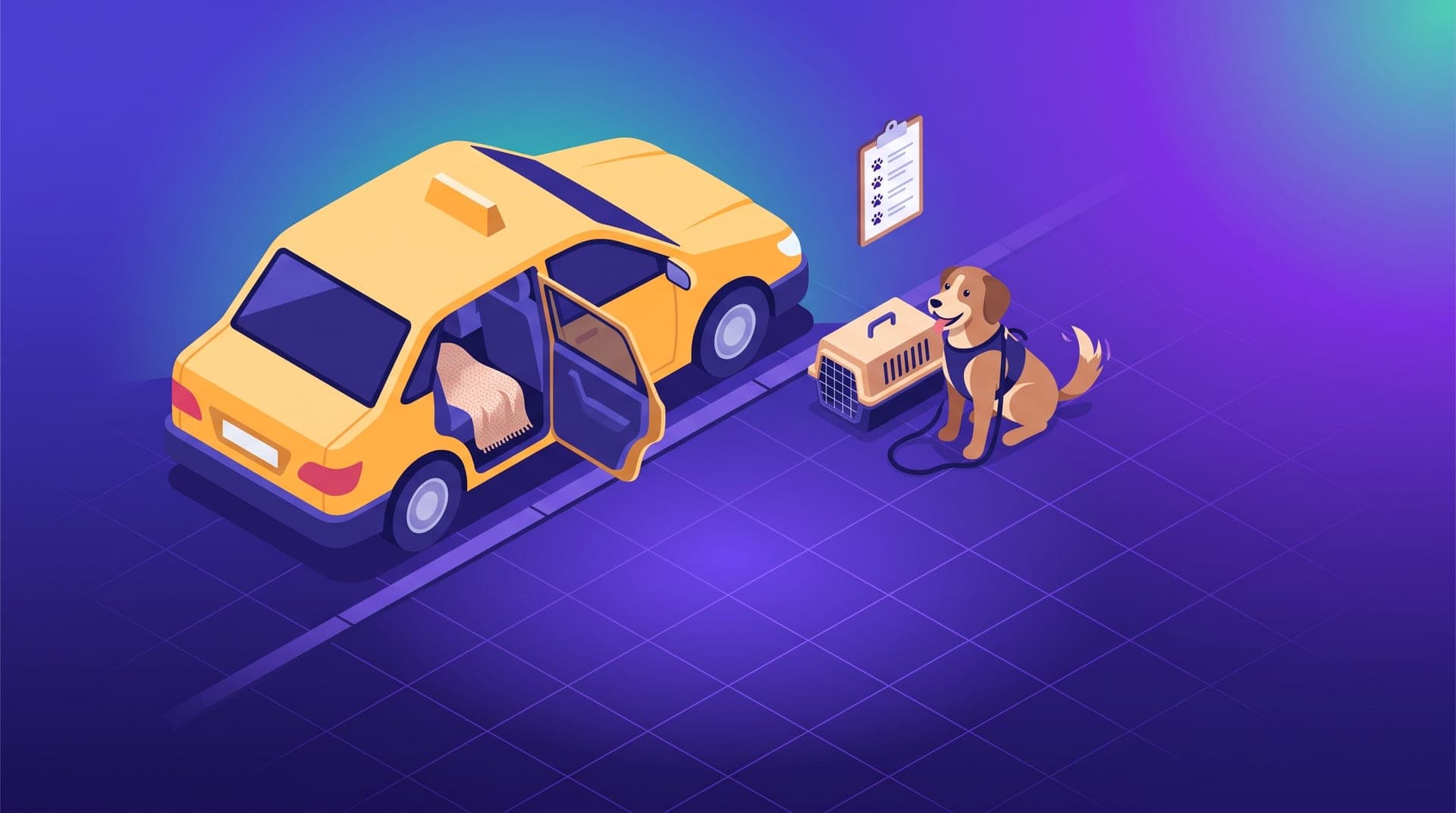
Sooner or later, the same thing happens in every app-based taxi fleet: a passenger books a trip, the driver arrives and waiting on the pavement is someone with a dog, a carrier with a cat or a box with a newly adopted puppy. The driver hesitates, the passenger gets annoyed, someone calls dispatch and nobody really knows what the rule is. What follows is usually a cancellation, a bad review or a driver who reluctantly accepts and later complains about hair on the seat.
The thesis of this article is that the problem isn't pets but the lack of a written policy. More and more families travel with their animals to the vet, the groomer or on visits, and in many regional cities there are almost no transport alternatives for them. A fleet that defines clear rules, communicates them before the trip and respects the driver's decision turns a point of friction into a service the competition doesn't offer. We'll look at what that policy should say, how to charge, how to look after the driver and how to communicate it.
Why you need a written rule
Without a policy, each driver decides according to their mood that day, and the passenger gets a different service every time. One accepts the dog without any problem, another cancels on seeing it and a third accepts but charges an extra nobody authorised. For the passenger, the conclusion is that the service isn't reliable. For the fleet, the result is complaints that are hard to resolve, because there's no rule to compare what happened against.
There's also the question of respect for the driver. The vehicle is usually theirs or is their working tool, and a scratched seat or one that smells affects the rest of the shift's trips. A clear policy doesn't force the driver into anything that isn't theirs to bear: it gives them rules to accept calmly and backing when something goes wrong.
What the policy should say
A good pet policy fits on half a page. It doesn't need to cover every possible case, only the ones that come up repeatedly. These are the points most fleets end up including:
- Which animals are accepted and what size, generally household pets.
- That small animals travel in a closed carrier.
- That large dogs travel on a lead and, if possible, on a blanket or seat cover.
- That the passenger mentions the pet when booking, not when the driver arrives.
- What extra charge applies, if any, and when.
- What happens if the animal soils or damages the vehicle.
- The exception for assistance dogs, which are always accepted.
The point about advance notice is the most important. Most conflicts happen because the driver finds out about the pet on the pavement, after already driving there. If the passenger mentions it when booking, whether in a trip comment or in a message to dispatch, the driver can decide before accepting and nobody wastes time.
It's also worth setting a reasonable limit on animals per trip and clarifying what happens with less common species, such as birds or reptiles. There's no need to ban them: it's enough to say they're accepted if they travel in a closed carrier and the assigned driver agrees. Putting that case in writing saves dispatch from inventing an answer every time someone asks, and gives the passenger an immediate answer instead of a "let me check".
How to charge without scaring the customer away
Many fleets charge a small fixed fee for travelling with a pet, to cover the extra cleaning and the extra time getting the animal in and out. Others charge nothing for carriers and apply the fee only to large dogs loose on the seat. Either works, as long as the amount is published and is the same for everyone. What doesn't work is the driver deciding the extra on the spot, because the passenger experiences it as abuse even if the amount is reasonable.
It's best to separate the pet fee from the cleaning fee. The first is predictable and is charged on every trip with an animal. The second only applies if there was real damage or soiling, and it should be documented with photos taken at the end of the trip. That way the responsible passenger doesn't pay for the careless one, and the driver has something to back up their claim.
For long trips with a pet, such as a transfer to a veterinary clinic in another city, it's worth agreeing on stops and timings before leaving. A nervous animal sometimes needs a break for water or a moment outside, and if that's already built into the price and the trip plan, neither the driver nor the passenger feels pressured by the clock.
The driver decides too
A pet policy can't force a driver who is allergic, afraid of dogs or has a newly upholstered vehicle to accept any animal. The reasonable thing is for each driver to state whether they accept pets, and for dispatch to assign these trips to those who do. In most fleets there's always a group of willing drivers, sometimes because they have pets themselves and understand the customer.
That group deserves something in return. It might be the full pet fee going to them, priority on certain scheduled trips or simply public recognition within the fleet. The important thing is that accepting pets doesn't feel like a punishment. And it's worth equipping them with the basics: a cover or blanket for the back seat and something to clean up at the end of the trip.
There's one exception that admits no choice: assistance dogs accompanying people with disabilities. In many countries their access to transport is protected by law, and although the rules vary from place to place, the safest practice is for the fleet to always accept them, without an extra charge, and for every driver to know this from the day they join.
At first each driver did whatever they wanted with pets and we had complaints every week. We wrote the rule on one page, asked who accepted animals and sent those trips to them. Now there are customers who choose us just because they know they can take their dog to the vet without an argument.
How to communicate the policy
A rule only dispatch knows is useless. The passenger has to find it before booking, and the driver has to be clear on it before their first shift. These are the places where it's worth publishing:
- In the FAQ of the fleet's app or website.
- In a saved dispatch message, ready to send on WhatsApp.
- In the onboarding material for new drivers.
- On social media, with a simple post and a friendly photo.
- In the reply to any review that mentions pets.
Tone matters. A policy written as a list of prohibitions conveys that the fleet doesn't want pets; the same policy written as "this is how we travel with your pet" conveys that pets are welcome, with rules. The rules are identical, but a customer with a dog reads the second version as an invitation.
A niche opportunity
In many regional cities, families with pets have no way to take them to the vet if they don't own a car. Large platforms usually leave the decision to each driver without a visible rule, and public transport rarely accepts animals. A local fleet that advertises itself as the option for travelling with pets can win very loyal customers, because once a family finds a service it trusts for its animal, it rarely switches.
Partnerships help too: vets, dog groomers and pet shops usually have customers who need transport and don't know whom to call. A simple agreement to recommend the fleet, with the pet policy up front, can generate recurring trips from a segment few are serving.
Clear rules, calm trips
Travelling with pets doesn't have to be a source of arguments on the pavement. With a half-page policy, advance notice from the passenger, a published fee and a group of willing drivers, most conflicts disappear before they happen.
If your fleet doesn't have a written rule today, the first step is simple: ask your drivers who accepts pets and under what conditions, write down what you agree and publish it where your passengers will see it. It's one of the cheapest improvements you can make, and it can bring you customers who currently have nobody to call.