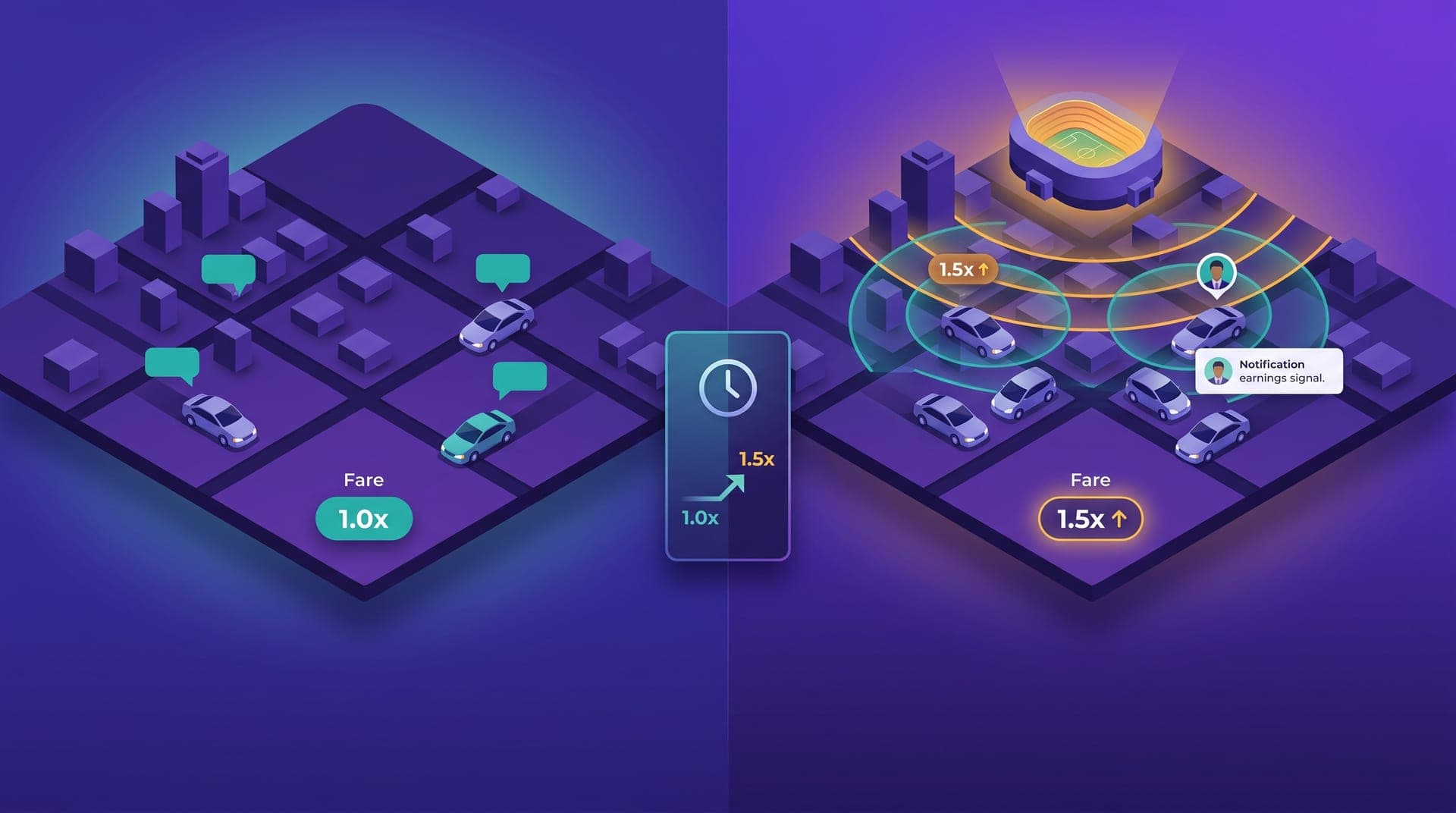
Surge pricing — charging passengers more and paying drivers more during demand peaks — is the most effective balancing tool a ride-hailing platform has, and also the most avoided by regional operators. The usual reason is fear of passenger abandonment: a multiplier that raises the fare right when the service is most needed seems counterproductive. That reasoning confuses the symptom with the problem. Without surge pricing, the demand peak doesn't disappear — it is simply absorbed as wait times of 12 to 20 minutes, elevated cancellation rates, and drivers disconnecting because request volume exceeds their capacity. A passenger who waited 15 minutes to get a trip has a worse experience than one who paid 30% more and waited 4.
This article is for the operator who has identifiable demand peaks — local events, rush hours, holidays, adverse weather — and has not yet implemented surge pricing because they don't know which multiplier to use, how to communicate it, or when to turn it off. It covers why surge pricing is a supply-demand balancing mechanism and not a driver bonus, which types of peaks justify activation in regional markets, which multiplier range is effective without producing passenger abandonment, how to communicate it to both passengers and drivers, when not to activate it, and how to use the agent to identify thresholds and evaluate results.
Why surge pricing is a balance mechanism, not a driver bonus
The most common confusion is treating the driver's extra income as the goal and the higher passenger fare as the cost of achieving it. The correct logic is the reverse: the goal of surge pricing is to increase the number of drivers available in a high-demand zone and reduce demand to the threshold that supply can handle without degrading wait times. The higher fare moves both actors in the direction that balances the system: the driver benefits from connecting because per-trip income is higher; the marginal passenger may prefer to wait or find another option, freeing capacity for those who accept the price. Without that simultaneous double adjustment, the platform has no real mechanism to respond to excess demand over supply in real time.
In regional operations, surge pricing has a more pronounced supply recruitment effect than on platforms with large fleets. When there are 60 registered drivers and 18 active on a normal Wednesday, a 1.5x multiplier in the northern corridor during a local match can activate between 5 and 9 drivers who were evaluating whether it was worth connecting. In a market with 400 drivers, that marginal activation is noise. In one with 60, it is the difference between wait times of 5 minutes or 14. Surge pricing in small markets doesn't just adjust demand — it activates latent supply that would otherwise not be available, making the mechanism qualitatively more valuable than on platforms with a chronic oversupply of drivers.
The three types of peak that justify activation in regional operations
Not every demand increase justifies surge pricing. Three types of peak produce sufficient imbalance for activation to have real impact. The first is the one-off event — a match, concert, local fair, graduation ceremony — that concentrates demand geographically and temporally in ways base supply cannot handle without abandonment-level wait times. The second is the sustained daily slot peak — the 7 to 9 a.m. window in cities where commuter demand arrives in a cluster and the driver supply has not yet reached its own peak — predictable week to week and suitable for automatic multiplier scheduling. The third is the weather peak — heavy rain, extreme heat — unpredictable by date but which, when it hits, raises demand by 40 to 80% in 20 minutes. All three share the same characteristic: base supply cannot respond without price support.
The five criteria that determine whether a peak justifies activating surge pricing:
- **Request-to-active-driver ratio above 2.5 for at least 15 minutes**: below that threshold, base supply can handle demand without significant wait time degradation.
- **Median wait time above 6 to 7 minutes in the affected zone**: that is the point where passengers begin to cancel, so activation must happen before abandonment, not after.
- **Predictable peak duration of at least 45 minutes**: shorter activations create communication friction without enough time for additional supply to respond and reach the zone.
- **Geographically bounded zone**: if the peak is diffuse across the whole city, surge pricing cannot be communicated clearly and additional supply doesn't know where to position.
- **Ability to notify drivers before or at the start of the peak**: a driver who doesn't know surge pricing is active has no signal to connect; communication is part of the mechanism, not a supplement.
The right multiplier: between 1.3x and 1.7x for secondary markets
The effective multiplier range in regional markets across Mexico and Central America is 1.3x to 1.7x. Above 1.8x, the passenger abandonment rate on the confirmation screen rises enough that the supply benefit doesn't compensate for the lost demand: the passenger sees the multiplier, decides not to travel, and the operator ends up with more drivers available but less real demand to use them. Below 1.25x, the inactive driver activation effect is minimal — the income differential is not enough to get a resting driver to connect for that extra. The optimal point in operations with fleets of 30 to 80 drivers appears to be between 1.4x and 1.6x: it produces marginal supply activation without reducing the volume of demand that accepts the price.
Multiplier progressiveness also matters. Activating directly at 1.6x produces more passenger abandonment than starting at 1.2x and stepping to 1.5x after 15 minutes if the peak persists. A passenger who sees 1.2x and accepts it is more likely to accept 1.5x on the next attempt, having already established an expectation of variable fares. A passenger presented with 1.6x as the first price is more likely to abandon with no prior reference. Progressiveness requires real-time adjustment capability, but even with two levels — one for moderate peaks and one for intense peaks — the effect on abandonment rate improves significantly compared to applying the maximum multiplier immediately from the start.
How to communicate surge pricing to the passenger without producing abandonment
Communicating surge pricing to passengers has three key moments: before the peak, on the confirmation screen, and after the trip. Advance communication — 'this weekend's events may generate dynamic fares in the northern zone' — is the most effective in reducing abandonment, because a passenger with that expectation doesn't interpret the multiplier as a surprise or as exploitation. On the confirmation screen, the surge fare should be shown as an estimated final amount, not as a multiplier: 'Your trip may cost between 65 and 75 MXN due to high demand in the area' produces less abandonment than 'Fare ×1.5'. The concrete amount anchors cost perception; the abstract multiplier activates the perception of unfairness. After the trip, a brief note explaining why the fare was higher turns the experience into education rather than a complaint.
How to communicate surge pricing to drivers to activate latent supply
For surge pricing to activate latent supply, drivers must know about it before the peak reaches its maximum. A driver who receives a notification saying 'dynamic fare active in northern zone until 10:30 pm, estimated income per trip 38-48 MXN' has a concrete signal to connect or head to that zone if already in session. A driver who discovers the multiplier when accepting a request was already available — surge pricing didn't activate their supply, it simply paid them more for a trip they would have taken anyway. Lead time varies by peak type: for scheduled events, 24 to 48 hours in advance; for recurring daily slots, the night before; for weather peaks, within the first 5 to 10 minutes of the event. A notification that arrives late doesn't activate additional supply — it only transfers income to drivers who were already connected.
The first time I tried surge pricing I went to 1.8x for the Saturday match and got three direct complaints on WhatsApp. But I reviewed the numbers: passenger cancellation rate dropped from 22% to 11%, wait times went from 14 minutes to 5, and my fleet's income that night was the highest of the month. The complaints came from the three passengers who saw the fare, rejected it, and then messaged me. The ones who accepted had the best trip of the week. I dropped to 1.5x for the next event, told drivers a day in advance, and had no complaints. Same availability outcome, less friction.
When not to activate it and why turning it off late causes more damage than turning it on late
Surge pricing should not be activated when the cause of high demand is an own-service failure — drivers inactive due to a platform error, uncovered zone from poorly managed redistribution, a predictable peak the operator didn't prepare supply for in advance. In those cases, surge pricing doesn't balance supply and demand: it charges the passenger more for an operator's failure, producing the worst type of perception. It also shouldn't be activated when passenger price elasticity in that zone or context is structurally low — emergency destinations, hospitals, late-night bus terminals — where dynamic fares have more reputational impact than operational benefit. The activation criterion must be actual excess demand over available supply, not simply high demand.
Turning off the multiplier late damages the operation differently. A passenger who requests a trip with surge active, waits through a reassignment, and accepts at normal price because the multiplier was deactivated during that interval perceives the experience as inconsistent. A driver who expected multiplier income because the notification said it would be active until 10:30 pm and it cuts off at 10:15 loses trust in the signal for the next activation. Deactivation must have a clear threshold — requests-to-active-drivers ratio below 1.5 for 10 continuous minutes — and execute progressively: stepping down from 1.5x to 1.2x and then to 1.0x in two 5-minute increments rather than cutting directly. That transition reduces the perception of arbitrary variability for both passengers and drivers.
How the agent identifies when to activate surge pricing and evaluates the results
The agent instruction to monitor and manage surge pricing: 'Every 15 minutes during identified peaks, check the ratio of received requests to active drivers by zone. If that ratio exceeds 2.0 in any zone and the median wait time of the last 10 requests in that zone exceeds 6 minutes, notify me with: affected zone, current requests-to-driver ratio, median wait time, and the multiplier I used in similar situations last month.' That notification with operational context allows the activation decision to be made with concrete data rather than intuition. For operators who want to delegate the initial decision: 'If that condition is met in a zone with a previously registered event, activate a 1.4x multiplier, send a standard notification to inactive drivers in the zone, and inform me of the activation. If the condition persists more than 20 minutes without improvement in wait time, notify me to evaluate stepping to 1.6x.'
The follow-up query to evaluate whether surge pricing had the expected effect: 'For the peak on [date], show me: how many additional drivers connected in the 30 minutes after the notification, how median wait time changed from activation to close, the passenger abandonment rate on screen during the multiplier versus the same time slot the prior week without a multiplier, and average driver income in that session versus the historical baseline for that slot.' Those four metrics — supply activated, wait time change, comparative abandonment, and driver income — determine whether the multiplier was correct or whether the next similar event deserves adjustment. Without that post-event analysis, surge pricing remains an intuition decision rather than a parameter calibrated with real operational data.
Surge pricing remains the most underused tool in regional ride-hailing precisely because its positive effects — lower wait times, more available supply at peak, higher driver income — are less visible than its most immediate potential negative: the complaint from the passenger who rejected the fare. That visibility imbalance leads operators to avoid it to prevent friction, without measuring the impact on passengers who silently canceled because wait time was too long at normal fare with insufficient supply. The explicit complaint from the one who rejected the price competes in the operator's perception against the implicit abandonment from the one who left without complaining — and that second group is always larger than the first.
The operator who designs surge pricing with multipliers calibrated for their market, communicates activation to drivers with sufficient lead time, shows passengers the final estimated amount rather than the multiplier, and defines clear on and off thresholds has a tool that simultaneously improves the passenger experience — shorter waits during peak pressure — and the driver experience — higher income during the slots the operation most needs them. The agent turns that intuition-based calibration into a process: it measures when thresholds are reached, notifies before the peak hits its critical point, and produces the data that allows the correct multiplier to be set for each type of peak the operation faces.