The most costly pricing mistake in a regional ride-hailing launch doesn't happen in month 8, when the operator discovers that the fare doesn't cover driver costs. It happens in month 1, when they decide to launch at 20 to 30% below what the operation needs to run sustainably. The logic behind that discount is intuitive: a lower price attracts the first passengers faster, and early passengers build the initial density that makes the platform viable. That logic is correct in the short term. What doesn't appear in that calculation is the effect it produces in the medium term: in markets without a prior ride-hailing reference point — which describes most of the cities of 80,000 to 500,000 residents where regional operators in Mexico and Central America launch — the first price the platform charges is not a temporary discount from a market reference. It is the market reference. That first price trains passengers on what the service is worth, and that expectation persists for 18 to 24 months after launch.
This article is for the operator who has been running for 3 to 14 months with fares they know are below what the operation needs to sustain fleet quality, or who is about to launch in a new city and wants to understand the long-term consequences of the pricing decision before making it. It covers why the launch discount produces a hard-to-reverse anchor effect; how the initial price sets expectations in markets without a prior reference; what distinguishes the price-acquired passenger from the service-acquired passenger; how to calculate a launch fare that sustains driver economics; when and how to raise prices after launch without losing the passenger base; and the agent query that confirms whether your current fare covers the real cost of the operation. The thesis is direct: in a secondary city without prior ride-hailing, the operator who launches at market rate with quality service builds a more defensible business than the one who launches cheap and then tries to raise prices while maintaining quality — because doing both simultaneously is harder than starting in the right place.
The launch discount: what it delivers short-term and what it defers long-term
The launch discount delivers exactly what it promises in the first 60 days: more passenger activations, higher initial usage frequency, and a lower friction threshold for passengers trying the service for the first time. That result has genuine value — the platform that reaches its first 500 activations in month 2 rather than month 5 has a density advantage that affects service quality for all users. What the discount also does, invisibly in the short term, is adversely select the type of passenger it acquires. The passenger who chooses a mobility platform because it's the cheapest in their city has a different retention profile from the one who chooses it because it arrives in 3 minutes or because the vehicle was clean. When the price rises, both have to re-evaluate: the second has a history of positive experiences that justify the new price; the first has no loyalty reason beyond the fare, and if that reason disappears, so does the loyalty.
In operations where the behavior of passengers acquired through promotional pricing was measured against passengers acquired during non-promotional periods, the 90-day retention gap consistently ranged between 15 and 25 percentage points: the price-acquired passenger retained at 25-40%; the non-discounted acquisition retained at 48-62%. The 12-month revenue gap between the two cohorts was 1.8 to 2.7 times in favor of the non-promotional passenger, because that passenger takes more trips per month and maintains them when the price adjusts. The cost per price-acquired passenger was lower at the moment of acquisition; the cost per passenger retained at 12 months was higher because most discount-acquired passengers didn't reach the one-year mark.
How the first price sets expectations in markets without a prior reference
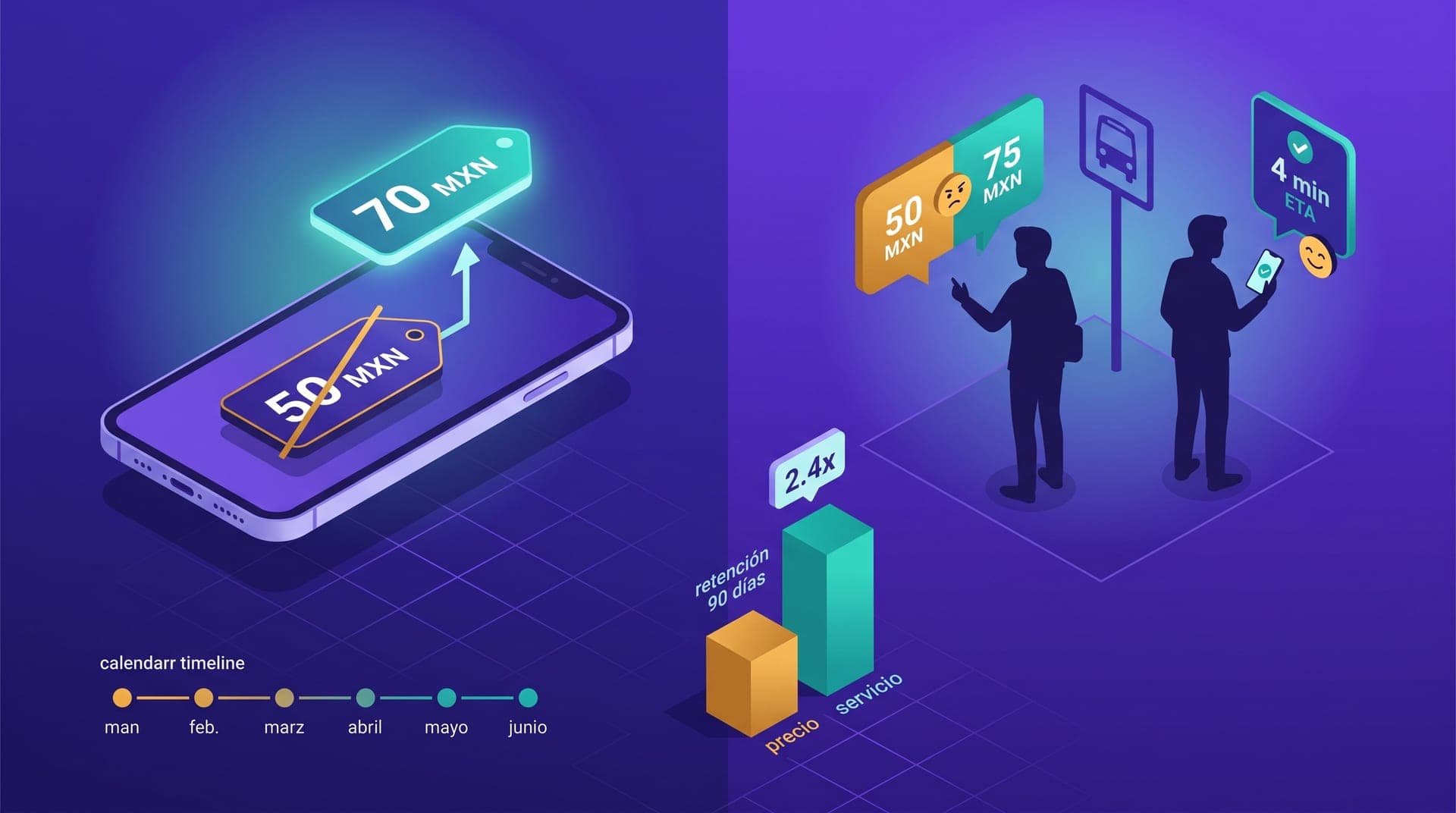
In a city of 150,000 to 300,000 residents where ride-hailing didn't exist before your launch, passengers have no reference price to assess whether 55 MXN for a 4 km trip is expensive or cheap. What they do have is the informal taxi price in the city — 40 to 65 MXN per short trip, but with no availability guarantee or known vehicle — and, after their first week using your platform, the price they paid for their first 5 trips. The informal taxi price stops being the reference as soon as the passenger has a history in the app. The price of their first app trips becomes their anchor. Six months later, when you need to raise from 55 to 70 MXN so that fuel costs don't erode the driver's margin, the passenger isn't comparing 70 MXN to the informal taxi. They're comparing 70 MXN to the 55 they know as the normal platform price. A 27% increase over their reference price is very different from a 70 MXN price evaluated without prior history.
The anchoring effect is stronger the longer the passenger has operated at the lower price. A passenger with 3 weeks of history at the time of the first adjustment reacts very differently from one with 7 months of history. This means that if the launch was below the sustainable price, the best time to correct it is not when the operator can no longer sustain the low price — which is usually months 7 or 8 when the driver retention problem becomes acute — but within the first 90 days of operation, before the anchor is fully established. The correction window without high retention cost is months 2 to 4: the passenger has enough history to know the service is reliable, but not so much that they perceive the original price as a permanent promise.
The passenger acquired with a low price and the one acquired with service quality
In the first 30 days of operation, the passenger acquired through promotional pricing and the passenger acquired through fast response times and a well-maintained vehicle look identical: both use the platform, both rate positively, both return for a second or third trip. The divergence appears at the first friction point: a 10 to 15% price adjustment, a 7-minute wait instead of 3, or a competitor arriving at a lower price. The price-passenger has a lower abandonment threshold because their primary reason for choosing was economic. The service-passenger has a higher threshold because they have evidence that this platform solves their transportation problem more reliably than available alternatives, and that evidence has value to them beyond the price.
The differential behavior of the price-acquired passenger versus the service-acquired passenger at the moments that matter:
- **Tolerance to fare adjustments**: the price-passenger reduces frequency by 15 to 35% after a 15-20% increase; the service-passenger shows drops below 10% for the same adjustment, because their reason for using the platform was reliability, not price.
- **90-day retention by acquisition channel**: passengers acquired through driver referrals or organic discovery retain at 50-65%; passengers acquired through price promotions or launch discounts retain at 25-40%. The 12-month revenue difference is 2 to 3 times higher for the non-promotional passenger.
- **Response to low-price competitor entry**: when a competitor enters the market at a lower price, the price-passenger switches platforms easily; the service-passenger first evaluates the new competitor's quality before switching, giving the operator time to respond with service improvements rather than a price cut.
- **Type of referral generated**: the passenger who chose the platform for price recommends 'the cheapest app in town'; the one who chose for service recommends 'the app that arrives in 4 minutes and always has a driver available'. The first type of referral attracts more price-passengers and perpetuates the cycle; the second builds a passenger base with higher future price tolerance.
How to calculate a launch fare that sustains driver economics
A defensible launch fare isn't the maximum price the market can absorb: it's the minimum price that makes driver economics work. The driver who accepts trips at a fare that doesn't cover their operating costs — fuel, depreciation, maintenance, time — has two possible responses over time: they reduce service quality to cut costs, or they leave the platform. Both outcomes deteriorate service for passengers and prevent the platform from building the reliability reputation that justifies a market-rate price. The calculation starts with driver numbers: in a secondary Mexican city with a 5-to-8-year-old vehicle, the driver needs between 8 and 13 MXN per driven kilometer to cover operating costs and generate a net income of 150 to 220 MXN per active hour after platform commission. A typical 5 km trip at those rates generates a fare of 55 to 80 MXN before commission.
The benchmark ranges for secondary Mexican cities with populations of 100,000 to 400,000 residents: a base fare of 25 to 35 MXN for the first 2 km, plus 7 to 12 MXN per additional kilometer, with a minimum trip fare of 45 to 65 MXN. Those parameters produce a typical 5 km trip fare of 60 to 85 MXN before commission. An operator launching at 55 MXN for 5 km is at the lower end of the defensible range: it survives if trip density is high and driver turnover is low. An operator launching at 40 MXN for 5 km is below any defensible floor unless they are explicitly subsidizing the launch period with a capital reserve and have a normalization date defined in advance. The launch subsidy is a valid strategy when the operator knows exactly when and how they will withdraw it, communicates that plan to drivers from the start, and executes the adjustment before month 4. When there is no such plan, the subsidy period becomes the new normal.
When and how to raise prices after launch without losing passengers
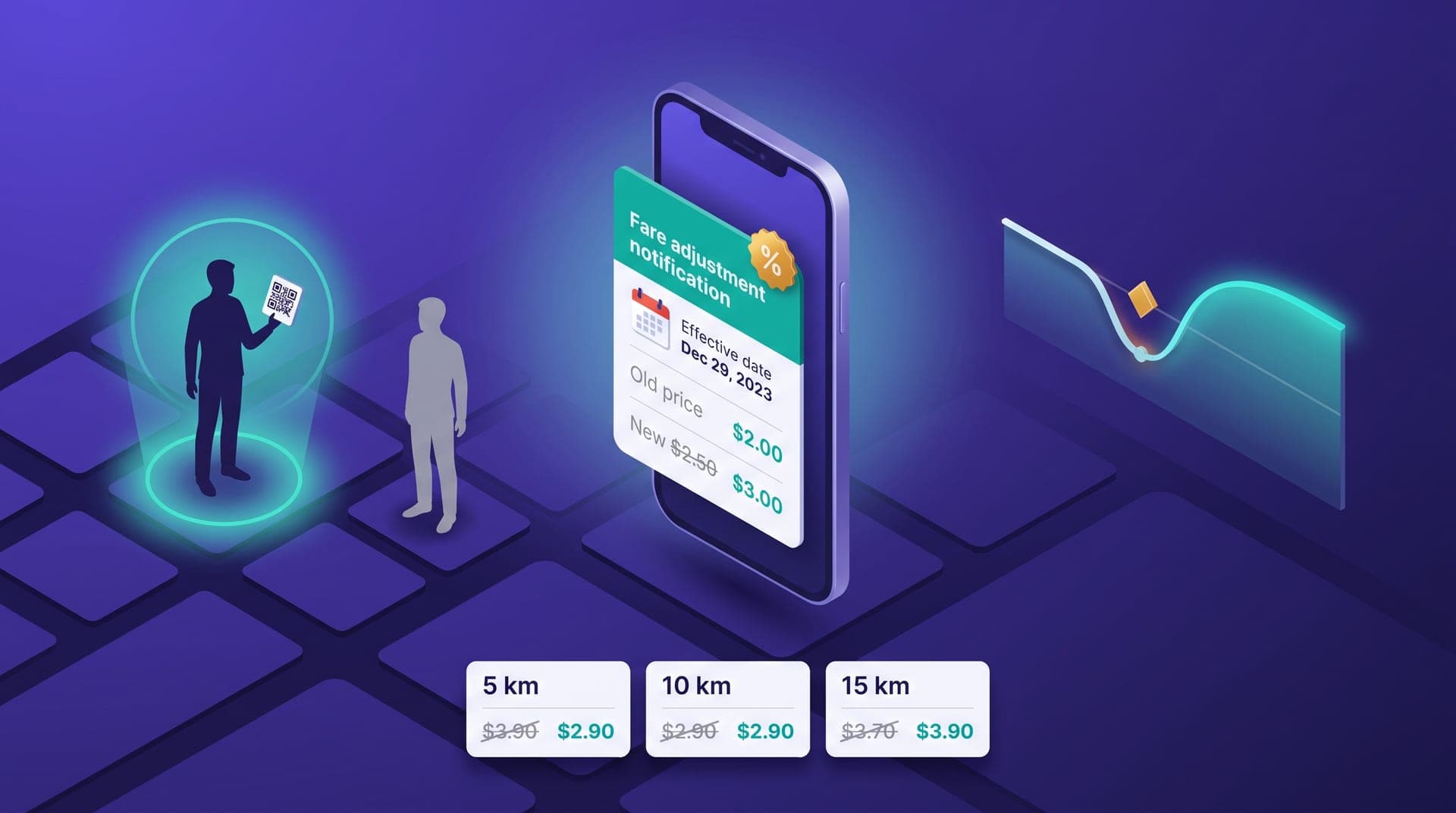
If the operator already launched below the equilibrium price and needs to normalize it, the adjustment is manageable if executed before the anchor is fully established. The lowest passenger retention cost window for the first adjustment is between months 2 and 5 of operation. In that period, the passenger has enough history to value the platform's reliability but hasn't processed the original price as permanent. After month 6, the passenger who has made 12 to 30 trips at the launch fare has an expectation that's hard to renegotiate without the friction of change being visible. The magnitude of the adjustment also matters: a 10 to 15% increase generates a usage frequency drop of less than 10% in passengers with a positive service history. An increase of 20 to 30% generates drops of 18 to 35%, and requires active justification to stay below that range.
The adjustment communication determines where in that range the usage drop falls. Adjustments announced with a concrete reason — fuel costs increased, the vehicle quality standard we require from drivers demands higher trip income, the adjustment ensures the best drivers can remain on the platform — generate 30 to 50% less abandonment than unexplained adjustments. The operator who frames the increase as a quality decision — 'so the driver who arrives in 3 minutes in a clean car can keep doing it' — converts a price adjustment into a confirmation of the service's values. The one who simply raises the fare without context leaves passengers to interpret the change as the platform prioritizing its margin over user price, which is the interpretation that generates the most abandonment.
I launched at 50 pesos for the average trip because taxis charged between 40 and 60 and I wanted to be the cheapest option. At 8 months I needed to raise to 65 so my drivers wouldn't leave. Twenty-eight percent of my passengers left or stopped using the app as frequently. What I didn't see at the start was that the ones who stayed were those who chose the app because it arrived fast and always had a driver available — not those who chose it because it was cheap. The ones who left were going to leave as soon as a cheaper option appeared anyway. I should have launched at 60 from the start instead of spending 8 months with insufficient revenue to end up in the same place.
The agent query that confirms whether your current fare covers the real cost of the operation
The verification of the current fare's equilibrium starts from the driver's perspective, not the passenger's. The agent query that produces that diagnostic: 'For the last 90 days, calculate the average fare per trip, the average distance, and the average trip duration across the fleet. Using those inputs, calculate the income per active hour for a driver completing the average trip volume of the period. Compare that income per active hour against an estimated operating cost of [X MXN per km in fuel and maintenance] and my platform commission of [Y%]. Is the median driver's net income per active hour above or below 150 MXN after estimated operating costs and commission? If it's below, what base fare level would be needed to reach that threshold while maintaining current trip volume?' That number — 150 MXN in net income per active hour — is the floor below which mid-quality drivers start reducing active hours or looking for alternatives. Operations with net income per active hour of 120 MXN or below show driver turnover rates 35 to 55% higher than operations above 160 MXN.
The second query that measures whether the passenger mix is shifting in the right direction after an adjustment: 'For active passengers who joined in the first 90 days of operation versus those who joined in the last 90 days, compare 90-day retention for each cohort, average trips per active month, and average fare per trip. If the recent cohort has higher 90-day retention than the launch cohort, the price adjustment is filtering toward passengers with higher service-price tolerance — a signal that the mix is improving. If retention is similar or lower, the adjustment affected both types of passengers equally, and the communication strategy or timing of the adjustment wasn't right.' The two queries together determine whether the current fare is sustainable for the driver and whether the active passenger profile is moving toward or away from price dependency. They are the two indicators that, reviewed together monthly, tell the operator whether they have an operation that can sustain quality over time or one that will deteriorate it as service costs increase.
The launch price anchoring effect is not inevitable: it is the structural consequence of a specific decision made in month 1. The operator who launches at market rate with a service that justifies it — reliable response times, drivers with well-maintained vehicles, no last-minute cancellations — doesn't need to sell the lowest price in the city because they're not competing on that dimension. They're competing on reliability, and in a secondary city without prior ride-hailing, that's the dimension where the formal platform wins against the informal taxi without needing to be cheaper. The passenger who chooses for reliability is the passenger who stays when prices rise, who recommends the service for the right reasons, and who tolerates the occasional imperfection because they have a positive history that puts the incident in context.
The long-term math is direct: the passenger who chose the platform at 70 MXN because it arrived in 4 minutes in a clean vehicle is worth 2 to 3 times more to the operation over 12 months than the one who chose it at 50 MXN because it was the cheapest option. That value difference isn't in the price per individual trip — it's in how many trips that passenger makes in a year, whether they stay when prices rise, and whether they recommend the service in a way that attracts more passengers like them. The cheapest launch is not the launch with the lowest fare: it's the launch that acquires the type of passenger with the lowest retention cost over time. In most secondary cities in LATAM, that type of passenger isn't acquired with the lowest price in the city — they're acquired with the most reliable service.