The regional operator who launches a referral program thinking of it as an acquisition channel is solving the wrong problem. Referral programs in ride-hailing don't acquire passengers — they multiply existing relationships. When the passenger making the referral doesn't yet have an established habit of platform use, the program produces discount hunters: people who arrive, use one or two subsidized trips, and disappear when the incentive ends. The difference between a program that generates durable growth and one that generates subsidy cost without return isn't in the incentive amount — it's in who the referrer is when they share the code.
This article is for operators with 200 to 600 monthly active passengers who have a stable consumer base and want to grow it organically without increasing advertising spend. The thesis is not that referral programs don't work in regional ride-hailing: it's that they only work when the referrer is a passenger who already uses the platform with frequency, not one who was recently acquired through a discount themselves. Understanding how to design the mechanic, when to launch it, and how to measure whether it's producing habitual users or single-trip subsidized passengers determines whether this investment generates compounding growth or a cash drain with inflated acquisition metrics.
The referred passenger has a different retention profile than one who arrives through advertising
The passenger who arrives through a referral from someone in their network starts in a different position than one who came from a digital ad. The referred passenger arrives with context: someone they trust used the platform and recommended it from their own experience. That context lowers the indifferent-first-trip threshold that produces most post-first-trip churn: the referred passenger already has an expectation that something is worth trying, because someone they know is saying so. In regional operations that track acquisition source, referred passengers who complete a second trip within 7 days of the first consistently outperform the platform average for paid-advertising passengers by 15 to 25 percentage points.
That retention advantage compounds over time. A passenger who arrived through a trusted referral and had a satisfactory first trip doesn't just have a higher probability of returning — they also have a higher probability of becoming a referrer themselves within 60 to 90 days. The referral loop, when it works, doesn't require the operator to reinvest in each new cycle: the retained passenger becomes the source for the next referral without a per-referral acquisition cost. The condition that makes this loop self-sustaining rather than single-cycle is that the referrer already uses the platform with frequency when they share the code — not that they're motivated by the incentive to refer someone before they've built their own usage habit.
The mechanic that turns the program into a subsidy
The most common referral mechanic in regional ride-hailing looks like this: any passenger can share a code, both the referrer and the referred receive a discount on one or two trips, and the referral is counted as successful when the referred passenger completes their first discounted trip. That mechanic has three structural problems that produce subsidy costs without durable growth:
- Any passenger can refer: by not distinguishing between the habitual passenger — 4 or more trips in the last 30 days — and the recent passenger — 1 or 2 trips since signing up — the program activates the referrer's incentive for someone who doesn't yet have enough experience to credibly endorse the platform. A passenger with two trips in 30 days sharing a code isn't recommending from experience — they're distributing a coupon.
- The referrer's incentive is paid at the referred passenger's first trip: that defines referral success at the easiest-to-achieve moment — a subsidized trip — not at the most valuable one — when the referred passenger completes 3 or more trips in 30 days. The operator pays the referrer's incentive for a passenger who then churns, with no mechanism tying the payment to the outcome that matters.
- The referred passenger's incentive is a first-trip discount: the price-sensitive passenger who uses the discount and then returns to their usual alternative was not retained — they were temporarily activated. A first-trip discount has the lowest retention rate of all available referral incentives, because it doesn't create a usage habit: it only reduces price friction one time.
When it makes sense to launch the program — and when it doesn't
A referral program has two conditions for being cost-effective in a regional operation. The first: the operation's 7-day second-trip rate must exceed 45 percent. If most passengers don't naturally return after their first trip, a referral program brings in new passengers who will have the same retention problem as the rest of the base, but with the added cost of the incentive. The operator who launches referrals with a 7-day second-trip rate below 40 percent is accelerating acquisition without having the retention machinery that makes each new passenger worth what it costs to bring in. The result is a growing subsidy cycle: the more referrals they activate, the more subsidized passengers churn without real active volume increasing proportionally.
The second condition is that the operation must have at least 150 to 200 passengers with 4 or more trips in the last 30 days. That is the pool from which the program can draw credible referrers — passengers who recommend from genuine experience, not from the incentive. An operation with 500 monthly active passengers of which only 80 have 4 or more trips in the month has too small a base of potential referrers to generate significant volume with the access restriction that makes the program work. The operator who meets both conditions has the foundation for the program to function as a growth multiplier. The one who doesn't meet them and launches anyway gets activation metrics that look good at 30 days and a negative balance at 90.
How to restrict access so the referrer is the habitual user, not the coupon hunter
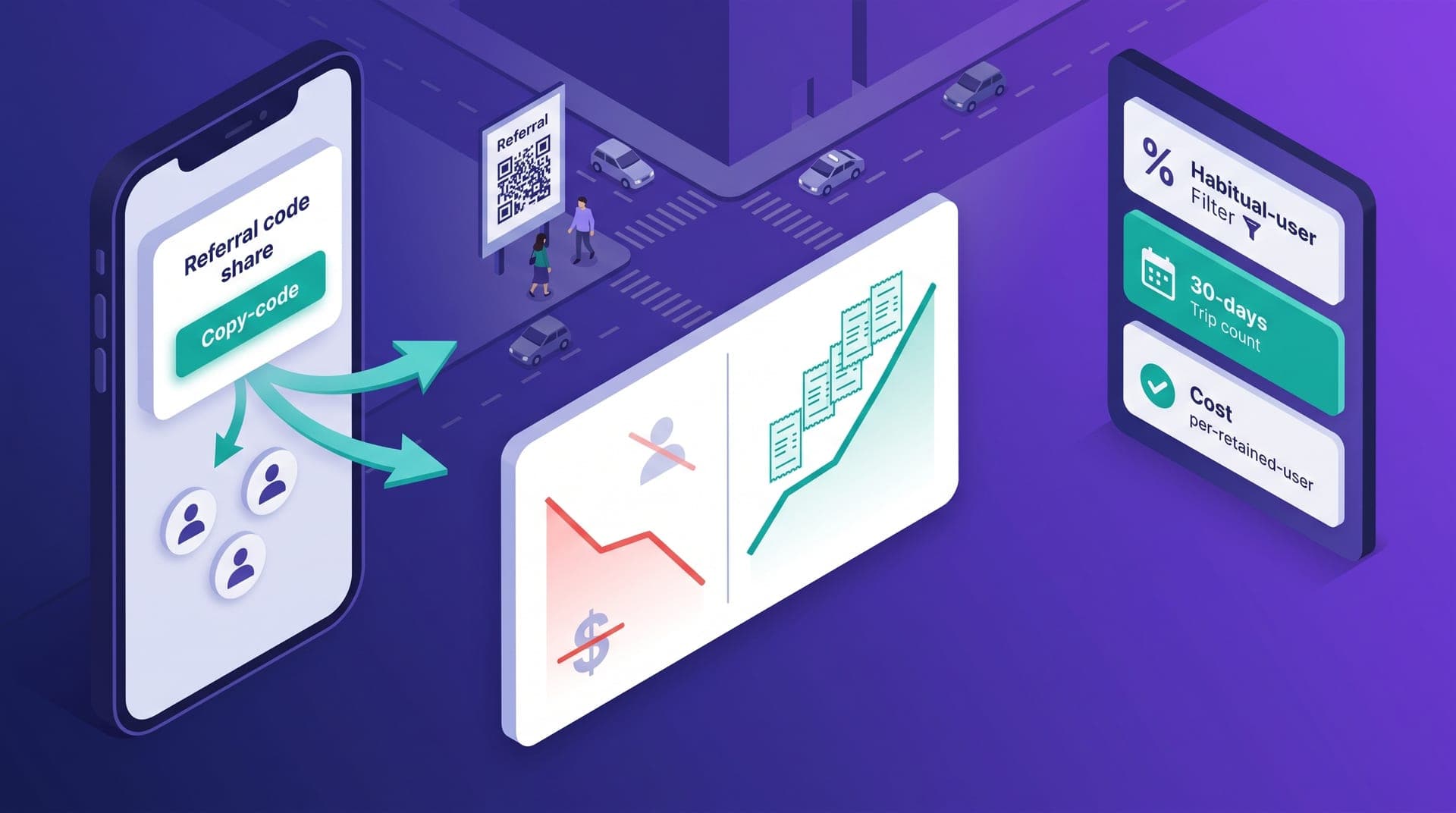
The mechanic that consistently produces better referral quality in regional operations has two adjustments to the standard model. The first is restricting access to the referral code to passengers with a minimum usage threshold — 4 or more trips in the last 30 days. That restriction makes the code valuable to the habitual user — who wants to share something they genuinely use — and invisible to the occasional passenger — who doesn't yet have enough experience to credibly endorse the platform. It also makes the invitation feel differentiated rather than like a mass campaign: the habitual passenger who receives code access perceives that the platform recognizes them as a frequent user, which reinforces their connection with the operation regardless of whether they end up referring anyone.
The second adjustment is making the referrer's incentive conditional on the referred passenger completing not one but three or more trips within 30 days. The operator who pays the referrer's incentive only when the referred passenger reaches 3 trips in 30 days is purchasing a habitual user, not a first trip. The cost per retained user under this mechanic is typically 30 to 50 percent lower than with the standard model, because the incentive isn't paid for single-trip passengers who then churn. The downside is lower raw referral volume — fewer total referrals reach the threshold. The trade-off is better referral quality and lower total incentive cost per retained user. The operator who optimizes the program for activations rather than retained users pays more and retains less.
The incentive form that produces the best referred-passenger retention
The form the incentive takes for the referred passenger matters as much as the amount. Three types of incentive are common in regional operations, with different retention outcomes:
- First-trip discount: produces the lowest retention rate of the three options. It attracts price-sensitive passengers who use the discount and then evaluate on the next occasion whether the platform is still convenient without the benefit. The 7-day second-trip rate for referred passengers who arrive with a first-trip discount is on average similar to that of passengers arriving through digital advertising — the discount doesn't produce the differential effect one would expect from a trusted referral.
- Credit distributed across multiple small trips: a $40 credit split into 8 trips of $5 each requires the referred passenger to use the platform more than once to consume it. That structure consistently produces higher second- and third-trip rates than a first-trip discount, because each trip within the credit period has an incremental incentive to choose the platform. The referred passenger who consumes 5 of 8 credit trips in 30 days has built enough experience to evaluate whether the platform is worth it without the benefit.
- Service benefit on the referred passenger's frequent route: the option with the greatest long-term habit effect. Giving the referred passenger a fixed fare on the route they regularly travel — or priority assignment with the driver the referrer habitually uses — produces the highest loyalty level, because the benefit is tied to a real recurring need, not a generic discount that gets used up.
The three metrics that distinguish real growth from hidden subsidy
The operator who runs a referral program without tracking these three metrics knows how many referrals activated, but not whether they produced value:
- Percentage of referred passengers completing 3 or more trips in 30 days: the habitual user threshold. A program with fewer than 35 percent of referred passengers reaching that threshold is producing mainly single-trip passengers. If the program has been running for 60 days or more and that percentage doesn't exceed 35 percent, the problem is in the mechanic, not the budget.
- Cost per retained user — not per acquired user: divide the total program cost by the number of referred passengers who reached 3 or more trips in 30 days. If that cost exceeds the equivalent retention cost through direct organic channels — welcome message, low-rating response, contextual availability communication — the program has no economic justification compared to available alternatives.
- 90-day retention rate of referred passengers compared to the general base: if referred passengers don't show higher retention at 90 days than the platform average, the program is producing the same user profile as other channels, with the added cost of the double incentive. That result indicates the referrers are not habitual enough to transmit credibility — the mechanic needs adjustment before scaling the budget.
We launched the program with no restrictions: any user could share the code and both got a discount on their first trip. In three months we activated 340 referrals. When we looked at how many had taken a second trip within the following 30 days, the rate was 29 percent — worse than the app average. We were paying both the referrer's and the referred passenger's incentive to bring in users who churned the same as everyone else. We changed the mechanic: only passengers with 5 or more trips in the last month could share a code, and the referrer's incentive was paid when the referred passenger reached 3 trips. Volume dropped by half, but 56 percent of those referred passengers reached 3 trips within 30 days. The program started working when we stopped measuring activations and started measuring users who came back.
A referral program that produces compounding organic growth in regional ride-hailing is not more complex to run than one that generates subsidy costs — it requires different design decisions from the start. The conditions that make it work — a 7-day second-trip rate above 45 percent, a sufficient habitual-user base, a mechanic that restricts code access to frequent users and ties the referrer's incentive to the referred passenger's habit — are the same conditions that make any other growth investment cost-effective. The program that ignores those conditions doesn't fail visibly: it accumulates cost gradually while producing acquisition metrics that look healthy until the operator measures what happened to those users 60 days later.
The operator who treats referrals as a multiplier of retention — not a substitute for it — builds a program that improves over time. Each cohort of well-designed referrals adds habitual users who in turn become referrers with higher credibility and more trust than any advertising campaign can produce. In a city of 200,000 to 400,000 people, the operator who has 15 to 20 percent of their active base making referrals from genuine experience holds a position in local word-of-mouth that a competitor arriving with discounts cannot replicate in their first three months of operation. The advantage of organic referral growth isn't speed — it's the quality of the users it produces and the cost of the next cycle, which falls rather than rises.