Almost every app-based taxi fleet uses discounts at some point: to launch the app, to win back passengers who stopped booking or to move a slow season. The problem is that most discounts apply to everyone, across the whole city and on any trip. So the coupon meant to attract new passengers in an outlying neighbourhood ends up being used by the regular passenger in the centre, who would have booked the taxi anyway.
The thesis of this article is that a discount is only worth it where it changes a decision: in the area where you want to grow, on the trip people don't yet take by taxi or at the time when your drivers are idle. Limiting the promotion by zone and distance lets you spend the same budget where it really generates new trips. We'll look at why a general discount gives away margin, where a zone promotion makes sense, how to use distance, how to design the coupon, how to measure whether it worked and which mistakes to avoid.
Why a general discount gives away margin
When a coupon is valid for any trip, most of the time it's used by passengers who already booked taxis frequently. They're the ones who open the app most, who hear about the promotion first and who take the most trips. For them, the discount changes nothing: they would have travelled anyway, only now they pay less. That money comes out of the fleet's margin or the driver's pocket, depending on how it's designed.
The effect a promotion is after is different: getting someone who wasn't going to book a taxi to do so. That happens more often in specific places and moments, not evenly across the whole city. That's why, before launching any discount, the useful question isn't "how much do we discount?" but "where, and for which trip, do we want people to change their habits?"
Where a zone promotion makes sense
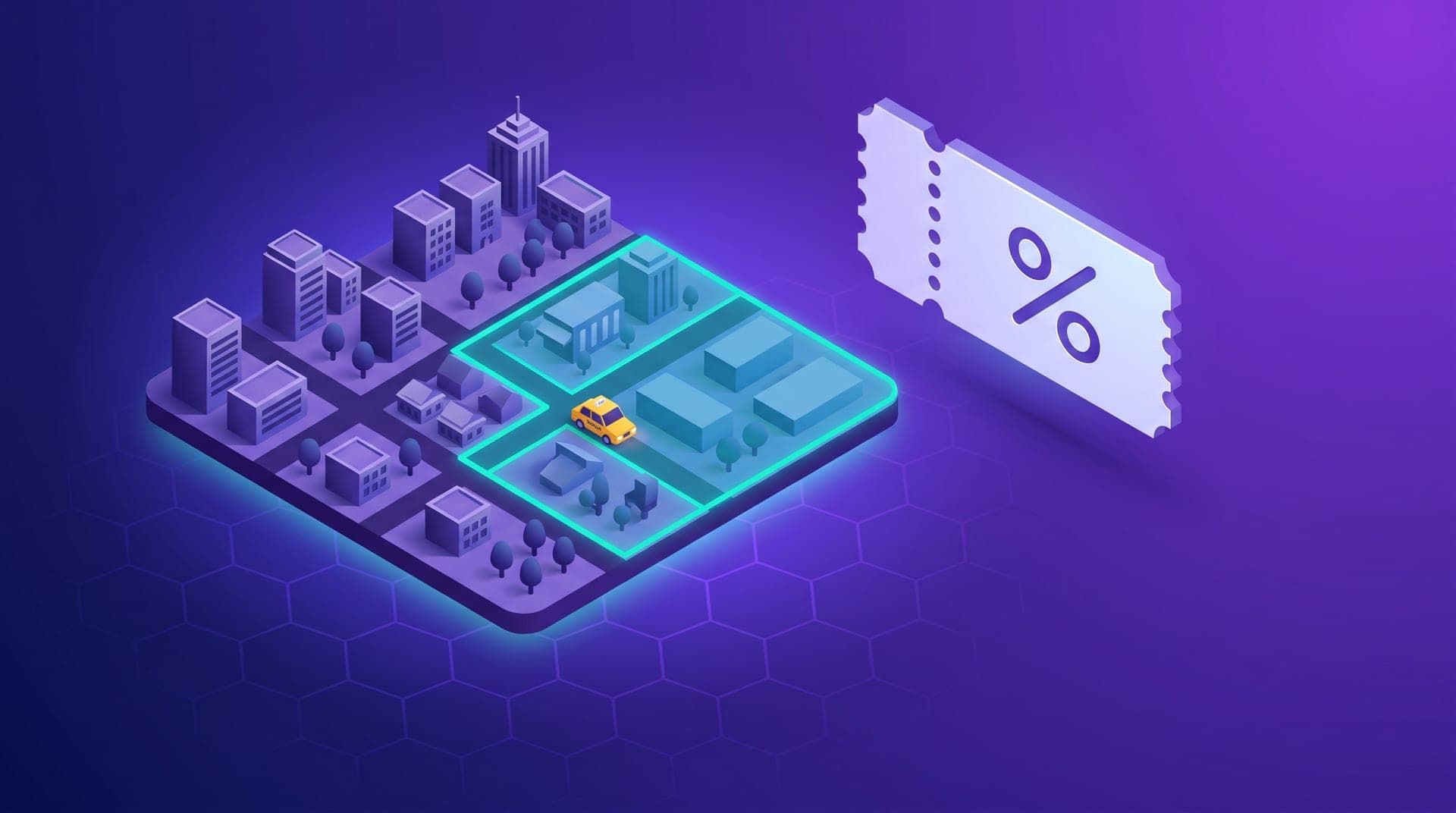
There are situations where limiting the coupon to certain pickup zones makes a lot of sense, because that's where a nudge changes behaviour. These are the most common in a regional city:
- A neighbourhood or nearby town where you've just started providing service.
- An area where your drivers tend to wait a long time without trips.
- A district where a competitor is strong and you want people to try you.
- A new point of demand, such as a shopping centre or a university.
- An area where there are already drivers, but passengers don't know the app yet.
- An event or fair with a specific date at a place in the city.
In all these cases, the promotion has a clear goal and a specific place. The passenger in the centre who already uses the app doesn't see it applied to their usual trips, so the budget is concentrated where it can generate something new. A zone promotion also helps drivers: if you know there are idle drivers in a neighbourhood, generating demand right there improves their hourly income.
Zone can also be combined with time of day. A neighbourhood with good demand in the morning may be empty by mid-afternoon, exactly when your drivers wait the longest. A coupon valid only in that area and at those hours moves trips to the moment when there are spare drivers, without touching the hours when the service already works at full price.
Using distance to choose the trip
Distance is the other lever. A coupon limited to short trips helps persuade people to use a taxi for journeys they now make on foot, by bus or by asking for a lift: going to the market, to school or to the local clinic. They're frequent trips and, if the passenger gets used to it, they can turn them into a routine.
Conversely, a coupon limited to long trips can be used to promote specific journeys, such as the airport or a nearby city, where the price tends to hold the decision back. What matters is that the distance is chosen on purpose. A coupon with no distance limit can end up giving away a large part of a long trip the passenger was going to take anyway.
How to design the coupon
A good zone coupon has few rules, all of them clear. First, the amount: a small fixed discount is usually enough to get someone to try, especially on short trips; a high percentage on a long trip can be very expensive. Second, the usage cap: per passenger, so it doesn't become a permanent discount, and in total, so the budget doesn't spiral. Third, the end date, always: a promotion without a date stops being a promotion and becomes the new price.
You also need to decide who pays for the discount. If the fleet absorbs it, the driver earns the full fare and has no reason to reject trips with a coupon. If it's deducted from the driver's income without warning, the promotion causes resentment and rejections precisely in the area where you wanted to grow. Whatever the decision, it's worth explaining it to drivers before launching.
Finally, think about how people in that area will find out. A zone coupon is useless if nobody in that neighbourhood knows about it. Signs in local shops, neighbourhood groups and the drivers who pass through there are usually better channels than a general social media post.
We used to give coupons for the whole city and the same regular passengers used them up. We started making them only for the new neighbourhood where we wanted to grow, for short trips and valid for a month. We spent less than before and trips went up in that neighbourhood, because people who had never booked through the app tried it.
How to know whether it worked
Measuring a promotion isn't counting how many times the coupon was used. A heavily used coupon can be a failure if it was mostly used by passengers who were already travelling. What matters is how many new trips appeared in the area and on the type of trip you wanted to move, and how many of those passengers kept booking after the discount ended.
A simple way is to compare the promotion's area with previous weeks and with another similar area without a promotion. If trips go up in the coupon area and not in the other, and some of the new passengers keep booking afterwards, the promotion did its job. If trips collapse when the discount ends, you only brought trips forward or attracted people who were only after the price.
It's best to decide what you'll measure before launching, not afterwards. Note how many trips started in that area per week, how many distinct passengers booked them and how long drivers were waiting. With that starting snapshot, at the end of the promotion you just repeat the same counts to see what changed. Without it, any result looks good. And a promotion that looks good without being so gets repeated and becomes expensive.
Common mistakes
The first mistake is launching promotions with no end date or renewing them again and again: passengers learn to wait for the discount and stop booking without it. The second is choosing the area by instinct without looking at trip and driver data, and ending up promoting an area where there are no drivers to serve the new demand. A passenger who uses their coupon and can't find a taxi rarely comes back.
The third mistake is measuring only coupon usage and not trips after the promotion. Without that comparison, it's impossible to know whether the money helped you grow or just lowered the price for people who already paid in full. And the fourth is not telling drivers, who find out from passengers and don't know whether the discount comes out of their pocket.
Discounts with a purpose
A well-targeted discount can open up a new area, fill drivers' dead hours or turn a short trip into a habit. A general discount, on the other hand, almost always ends up giving margin away to people who were already customers. Limiting promotions by zone, distance and time, and measuring the new trips they generate, turns the marketing budget into real growth.
If you want to start this week, choose a single area where you want to grow, write the sentence describing the trip you want to happen and design a small coupon, with a cap and an end date. Then compare that area with a similar one. And with Cabgo you can launch your own branded taxi app and limit your coupons by pickup zone and distance, to promote exactly where you need to.