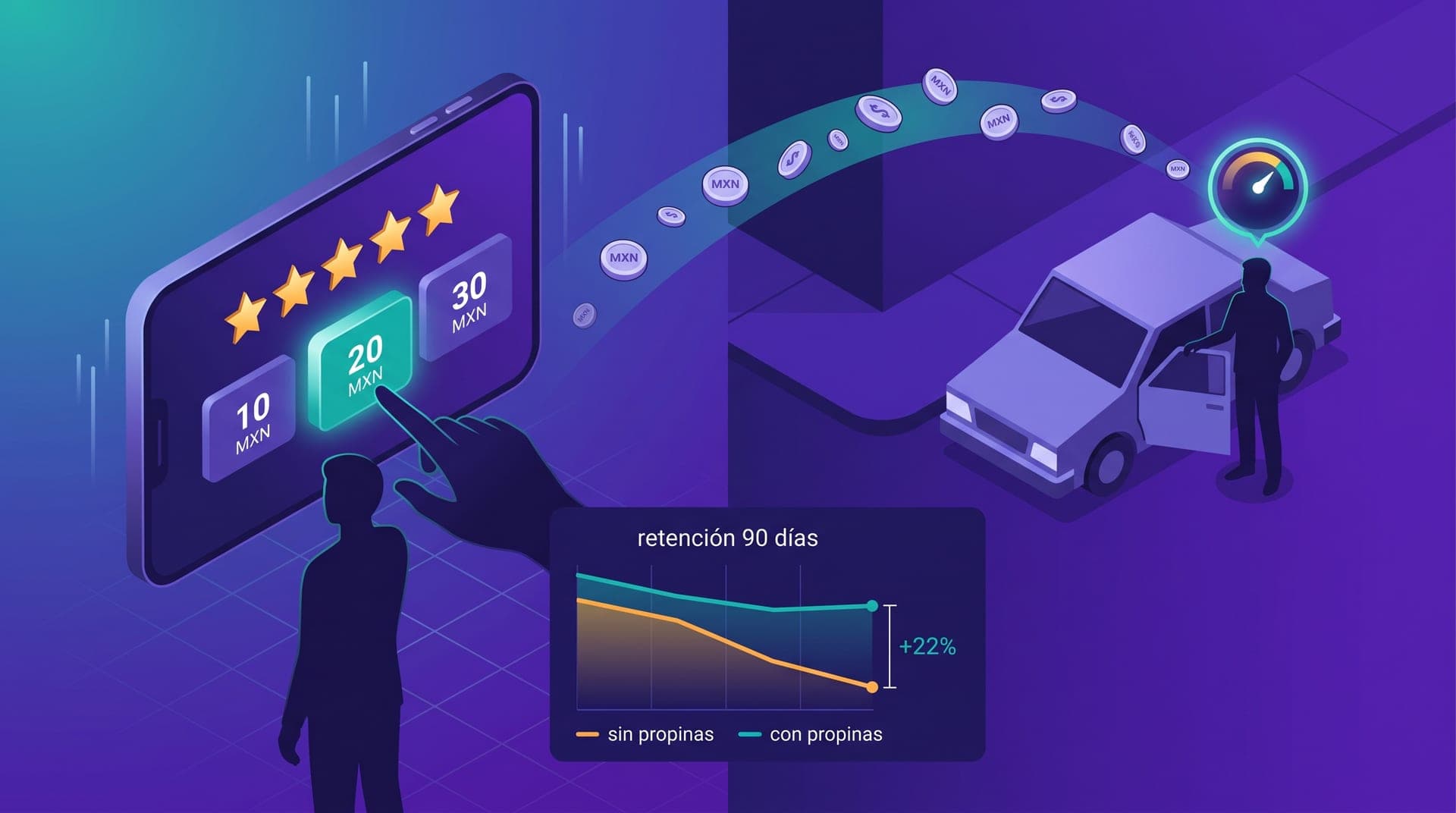
Tipping in regional ride-hailing in Latin America is not a conversion feature or an automatic retention strategy: it is a product decision that simultaneously affects the passenger experience, driver income, and brand perception. Most operators who activate tipping expect drivers to receive it as a straightforward income benefit and passengers to give it naturally, following the North American model where post-ride tipping has been culturally embedded for decades. In practice, initial adoption in regional operations across Mexico and Central America rarely exceeds 6 to 10% of completed trips in the first 30 days — not because passengers are unwilling to recognize good service, but because the feature's flow, the cultural expectation around it, and the economic context of the trip differ from the model where tipping was designed as an income compensation mechanism. The operator who activates tipping without adjusting the flow, without communicating it correctly to drivers, and without measuring impact in the first 8 weeks leaves 50 to 70% of the feature's potential uncaptured.
This article is for operators with 20 to 60 active drivers evaluating whether to activate tipping on their platform, or who activated it less than 90 days ago without seeing the expected impact on driver retention. It covers why tipping in regional markets has a different cultural and economic context than the North American model; when a fleet is ready to activate the feature — operational signals that determine whether tipping is perceived as voluntary recognition or implicit obligation; what passenger flow design maximizes adoption without creating friction; what adoption metrics are realistic in the first 30 and 60 days; how to measure tipping's impact on driver retention separately from other variables; and what driver communication — before and after launch — determines whether the feature becomes a quality motivator or a source of frustrated expectations. The thesis is direct: well-implemented tipping is the driver-retention tool with the lowest activation cost on the platform, but its effectiveness depends almost entirely on three execution decisions that happen before the first live day.
The cultural difference that determines adoption in LATAM
The ride-hailing tipping model was designed in a North American context where tipping is part of the implicit service contract: a passenger using a mobility app in the United States doesn't perceive tipping as a discretionary expense but as a social obligation of 15 to 20% on top of the fare, similar to a restaurant. In Latin America — and especially in regional operations in cities of 80,000 to 500,000 residents in Mexico and Central America — that implicit contract does not exist for private transportation. The same passenger who tips at a restaurant without thinking about it, because social protocol expects it, doesn't carry that expectation into a taxi or a local mobility app, where the trip price is perceived as the complete cost of the service. The difference isn't a lack of generosity: it's the absence of an established cultural protocol. The operator who activates tipping assuming passengers are waiting for the feature is designing the communication for the wrong context.
The economic context matters too. In regional Mexican cities, the average trip fare ranges from 60 to 90 MXN. For a passenger with a monthly income of 8,000 to 15,000 MXN, that fare already represents a significant share of daily transportation spending. Adding a 15 to 20 MXN tip — the socially acceptable minimum in the North American model — means a 17 to 33% increase above the price already paid. The tip that works in regional LATAM markets is not the same in proportional amount: it is discreet, genuinely optional, and small in absolute terms — 10 to 25 MXN — representing symbolic recognition rather than income compensation. That distinction changes how the flow should be designed, how suggested amounts should be presented, and how expectations should be communicated to drivers.
When to activate tipping: signals that the fleet is ready
Activating tipping before the operation has the necessary maturity produces the opposite of the desired effect: drivers develop income expectations that early adoption cannot meet, and that frustration affects their perception of the platform before the feature has had time to deliver. The signals that indicate a fleet is ready for tipping are operational, not product-level: fleet average rating above 4.5 stars in the last 30 days — an indicator that the service is at a level passengers may perceive as deserving extra recognition — driver cancellation rate below 15%, and at least 6 months of active operation with a returning passenger base. Activating tipping before those thresholds, when the service still has coverage or quality gaps, leads drivers to associate the feature with compensating for a fare they perceive as insufficient rather than recognizing excellent service. An operation with a 4.2 average rating and high cancellations isn't ready for tipping: it's ready to fix those problems first.
The passenger flow: timing matters more than the suggested amount
The most decisive factor in tip adoption isn't the suggested amount or the visual position on screen: it's the moment in the flow when the tip prompt appears relative to the trip rating. There are three flow patterns with measurably different outcomes in regional LATAM operations, and the gap between the best and worst can be 10 to 12 percentage points in adoption rate at 60 days. Fixed suggested amounts — 10, 20, 30 MXN — work better than percentage-of-fare options because regional passengers don't have the habit of calculating proportions on a service price, and seeing a percentage creates cognitive friction that a fixed amount eliminates.
The three tip flow patterns and their adoption outcomes in regional LATAM operations:
- **Tip before rating**: produces the lowest adoption — 3 to 6% in the first 30 days. The passenger who just exited the vehicle sees the extra payment request as friction before they have mentally processed whether the trip deserved recognition. This is the most common flow in initial implementations and the first thing to fix when early adoption is low.
- **Tip after rating, on the same screen**: produces the best results — 12 to 18% in the first 60 days with a fleet averaging 4.5 stars or above. The passenger who just gave 5 stars is in a positive evaluation mindset; the tip prompt at that moment has narrative coherence and isn't perceived as additional pressure.
- **Push notification reminder 15-20 minutes after the trip**: reinforces adoption from passengers who rated positively but closed the app before seeing the tip screen. It only works well when sent just once per trip and when the message is framed as recognition — 'want to thank your driver for that last trip?' — not as pressure.
Realistic adoption metrics in the first 60 days
The adoption benchmark for regional LATAM operations with the feature active: in the first 30 days with the correct flow — tip after rating, fixed suggested amounts — an operation averaging above 4.5 stars can expect 8 to 12% of completed trips to include a tip. From days 31 to 60, if the operator communicated the feature to drivers and adjusted the flow where needed, adoption can grow to 15 to 22%. In operations where tipping has been active for more than 6 months and drivers have a visible tip history on their profile, adoption can reach 25 to 35% for drivers rated 4.7 or above. The average tip amount when given, in operations with average fares of 65 to 90 MXN, ranges from 12 to 25 MXN per trip. At 20% adoption and an 18 MXN average per tip, a driver completing 10 trips per shift receives roughly 2 tips per day: an additional 250 to 400 MXN monthly working 5 shifts per week. For the driver rated 4.7 or above — who has a higher adoption rate — that additional income can reach 600 to 1,000 MXN monthly, a 6 to 12% increase above the typical base income in regional operations.
The retention impact on drivers: how to measure it in isolation
A tip isn't just additional income for the driver: it's an immediate recognition mechanism that the ratings system alone doesn't produce. A 5-star rating is a number; a 20 MXN tip is a direct economic signal that the passenger valued the service enough to pay for it voluntarily. That distinction has behavioral consequences: drivers who receive tips consistently show lower cancellation rates and more consistent active time on the platform than drivers with identical ratings but no tip history. To measure the retention impact in isolation from other variables, the operator needs to compare two groups during the first 90 days after activating the feature: drivers who received at least 3 tips in their first month with the feature active versus active drivers in the same period who received no tips. In operations where that comparison was made, the 90-day retention difference between the two groups ranged from 18 to 28 percentage points — an effect comparable to an onboarding bonus but without direct cost to the operator, since the payment comes from passengers.
Driver communication: the sequence that determines the outcome
The most common error in launching tipping is the reversed sequence: the operator activates the feature on the platform and then informs drivers it exists. The driver who discovers tipping because a passenger mentioned 'I left you a tip in the app' has a positive first experience but no context about how it works or what to expect. The driver who receives no tips in the first 30 days and wasn't informed about realistic early adoption — 8 to 12% — may interpret the absence as a problem with their profile or evidence that the feature isn't working. The correct communication happens before launch and includes three elements: first, that tipping is arriving on the platform and how to view it in the panel; second, that initial adoption is gradual — on average 1 to 2 tips per 10 trips in the first month; and third, that average rating is the strongest predictor of tip adoption: drivers rated above 4.6 stars receive tips at a rate 2 to 3 times higher than drivers below that threshold. That third point turns the tipping announcement into a quality-improvement lever while simultaneously managing income expectations.
When I activated tipping I expected drivers to see visible extra income from the first day. The first 15 days only 3 or 4 passengers tipped across almost 200 trips. My drivers were asking me whether the feature was working. I changed the flow so the tip appeared after the rating and added suggested amounts of 10, 20, and 30 pesos instead of the open field. Forty-five days after that adjustment, adoption hit 17%. By the three-month mark, my five highest-rated drivers were receiving between 400 and 700 pesos extra per month. None of those five left the platform during that period.
Tips are the only platform mechanism where passenger and driver have a direct economic interaction outside the base fare: the passenger voluntarily chooses to give more, and the driver receives that signal immediately and personally. That circuit, when it works, reinforces quality behavior in a way no operator bonus can replicate — because the recognition comes from the passenger, not the platform. The prerequisite for that circuit to operate is that the feature is activated at the right moment of operational maturity, that the flow places the tip prompt after the rating ritual rather than before, and that drivers understand from day one that initial adoption is gradual and that their rating is the primary predictor of how many tips they will receive. Those three conditions aren't product design decisions: they are operator execution decisions that determine whether the feature produces retention or only frustration.
The diagnostic for whether tipping is working is straightforward: 60 days after activating the feature with the correct flow and a fleet average above 4.5 stars, adoption below 8% signals a communication problem — passengers don't know the feature exists or the flow isn't visible enough. If adoption exceeds 8% but the retention impact on drivers isn't measurable, the problem is that the drivers receiving the most tips aren't being differentially recognized by the operator, and the feature operates as invisible income rather than as a quality lever. Well-managed tipping isn't a feature the operator activates and forgets: it's a data source showing which drivers deliver the service level passengers want to recognize voluntarily, and that information is worth as much as the income it generates.