Most regional ride-hailing operations develop their incident protocol in the same way: after the first incident that required one. A minor collision between a driver's vehicle and a parked car in month five of operation, a conflict between passenger and driver that ends in a one-star review and a threat to post on social media, or a disputed charge that the coordinator didn't know how to document in the moment. In 80% of cases the operator resolves the incident — the driver has insurance, the passenger is satisfied, the complaint closes — but without a process guiding the resolution, each incident consumes 3 to 7 hours of coordinator attention and produces inconsistent documentation that doesn't help prevent the next one. Operators with a protocol resolve the same incidents in 60 to 90 minutes and generate the report that lets them identify whether the incident is isolated or the first symptom of a pattern.
This article is for operators with 25 to 80 active drivers who have faced their first incident or want a protocol before needing one. It covers the incident taxonomy that determines which process to apply; the 30-minute window where the final outcome is shaped; communication with the affected passenger and the involved driver; the minimum documentation that protects the operation in case of a later dispute; when to involve authorities, insurance, or platform support; and the post-incident review that converts each case into preventive information. The thesis is direct: an incident protocol doesn't eliminate problems — it makes them manageable in the right timeframe, with the right information, without consuming the coordinator's entire day.
The incident taxonomy: which process applies to each situation
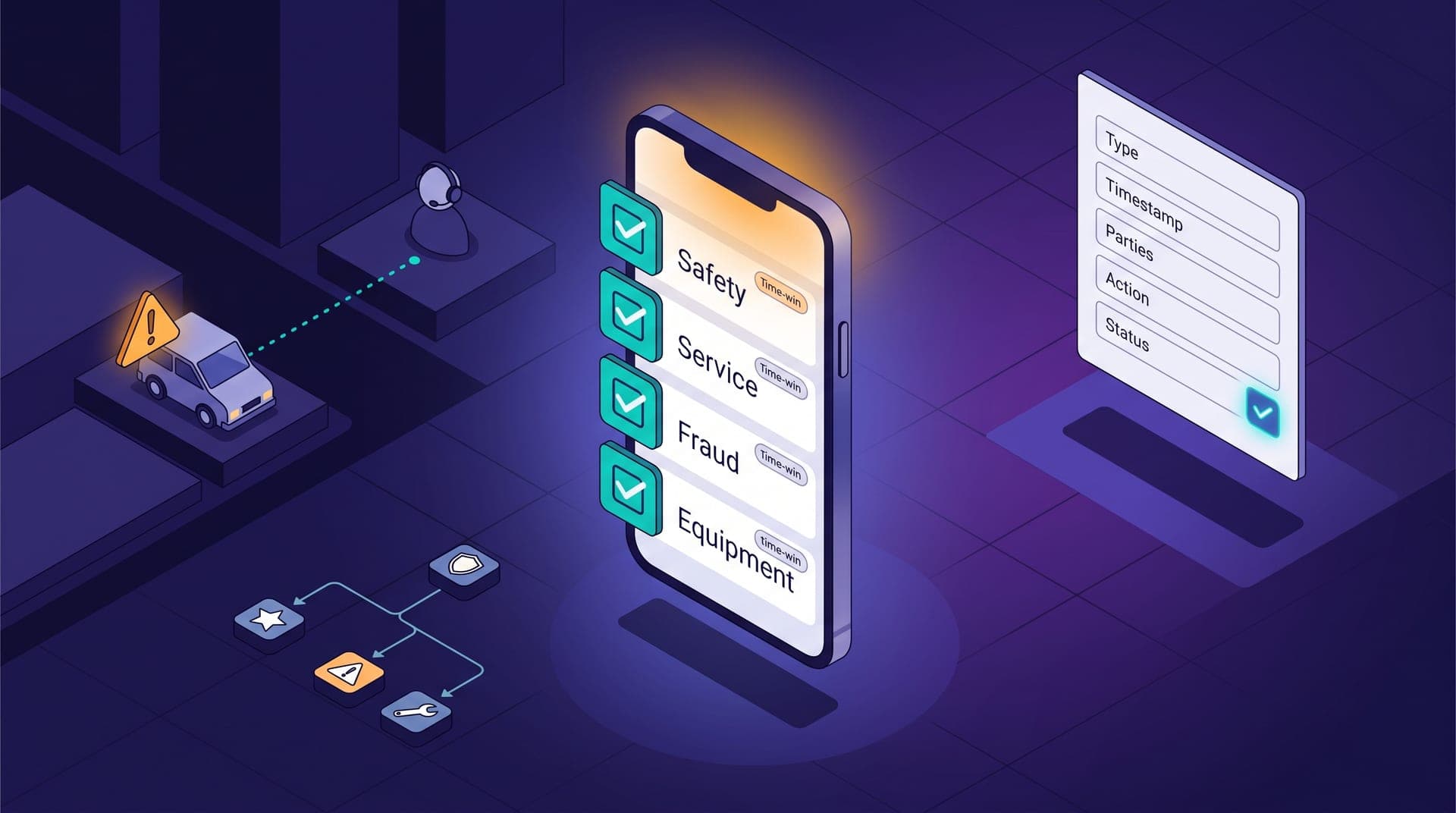
Before designing a protocol, the operation needs a simple taxonomy that determines which response level each situation requires. Without it, the coordinator treats a forgotten item with the same urgency as an accident with injuries, or dispatches a billing complaint through the same process as a safety conflict. Four categories cover 95% of incidents in a regional operation: safety incidents, service incidents, fraud incidents, and equipment incidents. The classification criterion isn't the perceived severity of the person calling the coordinator — it's the nature of the problem and the resource needed to close it correctly.
The four incident categories with their classification criteria and maximum coordinator first-response window:
- **Safety**: physical conflict between driver and passenger, accident with injuries or significant vehicle damage, passenger in the wrong vehicle, external threat to driver during the trip. First-response window: 5 minutes. Activates escalation protocol if there are physical injuries.
- **Service**: billing dispute, quality complaint the passenger wants actively resolved, wait time the passenger explicitly escalated, driver attitude complaint. First-response window: 30 minutes. Most close without external escalation.
- **Fraud**: driver or passenger reports a manipulated or non-existent trip, suspected falsified ride, dispute about destination change during the trip. First response: review platform records before any communication with the parties involved.
- **Equipment**: mechanical breakdown mid-trip, driver phone loss, app failure that affected the trip. Resolution: direct coordination of trip closure and vehicle substitute assistance where applicable in the operation.
The first 30 minutes: the window where the outcome is determined
For safety incidents, the 30-minute window from when the coordinator receives the notification determines 70% of the final outcome. Not because the problem is technically unresolvable afterward — but because the passenger or driver in crisis evaluates the platform's response in that window, and that evaluation conditions all subsequent communication. The coordinator who responds in 4 minutes with a direct question — 'are you in a safe place right now?' — and a concrete action — 'I'm going to talk to the driver in the next 10 minutes and call you back before 20' — establishes that the platform is present. The coordinator who responds in 45 minutes with a generic apology — no concrete action, no time commitment — establishes that the platform has no process.
For service incidents, the relevant window is two hours. A passenger with a billing dispute who receives a response within 90 minutes — with a resolution or a concrete commitment about when one will arrive — enters an active waiting state that in 65 to 75% of cases ends in retention. The same passenger who receives no response in four hours escalates the complaint to a public channel — Google Maps, local Facebook, neighborhood WhatsApp group — and the cost of a public response is four to six times the cost of an internal response in the same timeframe. The platform that has the protocol documented — including which number to call, what to ask first, and which time commitments are actually achievable — doesn't depend on the on-duty coordinator being experienced for the first response to be correct.
Communication with the affected passenger: what resolves and what escalates
The most common error in passenger communication during incidents is a wrong sequence: apology before understanding what happened, explanation before asking what the passenger needs, generic solution before confirming it's the right one. The sequence that works has four steps in fixed order: confirm the passenger is safe (in safety incidents) or that they received the coordinator's notification (in service incidents); ask what they expect as a resolution — don't assume you already know; propose the available resolution with a time commitment; and confirm closure before closing the case in the system. The coordinator who skips the step of asking what the passenger expects solves the wrong problem in 30 to 40% of service incidents: the passenger who wanted a partial refund receives an apology; the one who only wanted an explanation receives a credit they didn't request.
The specific language matters. 'What happened wasn't right' works better than 'I understand you, this was a mistake.' The first validates without implying established fault; the second sounds like a read script. 'Here's what I'm going to do in the next 15 minutes' works better than 'we're going to resolve your problem.' The first commits to time and concrete action; the second commits to nothing. Coordinators who handle incidents with the highest resolution rate without escalation use specific language, concrete time commitments, and active confirmation that the case is closed from the passenger's perspective before closing it in the system. The difference between an incident that generates a five-star review about how the platform responded to a problem and one that generates a public complaint isn't what happened — it's how it was managed in the following two hours.
Communication with the driver: getting the report without prematurely assigning fault
Communication with the driver during an incident has a different objective than communication with the passenger: obtaining the complete factual report before memory fades, without the driver interpreting the conversation as an automatic sanctioning process. The driver who perceives the coordinator's call as an interrogation closes down information; the one who perceives it as data collection to properly manage the case provides it more completely. The right opener isn't 'what happened?' — it's 'I need to understand what occurred so I can help you resolve this.' That framing difference produces 40 to 60% more complete reports in the first three minutes of the call, consistent with patterns seen in operations with an established protocol.
The four pieces of information the coordinator must obtain in the first call to the driver, in that order: exact time of the event; vehicle location at the time of the event; current status of the driver and passenger if still in the vehicle; and the driver's description of events in their own words without coordinator interpretation. Those four data points are sufficient to start the incident process, notify relevant parties, and determine whether escalation is needed. The follow-up conversation — with system evidence, trip records, app logs — can occur in the following two hours when there's less pressure and the driver can review the data alongside the coordinator. The driver who feels the first call was to understand them, not judge them, cooperates more in the follow-up.
Minimum documentation: what to record and where so it's useful six months later
Incident documentation in regional operations frequently has the same problem: it exists in three places simultaneously and in none of them completely. The coordinator notes something in the shift log, sends a WhatsApp summary to the operator, and adds a comment in the driver's chat. Six months later, when a passenger opens a dispute or the insurer requests the driver's history, the incident report doesn't exist as a single complete document — it exists as scattered fragments difficult to reconstruct under pressure. The solution doesn't require a sophisticated system: it requires a consistent format in a single location that any shift coordinator knows and can use within the first 10 minutes of managing the case.
The minimum record that protects the operation has five fields: incident type according to the four-category taxonomy; timestamp at each process stage — when notification arrived, when passenger was contacted, when driver was contacted, when the case was closed; factual description in under 200 words using the exact words of the driver and passenger without coordinator interpretation; action taken and commitment given to each party; and outcome with closure confirmation from both passenger and driver perspectives. That record, saved in a consistent format — a shared spreadsheet with one row per incident, a text document in the operation's folder, or a record in the platform if it has that feature — converts each incident into data the agent can query three months later to detect patterns that fleet averages never surface.
When to escalate: authorities, insurance, and platform support
Most incidents in a regional operation resolve without escalating outside the coordinator. But clarity about when to escalate — and to whom — reduces decision time when pressure is highest. Three situations require immediate escalation without waiting to evaluate more data: accident with physical injuries requiring medical attention — emergency services first, notify the operator within the following five minutes, open the insurance process within the first hour; active safety situation for driver or passenger requiring law enforcement — same sequence: emergency services first, internal notification second; and a fraud dispute where system analysis suggests documented manipulation — notify the platform's support team with the complete report before communicating any decision to the involved driver.
In most Latin American markets, the driver's insurer requires three documents to process a claim related to a platform trip: the accident report with timestamp and location; the record of the driver's active platform session at the time of the incident; and the coordinator's communication documenting that the driver was in service. The operator who has all three in the correct format processes the claim in 48 to 72 hours; the one who doesn't manages the process over two to four weeks with multiple calls to all parties. The escalation protocol doesn't just speed resolution for the insurer — it's also the evidence that protects the driver and the platform if the passenger opens an additional claim several months later.
Post-incident review: from isolated case to visible pattern
The post-incident review is the step most operations skip because the incident is already resolved and there's pressure to return to normal rhythm. It's also the step with the highest return on invested time: ten minutes of structured review after closing each incident produces, over twelve months of operation, a pattern diagnostic that fleet averages never generate. The four questions in the review that takes under ten minutes: does this incident share any element with one in the past 90 days — type, driver, zone, or time range? Was the coordinator's response time within the correct window for this incident type? Is the case documentation sufficient to consult six months from now if the same situation recurs with the same driver? Is there something in today's process that worked better than the last time, or something that worked worse?
The agent query that produces the real-time incident pattern diagnostic: 'For the last six months, how many incidents classified as safety occurred and what time range has the highest concentration of that type? How many drivers appear in more than one incident of any category in the period? For service incidents, what is the average coordinator first-response time and how many escalated to a public complaint? Are there geographic zones with incident concentration above the operation average?' That report, produced quarterly, is the input for two or three preventive decisions in the following semester: a protocol adjustment, a direct conversation with the driver who appears twice, or a coverage review in the highest-incidence zone.
I had my first accident in month seven of operation. A driver hit a parked car at 10pm with a passenger inside. I had no protocol — I sent a WhatsApp to the driver, messaged the passenger through the app, and spent the rest of the night trying to figure out what to do with insurance. Four months later when the second one happened, I resolved it in 90 minutes because I knew exactly what to do and in what order. The difference wasn't luck or the type of accident — it was the protocol. And the passenger from the second accident sent me a message the next day saying how the situation was handled had been impressive. That message was worth more than any marketing campaign.
The incident protocol isn't a legal risk document or a procedure reserved for extreme emergencies: it's the system that determines how much time and attention each problem the operation inevitably faces will consume. In a fleet of 40 to 80 active drivers, between 3 and 8 incidents of any type may occur per month; without a protocol, those incidents consume an average of 3 to 7 hours of coordination each; with a protocol, the same number consumes 60 to 120 minutes. The difference isn't just operational efficiency — it's response quality. The incident resolved in 90 minutes with precise communication and confirmed closure produces a different outcome than the one resolved in four hours with improvised communication and ambiguous closure, even if the technical result is identical.
The platform with a protocol converts the second incident of a given type into a more efficient intervention than the first, and the fifth into one that barely interrupts the coordinator's shift. The one without a protocol converts every incident into a version of the same improvisation, with the same time cost and the same outcome inconsistency. In a city of 100,000 to 300,000 residents, incident management is not invisible: the passenger who had a problem and saw it resolved in an hour talks about that. The one who waited four hours without a clear response also talks about that. In a city where everyone knows each other, the difference between both experiences is the difference between a platform that responds when most needed and one that disappears at exactly that moment.