In a regional ride-hailing operation with 6 to 18 months of life, between 25 and 40% of total registered users are inactive passengers: someone who completed at least one trip but has not requested one in the last 30 days. An operator without a reactivation process treats that passenger as if they never existed — they don't appear in acquisition campaigns or active operational management — but they have something no new user has: they already know the platform, have tested the service, and already made the decision to register. Reactivating them doesn't cost the same as acquiring them. In regional markets in Mexico and Central America, the cost of bringing back an inactive passenger in the first 14 to 21 days of inactivity is 3 to 5 times lower than the acquisition cost of a new user with an equivalent profile. The difference is the window: the probability of reactivation falls 65 to 70% after day 21, and after day 45 the inactive passenger behaves statistically like a new user — without brand recognition, without product memory, and without the specific intent they had when they registered.
This article is for operators with 300 to 2,000 registered users whose monthly active passenger base represents less than 55% of total registered users, without a systematic process to identify or contact passengers who stopped using the platform. It covers how to distinguish the temporarily inactive passenger from the churned one operationally; what the three inactivity periods — the first 14 days, days 15 to 45, and more than 45 days — reveal about recovery probability and the type of intervention that works in each; which inactive passenger segments respond to a coupon offer and which don't respond to the coupon but do respond to a communicated service improvement; how to structure the reactivation message — channel, timing, amount, condition — without creating the habit of waiting for a discount to use the platform; how to measure whether the reactivation was real or cosmetic — whether the passenger completed a second and third coupon-free trip in the following three weeks; and what agent query produces the map of passengers at risk of inactivity before they reach the 14-day mark. The thesis is operational: most regional operations have more growth capacity in their registered base than in new user acquisition, and the operator who activates a weekly reactivation cycle turns a static record base into predictably recoverable demand.
Temporarily inactive vs churned: the distinction that defines what to do first
For the reactivation process to make sense, the first step is to separate two categories that most dashboards group under the same label. The temporarily inactive passenger is one who requested trips regularly over a period and stopped for reasons unrelated to the product: work travel, vacation, a temporary routine change. In regional operations with local clientele, 35 to 50% of passengers appearing as inactive in the last 30 days are temporarily inactive and return without intervention in a 25-to-40-day cycle. Identifying which ones — from their historical trip pattern and habitual frequency before the inactivity — avoids sending reactivation messages to passengers who were already coming back on their own, which devalues the coupon and distorts campaign attribution. A passenger who typically requested every 6 to 8 days and has been inactive for 18 days is not churned: they are simply outside their usual cycle.
The churned passenger has a different profile. They completed 1 to 5 trips — concentrated in their first two weeks of use — and then didn't return. The probability they return without intervention after day 21 is under 12%. By contrast, a passenger with 8 to 20 prior trips who stopped using the platform has a churn with a cause: a negative experience, a price change perceived as unfair, or the discovery of an alternative. That passenger is more likely to respond to a reactivation message that directly addresses the possible cause — 'we improved wait times in your zone' or 'new rate for short trips' — than to a generic coupon. Diagnosing which type of inactive user you have determines which type of intervention makes sense, and that distinction comes from trip history data. No passenger survey is needed to know whether the problem was one of experience or frequency.
The three inactivity windows and how recovery probability changes in each
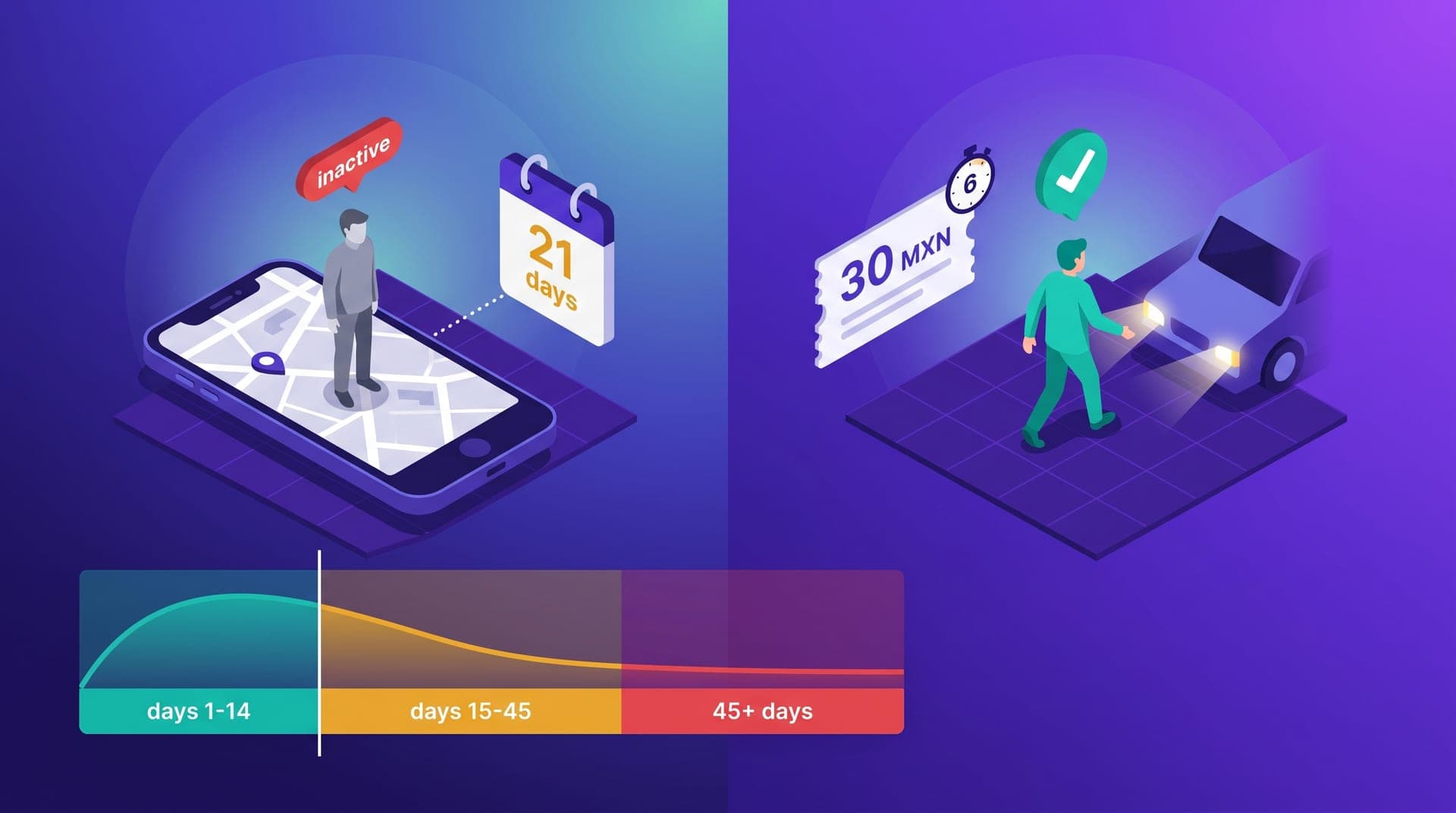
The probability of reactivating an inactive passenger is not constant: it falls non-linearly over time. In the first 14 days of inactivity, the passenger still has a recent product memory and hasn't consolidated the habit of seeking an alternative. An intervention during that period — a coupon of 25 to 35 MXN valid for 7 days, sent through the channel the passenger habitually uses — converts 28 to 38% of those contacted into a completed request. That rate drops to 12 to 18% if the intervention arrives between days 15 and 45. After day 46, the conversion rate of a standard reactivation campaign rarely exceeds 6 to 9% in regional markets: the passenger has already built an alternative habit or has no active need that the platform resolves at that moment.
The correct structure is not a monthly 'all inactive' campaign: it is a weekly process differentiated by window. Passengers who reached 10 to 13 days of inactivity that week have the highest probability of responding to a light intervention — a push or WhatsApp message with a fast-activation coupon. Those who reached 15 to 44 days need a more specific argument: a change in service, a communicated improvement, or a higher-value coupon to overcome greater inertia. Those who exceeded 45 days are candidates for a quarterly — not weekly — campaign, because the cost of frequently contacting them exceeds the expected return in that segment. That window-based segmentation doesn't require a sophisticated CRM: it requires a weekly query that lists the passengers who entered each inactivity range during that week, and a distinct action for each list.
Which inactive passenger segment responds to which type of offer
Not all inactive passengers respond to a coupon in the same way, and sending the same coupon to the entire inactive base produces worse results than segmenting by usage history. The amount that maximizes conversion without destroying margin in regional markets is between 25 and 45% of the passenger's average trip value — in operations with a 75 MXN average trip, that equals a 20 to 35 MXN coupon. Coupons below 20% of the average trip value don't move the conversion rate measurably in the early inactivity segment. Coupons above 50% produce a first request but create the habit of waiting for the next discount before requesting the following trip, turning real reactivation into a subsidized acquisition that repeats until the operator stops offering the discount.
The four inactive passenger segments and the offer type that produces the best conversion in each:
- **Passenger with 1-5 trips, inactivity < 21 days**: coupon of 20 to 35 MXN valid for 5 to 7 days. Conversion rate of 28 to 38%. Low risk of creating discount dependency because the passenger hasn't yet established a usage pattern the coupon can distort. The direct offer works better than a service message in this segment.
- **Passenger with 6-20 trips, inactivity < 21 days**: service message first, coupon second. Communicate a concrete improvement — wait times, new coverage zone, revised rate. If no conversion in 4 days, follow with a 20 to 30 MXN coupon. Conversion rate with only a service message is 14 to 22% in this segment — 2 to 3 percentage points above a direct coupon without a prior message.
- **Passenger with more than 20 trips, inactivity < 45 days**: check for a recorded negative experience before acting. If the history includes a driver-cancelled trip, a 1-star rating, or an unserved request, the first message should acknowledge the issue. A coupon without that acknowledgment converts under 8% in this segment; a message that addresses the likely cause converts 15 to 22%.
- **Any history, inactivity > 45 days**: quarterly campaign with product communication, not discount. A notification about a new feature or a new coverage zone relevant to the passenger's historical origin converts better than a coupon as a first contact after 45 days of inactivity. Direct coupons convert 5 to 8% in this segment; relevant product messages convert 9 to 14%.
The reactivation coupon: amount, condition, and validity that maximize return
The reactivation coupon design has three parameters that determine whether it works. The first is the amount: in markets with a 60 to 100 MXN average trip, the coupon that maximizes conversion without creating dependency is between 20 and 40 MXN off the first trip. The second parameter is validity: a validity of 5 to 7 days produces 3 to 4 times more conversions than a 30-day validity. A long-validity coupon creates the illusion of 'I can use it tomorrow' — and the passenger postpones it indefinitely. A short validity activates urgency without being perceived as manipulative, because the passenger understands it makes sense to use it now rather than later. The third parameter is the condition: a coupon with no minimum condition converts better in the 1-to-5-prior-trip segment. For passengers with 6 to 20 trips, adding the condition 'trip of 3 km or more' reduces coupon cost for the operator without meaningfully reducing conversion, because the frequent passenger already takes trips of that distance naturally.
The most frequent error in reactivation coupon design is setting the amount as a percentage of the fare — '30% off' — instead of an absolute amount. For the passenger, a discount of 25 MXN on an 80 MXN trip is more legible than '31.25% discount.' The absolute amount lets the passenger immediately calculate what they'll pay — certainty about the final price is more convincing than a percentage in low-frequency use contexts. In markets where the passenger has low historical frequency, cost predictability carries more weight in the request decision than the nominal percentage of the discount. A coupon for '30 MXN off your next trip, valid through Thursday' converts better than '30% off, valid 30 days' in both the early and late reactivation segments, at the same expected cost to the operator.
Channel and timing of the message: why WhatsApp outperforms push for inactive passengers
The channel of the reactivation message has a greater impact on conversion than the coupon amount in operations of 300 to 2,000 registered users. In regional markets, WhatsApp has a message open rate in the first hour of delivery of 65 to 80%, versus 20 to 30% for an app push notification. For inactive passengers — who rarely open the app during the inactivity period — WhatsApp has the additional advantage of arriving without depending on the passenger opening an app they're not using. The cost is higher — it requires a controlled sending process that respects WhatsApp Business policies — but the return per contact exceeds push by 2 to 3 times in the 10-to-20-day inactivity segment. SMS is a valid alternative if the operator doesn't have WhatsApp Business sending access: it has lower conversion — 12 to 18% vs 22 to 35% in that inactivity segment — but higher than push for passengers who don't open the app regularly.
How to measure whether reactivation was real: the second and third coupon-free trip
The indicator that determines whether a reactivation campaign succeeded is not the coupon conversion rate: it is the second and third coupon-free trip rate in the following three weeks. A passenger who used the coupon and didn't return in 21 days was not reactivated — they were temporarily subsidized. Real reactivation happens when the passenger completes at least two additional trips without any incentive in the month following the first post-coupon trip. In regional operations with well-executed campaigns, 40 to 55% of passengers who used the coupon complete a second coupon-free trip in the following 21 days. If that percentage is below 30%, the most common cause is that the coupon was the only attribute that attracted the passenger — without the discount, the service's value proposition isn't sufficient for them to return on their own initiative.
The complementary diagnostic that reveals whether the problem is one of value proposition or incentive design is the segment of returning passengers. If most passengers who completed a second coupon-free trip had between 6 and 15 prior trips before the inactivity period, the reactivation worked for those who had already formed the habit before churning. If most came from the 1-to-5-prior-trip segment, used the coupon, but didn't return without it, the problem is upstream: the initial onboarding didn't form the usage habit, and the reactivation coupon doesn't form it either. In that case, the reactivation effort must be accompanied by an improvement in the first-cycle trip experience — trips 2 and 3 after the first subsidized trip are what consolidate the habit, and if they don't happen naturally in the first week of use, no subsequent reactivation coupon will recover them.
The weekly agent query: the at-risk passenger map ready every Monday
The agent query that produces the weekly at-risk passenger map segmented by inactivity window: 'For registered passengers on the platform, show me three separate lists. First: passengers who completed at least 1 trip in the last 90 days and whose last trip was 10 to 14 days ago — immediate intervention candidates. Second: passengers with at least 1 trip in the last 90 days and whose last trip was 15 to 44 days ago — candidates for differentiated offer intervention. Third: passengers with at least 1 historical trip and whose last trip was more than 45 days ago — quarterly reactivation segment. For each list, include the passenger's total trip count, the average days between their last 5 trips when active, their most frequent origin zone, and whether in the last 3 completed trips there was any recorded negative event — driver cancelled, 1 or 2-star rating, unserved request. Sort by historical frequency descending within each list.' That query, run every Monday, produces the week's reactivation work list in 5 minutes, without any additional process outside the agent.
The complementary query that evaluates whether prior weeks' reactivations were real: 'For passengers who completed a trip using a reactivation coupon in the last 42 days, show me how many completed a second coupon-free trip within 21 days following the coupon trip, and how many completed a third trip within 42 days following it. Break the result by segment of history before the coupon: 1-5 prior trips, 6-20 prior trips, and more than 20 prior trips. Indicate the return rate in each segment and the overall rate.' That result determines whether the reactivation program is producing reactivated passengers or subsidized ones, and which segment has the best efficiency per coupon peso invested. The two queries together — the risk map and the return tracking — make Monday the week's reactivation diagnosis and decision moment, without requiring a separate database management process.
After 14 months of operation we had 1,850 registered users and 420 monthly actives — less than 23%. I had never looked at the inactive number as an opportunity: I saw it as a past failure. When I started segmenting by inactivity window, I found that 280 passengers had 5 or more prior trips and had left less than 30 days ago. I sent a WhatsApp to 140 of those passengers — the ones with 10 to 20 days of inactivity — with a 30 MXN coupon valid for 6 days. 52 completed a trip, 34 made a second coupon-free trip in the following two weeks. Those 34 are still active 4 months later. The total campaign cost was 1,560 MXN in coupons plus two hours of my time. The 34 reactivated passengers have generated 190 trips in those 4 months.
The inactive passenger is the demand source with the highest conversion probability in a regional operation with an established registered base — more than the new user who has never tried the service, more than the competitor's user who doesn't know the platform. The first-14-day window is not only the period of highest conversion probability: it is the period where the passenger still holds the intent they had when registering and the memory of the service as an available alternative. Past that period, that intent erodes and the cost of recovering it rises because it now competes with the alternative habit the passenger built during inactivity. The operator who detects entry into that period and acts within it doesn't need a complex CRM or significant marketing budget: they need a weekly query, a message-sending process, and a coupon with the right conditions.
The two metrics that signal whether the process is working are: the proportion of reactivated passengers in the 10-to-14-day window who complete a second coupon-free trip in the following 21 days — real reactivation — and the evolution of the proportion of active passengers over total registered — a base health indicator that improves 8 to 12 percentage points in the first six months of running the weekly reactivation cycle. The operator who adds this review to their Monday isn't doing marketing: they're converting data that already exists in their operation — who left, when, how many trips they had, whether they had any issue — into a specific action directed at the moment of highest success probability. The registrations that today appear as inactive on the dashboard are passengers who at some point made the decision to use the platform. The operational question is not whether they're recoverable — most within the first 21 days are — but whether the operator has a process to act in the correct window before the alternative habit consolidates.