Every regional ride-hailing operation with more than 60 registered drivers has a cohort in its data that appears on the dashboard but generates no trips: drivers who completed onboarding, passed document verification, and downloaded the app, but haven't taken a single ride in more than two weeks. In an operation with 80 registered drivers, that group represents 12 to 20 people — a capacity reserve the operator already paid for in onboarding time but that still produces no return. Most operators write them off as a sunk cost and redirect acquisition effort toward new drivers, repeating the cycle: recruitment cost, document processing, calibration period, and another group of registered drivers who go dormant after the third or fourth trip.
This article describes the concrete sequence for converting registered drivers with no recent trips into active drivers within two weeks. The sequence has three contacts, two incentives, and one evaluation checkpoint: if a driver doesn't respond in fourteen days with that level of stimulus, the probability of future activation falls below 15% and it makes more sense to release that registration and concentrate energy on genuine acquisition. The critical step before executing the sequence is correct segmentation — not all registered drivers without trips have the same diagnosis, and treating someone who never completed app setup the same as someone who had twenty trips and has been dormant for three weeks produces confused results and wrong conclusions about which part of the process needs improvement.
Why registered drivers go dormant
The most common cause isn't disinterest or migration to a competitor — it's unresolved friction in the period between completed registration and the first trip. Four distinct causes explain most of the inactivity: incomplete app setup (the driver never enabled notifications or never correctly configured driver-active mode), uncertainty about how the first trip works (no reference for how to accept a request, navigate to the passenger, or handle a cancellation), income expectation unmet in the first three trips (initial rides produced less than the driver expected per hour), and active recruitment by a competing platform during the dormant period. The most common distribution in regional markets: 35-40% of dormant drivers have some incomplete technical setup, 25-30% had a negative early experience, 20% were left with unmet income expectations, and the remaining 15-20% were captured by a competitor during those weeks.
Segmentation matters because the correct response to each cause is different. The driver with incomplete setup needs specific technical support before any financial incentive — a first-trip credit is useless if the app is configured so that no requests ever reach them. The driver with unmet income expectations needs an incentive that guarantees a different result in their next trial session, not another first-trip credit that no longer applies to their situation. The driver captured by a competitor during the dormant period is the case with the lowest response probability across all segments — which means spending effort on them first produces the worst return on investment in the reactivation sequence.
The difference between dormant and lost: how to segment before acting
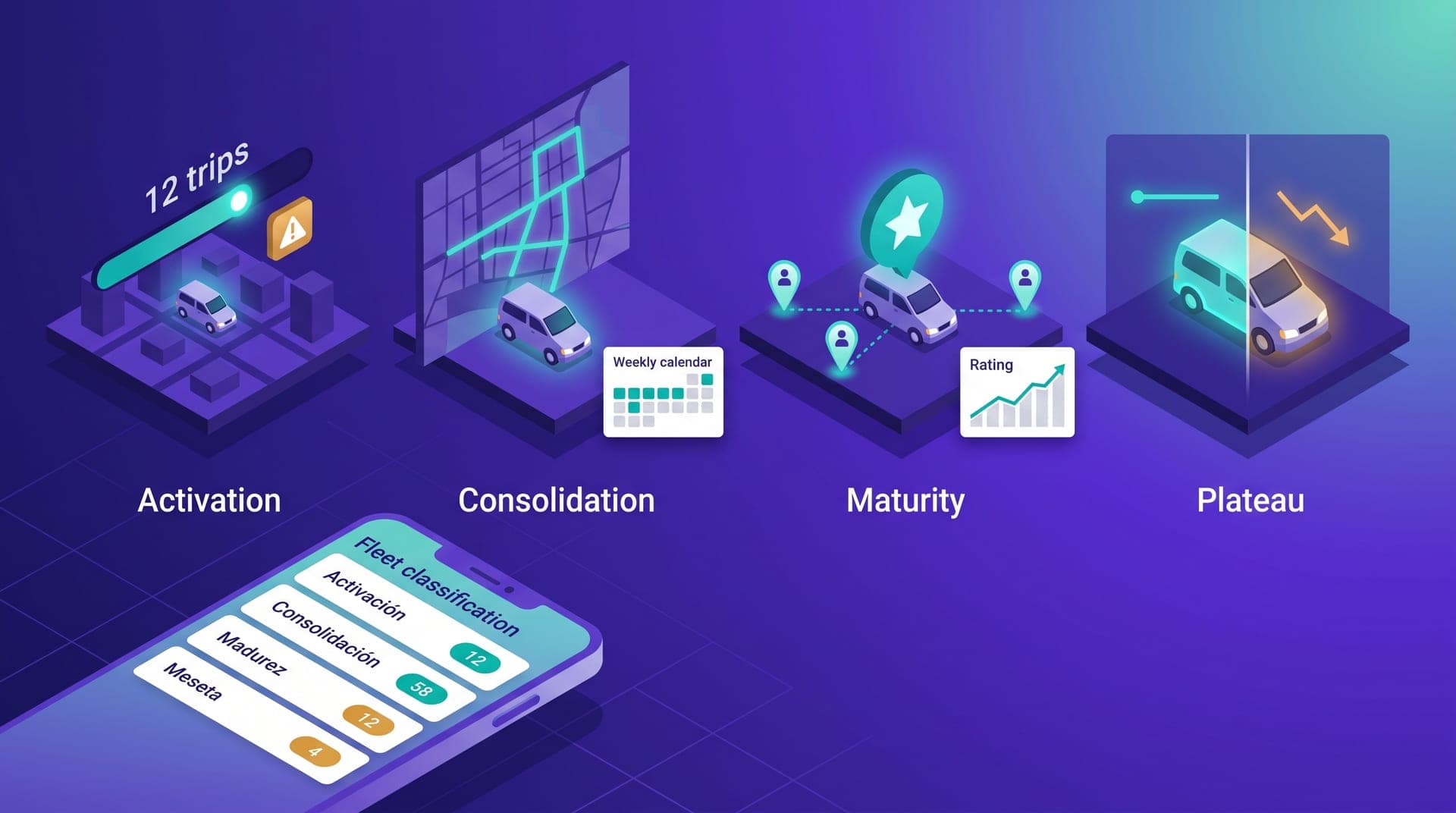
Before executing any contact sequence, the list of drivers without recent trips needs to be divided into three groups with different treatments. The first is the registered-never-active driver: they completed onboarding and have zero historical trips on the platform. Their activation probability with the right sequence is the highest in the group — they haven't had any negative experience yet, their inactivity is probably technical or due to uncertainty about the first trip, and the activation threshold is relatively low. The second group is the early-active-gone-dormant driver: they had between one and ten trips in their first seven days and then disappeared. Their diagnosis is an unsatisfactory early experience — the first trips didn't produce what they expected, or something about the platform's mechanics was difficult to manage. The third is the seasonally dormant driver: they have a real history of twenty or more trips but haven't activated in three or more weeks.
The seasonal driver doesn't need the same stimulus as the other two groups — in most cases their inactivity is circumstantial: working in another sector for a few weeks, personal commitments, or simply that demand in their usual hours dropped and it wasn't worth their time. A message informing them of a concrete demand peak in their usual zone is typically enough to bring them back, with no additional financial incentive needed. Treating them with the same effort and incentive as a never-active driver isn't just an unnecessary cost — it can read as patronizing if the driver has months of platform experience. Correct segmentation avoids that friction and saves between 30 and 45% of the total incentive budget for the sequence.
The two-week sequence: three contacts, two incentives, one checkpoint
Day one of the sequence is the diagnostic contact: a personalized WhatsApp message to the driver by name, acknowledging that they completed registration but haven't taken a trip, and opening a diagnostic question without sales pressure. "Hey [name], we noticed you've been registered for twelve days but haven't taken your first trip yet. Is there anything about the app that wasn't clear, or any questions about how the first ride works?" The goal isn't to push them to take a trip that day — it's to identify whether the inactivity has a technical or uncertainty-based cause before offering any incentive. A driver who responds with a technical question needs immediate support. A driver who doesn't respond in 48 hours moves to contact two with the first-trip incentive.
Contact two happens on day three or four. For the registered-never-active driver who didn't respond to the diagnostic: the first incentive, designed to eliminate the uncertainty of the first trip. "If you complete your first trip this week, we'll credit $[amount] directly to your driver wallet, regardless of the trip's fare." The right amount is enough to ensure the first trip doesn't feel like wasted time regardless of what happens — in most regional markets in Mexico and Central America, $3 to $6 USD meets that threshold. For the early-active-gone-dormant driver, the incentive is different: a minimum income guarantee per session. "If you complete four trips on any day this week, we guarantee a minimum of $[amount] for that session, regardless of the fares you receive." That incentive targets the most common cause of their inactivity directly: the experience of sessions with low income due to circumstances outside their control.
Day seven is the evaluation checkpoint. Drivers who took at least one trip in response to the first contacts move into early-activation follow-up — the goal is for them to reach five trips in the second week, not to celebrate the first and disappear. The third contact for this group isn't an incentive — it's an experience check. "How did the first trip go? Was there anything you didn't know how to handle?" That question produces the most valuable data in the entire sequence: the real obstacles of the first trip in the specific operation, which go directly into the context file to improve onboarding for the next cohort of drivers. Drivers still with no response or trips by day seven receive contact three between days ten and twelve: concrete information about an upcoming demand peak in their usual zone, with no additional financial incentive — just operational context. On day fourteen the final evaluation is made: those who didn't respond or activate with the full stimulus have a future activation probability below 15%, and the registration can be marked as permanently dormant.
The first-trip incentive and the reactivation incentive: why they are not the same
The most common design error in reactivation campaigns is offering the same incentive to all segments. The first-trip credit — a fixed amount credited after completing the first service — is designed to eliminate the uncertainty of a driver who has never taken a trip: regardless of what that first service produces, the driver doesn't waste their time. It's insurance against debut bad luck, not compensation for a negative experience that already happened. For the registered-never-active driver, that credit is exactly the right stimulus. For the early-active-gone-dormant driver — who already had trips and came away feeling the income wasn't sufficient — the same credit doesn't solve the problem: what that driver needs to know is that their next session won't repeat the disappointing result.
The minimum income guarantee per session has a different incentive design: it buys the driver's willingness to try again in a context where they feel more control over the outcome. The guarantee amount doesn't have to be the maximum possible income from a session — it has to be sufficiently above the income they experienced in their most frustrating session. If the driver had a four-trip session that produced the equivalent of $6 USD and left them feeling it wasn't worth it, a guarantee of $18-20 USD for four trips is enough to produce the desired behavior. The operator who designs the reactivation incentive with the correct segment diagnosis spends on average 40 to 50% less per reactivated driver than one who applies the standard incentive to all groups without distinction.
How the agent identifies and prioritizes the reactivation list
The agent query that produces the working list for the sequence needs to include three parameters: the dormancy window (drivers without trips in the last 10-21 days), the registration date (to distinguish recently-registered never-actives from never-actives who have been in the panel for more than 30 days), and the trip history (to separate never-actives from early-actives). With those three parameters the agent can segment the list into different-treatment groups before the coordinator sends the first message. Priority always goes to the registered-never-active driver with less than 21 days since registration: activation probability falls between 30 and 45% after the first three weeks and continues declining until the registration becomes effectively permanent dormant.
The agent can also personalize contact one based on the driver's profile: registered zone, vehicle type, and any note in the history about questions during the onboarding process. A driver who asked a question about how navigation works in the app and never activated receives a more specific first message than one with no prior contact. With the right instruction — "Produce the first diagnostic contact message for each driver on this list, personalizing by usual zone and any prior onboarding queries" — the agent generates a draft per driver that the coordinator reviews in under two minutes and sends. The results of each contact are documented in shift closes, building the history of which type of opening works best in the specific operation and in which zone.
What the reactivation rate reveals about the onboarding process
The two-week sequence has a second benefit that exceeds the direct result of each reactivated driver: it produces the most precise available diagnostic of where the onboarding process is failing. If 60% of registered-never-active drivers have incomplete technical setup, the problem isn't in the reactivation sequence — it's that onboarding doesn't verify the driver completed all technical steps before closing their registration. If the drivers who reactivate fastest are the ones who received a message from the coordinator within the first 48 hours of registration, the data that matters isn't the reactivation — it's that onboarding needs that early contact as a standard step in the process.
A sustained reactivation rate below 20% across the full sequence — with all three contacts and both incentive types — is the signal that the problem is upstream of registration: the onboarding process is delivering technically approved drivers who aren't ready to take their first trip. The fix for that problem isn't in the reactivation sequence — it's in adding a five-minute technical verification to onboarding that confirms the driver knows how to accept a trip, has navigation working on their phone, and understands what happens if the first passenger cancels. Operators who include that technical check before closing a new driver's registration have first-seven-day activation rates between 45 and 65%, compared to the 25-35% of those who close registration after document verification without the functional test. The reactivation sequence is both a recovery mechanism and a diagnostic system for the onboarding process — and that second value is the one that persists after the current pool of dormant drivers has been resolved.
When I reviewed the registered drivers with no trips from the previous 90 days, I found that 38% had never enabled notifications in the app. Technically they had completed registration and uploaded their documents, but they were configured so that no trip requests ever reached them. That's not a motivation problem — it's a step that fell out of the onboarding flow. When we added the notifications check to the close of the onboarding process, the first-seven-day activation rate went from 28% to 51%.
The operator who treats every active fleet gap as a new-acquisition problem is paying an unnecessary cost on inventory they already have. Registered drivers with no trips are qualified inventory: they passed document verification, signed the terms of service, and downloaded the app. Reactivating them costs 60 to 80% less operationally than acquiring a new driver from scratch — without repeating the cycle of posting, interviewing, document processing, and initial setup. In regional markets with a lower density of potential candidates, that difference between reactivating the registered pool and recruiting anew is often the difference between growing the active fleet next week or waiting three weeks to complete the onboarding cycle for new candidates.
The indicator 'active drivers versus registered drivers with no trips this week' — which the operator's weekly review should carry as a permanent reference — has a concrete response lever before activating any new acquisition spend: the two-week sequence. That sequence is light enough for a coordinator to execute in 45 minutes of active weekly work, and the data it produces — which contact worked, which incentive reactivated which driver profile, which technical obstacle appears most often — is the most precise available input for improving onboarding for drivers registering in the following weeks. That's what separates operators who are always short of active drivers from those who built an onboarding process that converts every completed registration into an asset with a high probability of activation from day one.