Most regional ride-hailing operators who launch a driver referral program do it with a straightforward incentive: the referring driver receives 150 to 300 MXN when the referred driver completes their first 10 trips. The most common outcome of that structure in the first 90 days is a 25 to 35% increase in activations — the program works well as a recruitment magnet — and a 90-day retention rate for referred drivers that, in most measured operations, matches or underperforms drivers who joined without any referral. The problem isn't the bonus amount: it's when it's paid. A bonus that pays at activation tells the referring driver their job is done when the candidate finishes their first trips. Referral programs that build a fleet rather than just expanding it structure the bonus across tranches paid over 60 to 90 days, each tranche tied to an indicator that correlates with the referred driver's tenure: first active week, 45 days with regular activity and sustained rating, 90 days on the platform. The total amount can be identical to the activation program; the behavior it produces in the referring driver is fundamentally different.
This article is for operators with 20 to 70 active drivers who have a referral program running without the expected retention results, or who are considering launching one. It covers why the activation bonus produces the wrong behavior in the referring driver; which driver profile should have access to the mentor program; how to structure the bonus in three tranches so the economic incentive does the mentorship work without a formal training program; why the rating of the referring driver predicts the quality of the driver they recruit; what activation and retention metrics are realistic in the first 90 days; and the agent query that confirms whether referred drivers in your operation are performing differently from non-referred drivers. The thesis is direct: a well-structured referral program doesn't need a larger bonus than a poorly structured one — it needs to distribute the same amount in a way that gives the referring driver economic incentive to accompany the referred driver beyond day ten.
The standard program and why it generates activations without retention
The standard referral program in regional ride-hailing operations borrowed its design from the consumer referral model: the referring person receives a reward when the referred person completes their first value action. That model works well for passenger referrals, where the value action is a single transaction and the referrer has no role in ensuring the passenger returns. With drivers, the logic is different: the highest abandonment-risk moment isn't activation but the period between days 8 and 25, when the new driver still has a low rating from few reviews, when wait times for their first trips seem long compared to their expectations, and when weekly income still doesn't reflect what they'll earn once they've learned the platform. During that critical period, the referring driver who already collected their bonus has no economic reason to check how the driver they brought in is doing.
In operations where 90-day retention of referred drivers was measured against drivers who joined through other channels — social media, flyers, passenger recommendations — the difference when the program uses a simple activation bonus is marginal: the referred driver is 5 to 12% more likely to reach day 90 than the non-referred driver. That small gap doesn't justify the cost of the bonus if the program's stated objective is retention. The reason is that the only value the activation bonus adds is an initial filter: the candidate arrived because someone they know already operates on the platform and can answer questions before activating. That filter screens out the most uninformed candidates, but doesn't solve the primary early retention problem: the gap between the new driver's expectations and the reality of the first 15 days of operation on any regional mobility platform. In programs where the bonus has payment tranches linked to the referred driver's activity at 45 and 90 days, the retention difference between referred and non-referred drivers rises to the 20 to 30% range.
The activation bias: what the bonus timing tells the referring driver
The bonus timing isn't a program design detail: it's the most important signal the program sends to the referring driver about what's expected of them. A bonus that pays at activation optimizes the referring driver for the recruitment conversation: they need to convince the candidate it's worth activating on the platform. That conversation tends to be systematically incomplete. The referrer mentions possible earnings on a good shift, schedule flexibility, and platform support, but omits or minimizes the factors that drive early churn: the first 10 days with few reviews and an unconsolidated rating, short low-fare trips while the driver learns the high-density zones, vehicle inspection requirements if applicable. It isn't necessarily bad faith: it happens because their incentive is to secure activation, not to prepare the candidate for the hardest period. The tranche bonus inverts that logic. The referring driver who knows that collecting the second tranche at 45 days depends on their referred driver being active with a good rating at that point has a direct incentive to give complete information from the start — including aspects that might discourage a candidate with incorrect expectations — and to check in with the referred driver during weeks 2 and 3, which are the highest abandonment-risk weeks.
The mentor driver profile: who should have access to the program
Not every active driver in the fleet should have the ability to refer with a mentor bonus. A driver with a 4.1 average rating who refers a candidate implicitly conveys that operating on the platform at that rating is the norm. That calibrates the new driver to a standard the operation doesn't want propagated: the expectation that a 4.1 rating is operationally viable long-term. The minimum profile for a driver to have access to the structured referral program includes four verifiable conditions: average rating over the last 60 days at or above 4.5 stars, at least 4 months on the platform, cancellation rate below 12%, and an average of at least 5 trips per active day in the last 30 days. That group typically represents 15 to 25% of the active fleet in a regional operation with 30 to 80 drivers. Restricting the program to that cohort isn't exclusion: it's a guarantee that the referring driver is positioned to show, through their own operation, what working well on the platform looks like.
The restriction has a second, less obvious effect: it increases the perceived value of the program among drivers who don't yet qualify. A driver with 3 months on the platform and a 4.3 rating who knows they could access the mentor program within a month has an additional incentive to improve their indicators. The structured referral program, when communicated clearly to the full fleet with its access criteria, also functions as an internal development mechanism: it doesn't only propagate the culture of the best drivers toward new ones, but motivates growing drivers to reach the indicators that will give them access. The operator's communication should be transparent about the criteria and avoid framing them as a penalty for those who don't qualify: they are the quality standard the operator wants represented to every new candidate.
The three-tranche structure: the bonus that works for 90 days
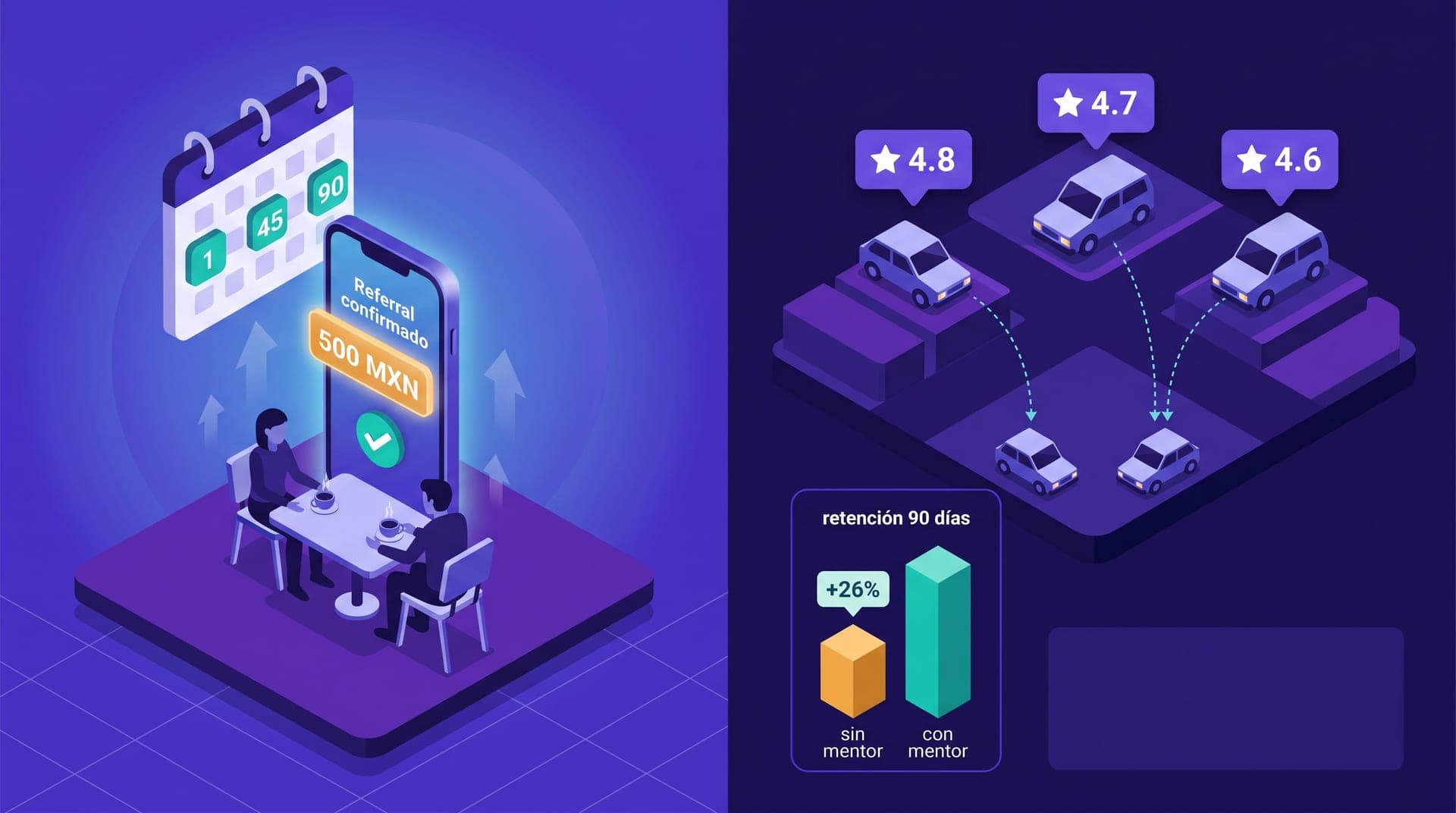
The concrete three-tranche bonus structure doesn't require a complex technology system: it requires the operator to define three time-measurable conditions and communicate the timeline to the referring driver before the process begins. An example with a total of 480 MXN — an amount in range with the activation bonus in many regional operations — distributed as follows: the first tranche of 150 MXN pays when the referred driver completes their first 10 trips in the first 7 active days, confirming that the activation was real and not just a registration without activity. The second tranche of 200 MXN pays when the referred driver reaches 45 active days with an average rating at or above 4.3 stars and an average of at least 4 trips per active day — indicators confirming the driver is working regularly and maintaining the minimum quality standard. The third tranche of 130 MXN pays when the referred driver reaches 90 active days with a sustained rating of 4.4 or above. The referring driver who wants all three tranches needs their referred driver to be active and performing well at days 45 and 90: they have concrete economic reasons to contact them in week 3, when abandonment risk peaks, and in week 8, before the second tranche cutoff.
The three tranches of the structured bonus and what behavior each produces in the referring driver:
- **Tranche 1 — Day 7, first 10 trips completed (150 MXN)**: confirms real activation. The referring driver makes sure the candidate arrives active, not just registered. Produces the preparation conversation before the first shift.
- **Tranche 2 — Day 45, rating ≥ 4.3 and ≥ 4 trips/active day (200 MXN)**: the most behaviorally valuable tranche. The referring driver has direct incentive to accompany the referred driver from days 8 to 25 — the highest abandonment-risk period — before the tranche window closes.
- **Tranche 3 — Day 90, active rating ≥ 4.4 (130 MXN)**: confirms the referred driver reached the tenure the operation needs. For the referring driver, the third tranche validates that their onboarding process worked; for the operator, it's the indicator that the program is producing fleet, not just activations.
Why the referring driver's rating predicts the referred driver's quality
The pattern that appears consistently in operations that have measured 90-day indicators for referred drivers segmented by referring driver rating: referrals from drivers rated 4.7 or above have 90-day retention rates 18 to 28 percentage points higher than referrals from drivers rated 4.2 to 4.4. Two mechanisms explain this pattern. The first is expectation transmission: the 4.7-star driver talking with a candidate describes what operating at that level requires — punctuality, clean vehicle, passenger interaction, initially low ratings while building a review history. The candidate who activates with that information arrives with expectations calibrated to the reality of high-performance work. The 4.2-star driver transmits expectations calibrated for 4.2: the new driver arrives believing that's the operational standard, and in the first 30 days when their rating is between 4.1 and 4.3 from lack of history, they feel no urgency to improve because the referring driver implicitly told them that range is acceptable. The second mechanism is selection filtering: the driver who works to high standards tends to refer candidates they evaluate as capable of maintaining those standards, not just any acquaintance who needs work.
Realistic metrics in the first 90 days of a structured program
The retention benchmarks for a referral program with tranche structure, restricted to mentor drivers rated at or above 4.5 stars: in the first 30 days, an operation with 25 to 60 drivers and 5 to 12 active mentors can expect 2 to 6 monthly activations via referrals. That's a lower number than the simple activation program, and it's correct that it should be: the referrer pool is smaller and the quality restriction reduces the number of available candidates. What changes is the quality of those activations. 30-day retention for referred drivers with a mentor structure ranges from 75 to 85%, compared to 55 to 70% for referred drivers with a simple activation bonus. At 90 days, structured retention is between 55 and 70%, versus 35 to 50% for unstructured referrals. The average rating of the referred driver at 60 days in structured programs tends to be within 0.1 to 0.2 stars of the referring driver's rating — a signal that standards transmission is working. The cost per driver retained at 90 days in the structured program, with a total bonus of 400 to 500 MXN, is 40 to 60% lower than in the simple activation program to produce the same number of active drivers at that horizon, because the structured program recruits fewer drivers but loses fewer of them.
The agent query that verifies whether referred drivers perform differently in your operation
Verifying the differential performance of referred versus non-referred drivers in historical operation is the first step before redesigning the program. The agent query that produces that verification: 'For drivers activated in the last 18 months, separate two groups: those who joined through a referral from an active driver on the platform, and those who joined through other channels. For each group, show 30-day and 90-day retention, average rating at 60 days after activation, average trips per active day at 45 days, and the percentage who completed at least 30 active days. If the referred group shows 90-day retention more than 10 percentage points above the non-referred group, the referral channel is adding real fleet value. If the difference is under 10 points, the current program generates activations but not retention — and redesigning the bonus toward tranches is the primary intervention.'
The second query that calibrates impact by referrer profile: 'For the referred drivers from the previous analysis, segment the 90-day results by the rating range of the driver who referred them: 4.6 stars or above versus 4.2 to 4.5. Show me 90-day retention, average rating at 60 days, and average trips per active day at 45 days for each group. If the 90-day retention difference between the two referrer rating ranges exceeds 15 points, program access should be restricted to drivers above the higher threshold.' The two queries together take under 15 minutes and determine whether the problem with the current program is the bonus structure, the referrer profile, or both. For the operation that has no historical referral data because the activation channel was never recorded, the first step is to start recording it for every new activation before launching any structured program.
I'd had a referral program since year one. When I reviewed the data I realized 80% of the drivers I had referred and paid for were off the platform within 60 days. I was paying 250 pesos at activation and then had no idea what happened to them. I changed the program: I split the bonus into three payments — at day 7, day 45, and day 90 — and only offered it to my five drivers rated 4.7 or above. My referred drivers went from an average of 48 active days to 94 active days. The only things I changed were when I pay and who I give the option to refer.
A referral program with an activation bonus is a recruitment mechanism with a social validation moment: the candidate arrives because someone they know already operates on the platform. That is valuable, but it isn't enough to build a fleet. The tranche program converts that recruitment mechanism into a culture transmission system: the referring driver with economic incentive to accompany the referred driver for 90 days transmits their operational standards, their expectations about the work, and their practical platform knowledge without the operator having to build a formal mentorship program with training sessions and instructional materials. The operator is outsourcing part of the onboarding process to their best-performing driver and paying them with the same bonus they previously paid for activation. The structure distributes the work; the cost can be identical.
Restricting the program to the top 15 to 25% of performing drivers has a secondary effect few operations anticipate: it improves the perceived standard of the program for the rest of the fleet. The driver working toward the rating and tenure thresholds doesn't do it only because they want to refer — they do it because the mentor program functions as a status signal within the fleet. Those who qualify are the ones the operator considers good enough to represent the platform to new drivers. That perception, when communicated clearly and without pretension, turns the referral program into an internal development lever that improves existing fleet quality while simultaneously adding new drivers. The total bonus amount doesn't need to be larger than an activation bonus; the design of when it pays and who can participate does the work the amount never could.