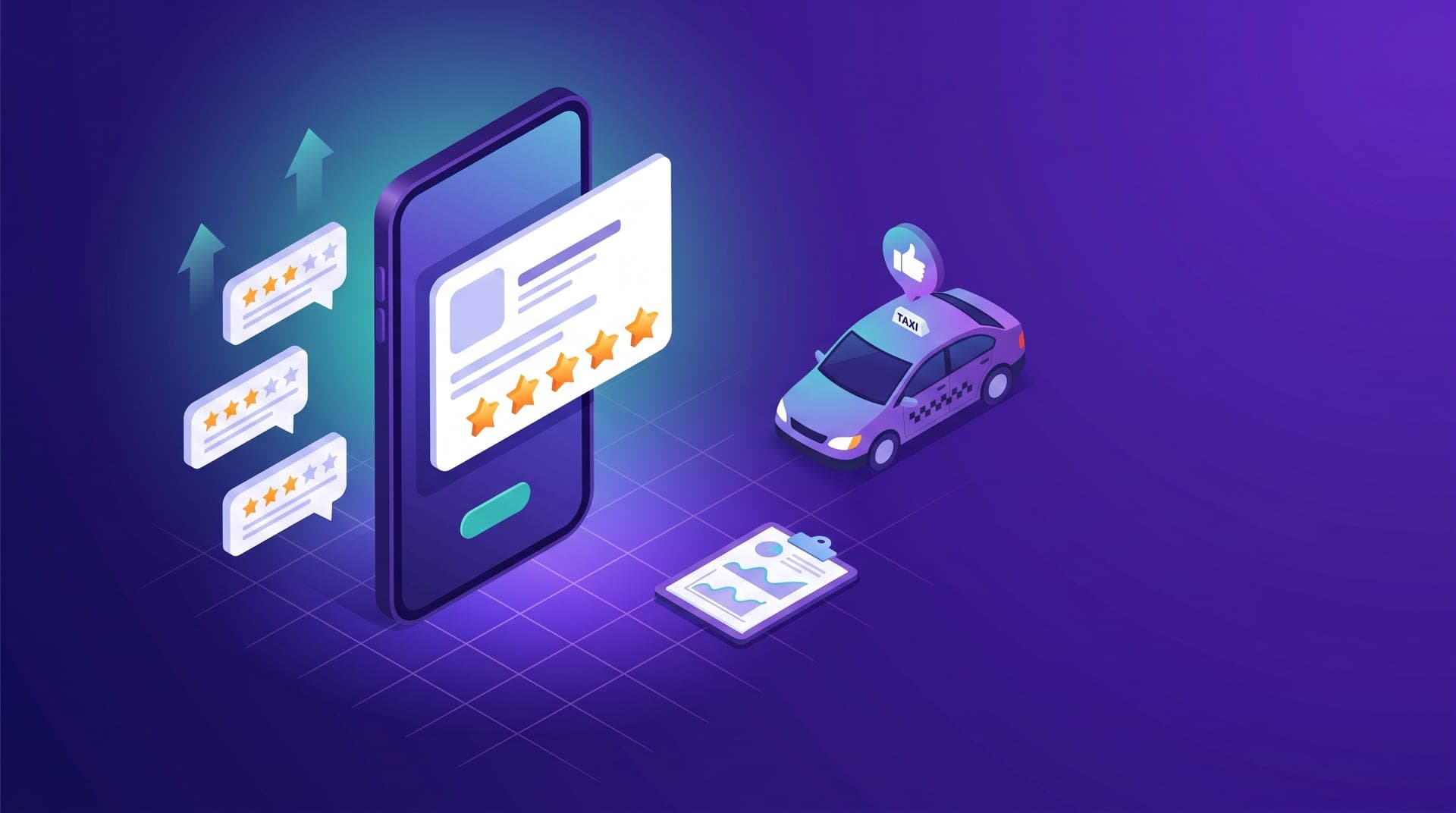
When a new passenger looks for your taxi app on Google Play or the App Store, the first thing they see after the name is the rating. Before reading the description or looking at the screenshots, they decide whether to trust an app with three stars and four angry comments. For many regional fleets, that page is the first impression of the service, and almost nobody is looking after it.
The thesis of this article is that your app's reviews aren't a marketing issue but an operational one. Stars move because of what happens on the street: arrival times, driver manners, charges that don't add up. We'll look at why negative reviews arrive on their own and positive ones don't, when and whom to ask for a rating, how to answer what's already published and how to turn those comments into operational improvements.
Why the rating weighs more than it seems
In a regional city, your app competes in the store with global platforms that have millions of ratings. You won't beat them on volume, but you can win on what the local passenger sees: a high rating and recent comments that mention their city, drivers with names and a service that responds. An app with a few recent good reviews conveys more trust than one with many old, lukewarm ones.
The rating also affects people who already know you. A frequent customer who recommends your app to a relative loses credibility if the relative opens the store and sees two stars. And for drivers thinking of joining the fleet, an app with a bad reputation in the store is a sign the business isn't doing well, even if that isn't true.
And keep in mind that the stores mainly show recent reviews. A low rating built up during a bad season can recover within a few months if the new comments are good, because what visitors see is what has happened lately, not what happened a year ago.
Why bad reviews arrive on their own
There's an asymmetry that explains almost every low rating for mobility apps: a satisfied passenger reaches their destination, pays and forgets the app until the next trip. An annoyed passenger, on the other hand, has a reason to open the store and write. That's why an operation that works well on 95% of trips can have a rating that seems to describe a mediocre service.
The complaints that appear most in the stores aren't usually about the app itself either. They're about the operation: a driver who didn't arrive, a long wait at peak time, a charge different from the estimate, unfriendly treatment. Reading negative reviews through that lens changes the reaction: instead of getting defensive, the operator finds a list of real problems that passengers are describing for free.
There are also reviews that don't describe a trip but a misunderstanding: people looking for another app, drivers leaving their complaint in the passenger app, or customers rating before they've used the service. They're worth answering. A short reply clarifying what it's about and where to go serves whoever reads the listing later and stops the comment from looking like an unanswered complaint.
When and whom to ask for a review
The way to correct the asymmetry isn't to buy or invent reviews, which the stores penalise and passengers can spot, but to ask the people who are already happy, at the moment they are. These are the situations in which a request usually works best:
- After the third or fourth trip, when the passenger already trusts the service.
- When a customer thanks the driver or the dispatch team for something specific.
- After solving a complaint well: a problem handled properly creates loyalty.
- With frequent customers and companies that use the service every week.
- After a special trip, such as a punctual airport transfer.
The request works best when it's personal and short. A message from dispatch on WhatsApp saying "it would really help us if you left your opinion of the app in the store, here's the link" converts better than a generic notice, because it comes from someone the customer has already dealt with. And it's best not to ask someone who just had a bad trip: solve the problem first, ask for the opinion afterwards.
One detail that makes a difference: drivers can be your best allies in getting reviews, as long as they don't pressure the passenger. A driver who, at the end of a good trip, mentions naturally that a store review helps the local fleet usually gets more responses than any campaign, and the passenger experiences it as a friendly gesture, not a sales pitch.
How to answer reviews that are already published
Both Google Play and the App Store let the developer reply publicly to every review from their console. That reply is read by the author and by everyone who visits the listing afterwards. That's why a good reply isn't written only for the person who complained: it's written for the next passenger deciding whether to download the app.
The replies that work best share the same structure: they acknowledge the problem without arguing, explain in one line what was or will be done, and offer a direct channel to solve it, such as the dispatch WhatsApp. Avoid copy-pasted replies that say the same thing to everyone, and avoid discussing trip details in public too: if a case needs reviewing, take it to a private channel.
Replying to positive reviews has value too. A "thank you, we'll let Pedro know" shows that there are people behind the app and that drivers are recognised. And when a passenger sees that their complaint got a reply and the problem was fixed, they sometimes come back and change their rating on their own.
For months we didn't look at the store reviews and we had three stars. We started replying to every comment and asking our regular customers for their opinion on WhatsApp. Within a few weeks reviews appeared that mentioned drivers by name, and new people told us they'd chosen us because of that.
From review to operation
Reviews are a source of information that many fleets waste. Sorting them once a week, even in a simple spreadsheet, quickly shows where the recurring problems are. A practical way to group them is this:
- Waiting time or drivers who don't arrive.
- Driver manners or behaviour.
- Charges, fares or differences from the estimate.
- Problems signing up or booking the trip in the app.
- Positive comments about specific drivers.
If a category grows week after week, there's a pending operational decision there: more drivers in a time slot, a conversation with a particular driver or a fare that needs explaining better. And the last category matters too: drivers who receive public praise deserve to know it, and sharing it with the fleet reinforces exactly the behaviour that improves reviews.
Set a response time too. A negative review left unanswered for weeks signals that nobody is watching; one answered the same day or the next shows the opposite. You don't need a dedicated team: it's enough for someone at dispatch to check the store console once a day, just as they check WhatsApp messages.
The store listing matters too
Reviews don't live on their own: they appear next to the description, screenshots and the app name. A listing that clearly explains which city the service operates in, how to book a trip and how to pay reduces negative reviews caused by wrong expectations, such as the passenger from another city who downloads the app and finds no drivers. Review the listing as often as the reviews.
Stars are earned on the street
No review strategy makes up for an operation that doesn't deliver, but many operations that do deliver have a rating that doesn't show it. The difference lies in three simple habits: asking happy customers for their opinion, replying to every comment and using what passengers say to decide what to fix.
Start this week with the smallest step: read your app's last twenty reviews, reply to those without an answer and prepare the message with the store link for your frequent customers. Within a month, your app's listing will start to look more like the service you provide on the street.