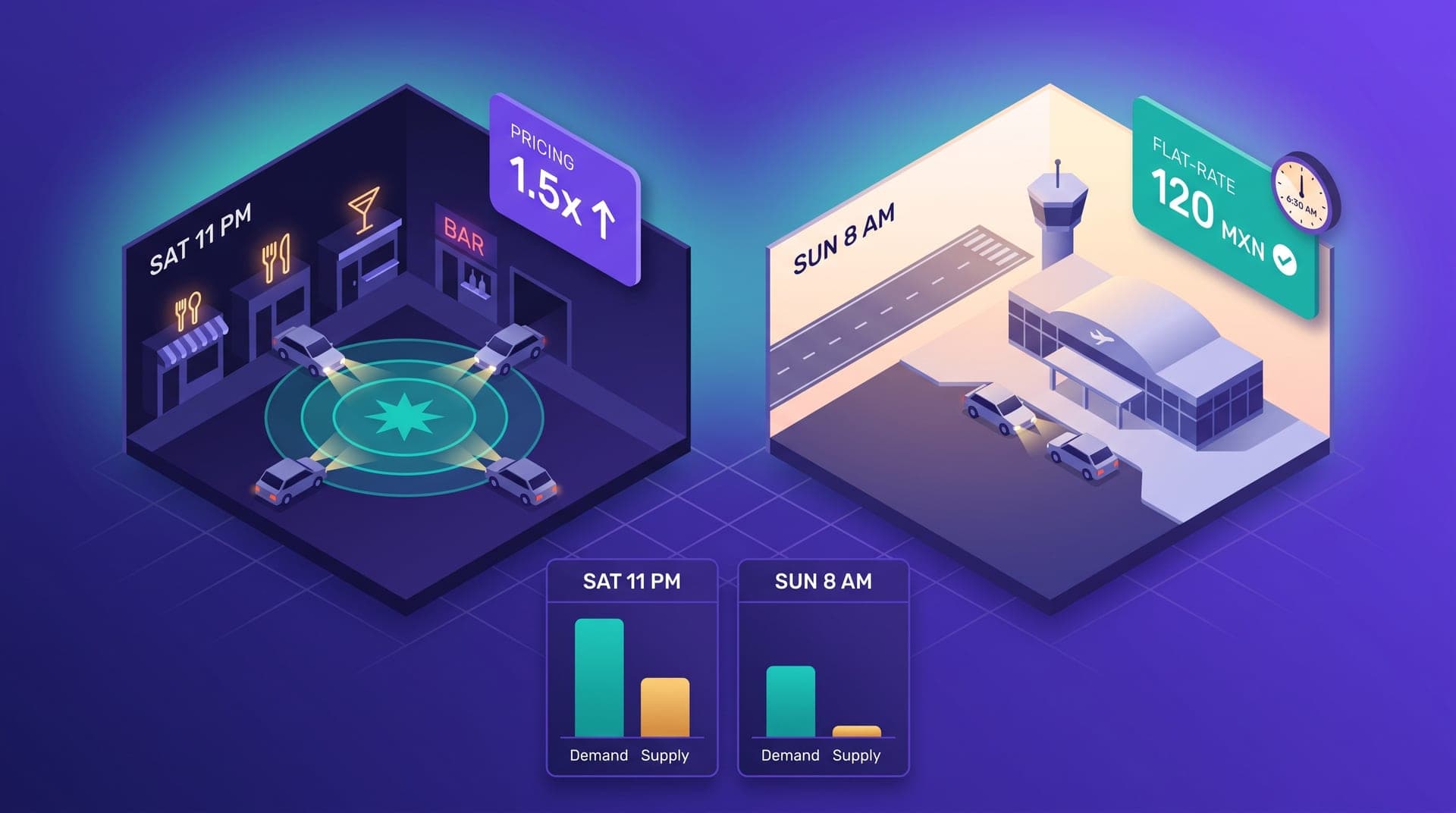
Weekend demand in a regional ride-hailing operation is not Monday demand multiplied by a volume factor. The trip profile is different — longer average distances, origin and destination points more concentrated in specific zones, passengers with qualitatively different urgency dynamics — and driver supply structure is as well. In cities of 150,000 to 500,000 residents in Mexico and Central America, the weekend concentrates two operational blocks that cannot be covered with the same logic: Saturday night — a block of leisure demand compressed into 3 to 4 hours arriving in short bursts from restaurant and bar zones — and Sunday morning — a block of early traveler demand with low cancellation rates, concentrated at airports, bus terminals, and hotel zones, beginning before most fleet drivers are connected. Managing both blocks with the same pricing, incentives, and coverage configuration as the midweek daytime operation produces systematically worse results in both.
This article is for operators with 20 to 80 active drivers whose weekend completion rate sits 8 to 15 percentage points below their Tuesday and Wednesday rate, without being able to isolate whether the problem is in Saturday night, Sunday morning, or both. It covers why the weekend demand profile is structurally different from the midweek profile and why that distinction matters operationally; why Saturday at 11 PM and Sunday at 8 AM have opposite operational logic requiring different responses; how driver supply structures differently in each block; what pricing works for Saturday night and why flat rates outperform percentage surcharges for Sunday morning in traveler zones; which zones concentrate demand in each window; and how to isolate weekend performance in the Monday review so the weekly average doesn't mask problems in specific blocks. The thesis is practical: most weekend operation problems don't require more drivers — they require available drivers to be in the right zones at the right moments, with a compensation structure specific to each block.
Why the weekend doesn't work like a Tuesday with more demand
The average weekend trip in regional operations in Mexico and Central America is 30 to 55% longer than the average weekday trip in the same market. The explanation is the origin-destination mix: weekday trips concentrate workplace-to-home commutes, shopping centers, and routine errands — short distances within familiar zones. Weekend trips include transfers to leisure zones that in many markets are farther from residential fabric, airport and bus terminal runs, and social trips where the passenger is willing to ride 15 to 20 minutes rather than walk 5 blocks. That changes the operational geometry: a longer trip generates higher gross income per trip for the driver, but it also keeps the driver out of circulation longer, reducing the number of serviceable trips per hour for remaining demand. In a fleet of 30 drivers with a 12-minute average weekday trip, raising the average to 19 minutes on Saturday night reduces the number of completable trips per hour by 35 to 45% without a single driver leaving the fleet.
The second structural factor is temporal concentration. A typical Tuesday in a market of 280,000 residents delivers demand in two sustained peaks of 60 to 90 minutes — morning and afternoon — with continuous residual flow between them. Saturday demand has a 60-to-90-minute peak around 12:30 to 1:00 AM that concentrates 35 to 45% of that day's total night volume, followed by thin residual through 3:00 AM. Sunday morning has a demand block that starts at 5:30 or 6:00 AM — airport and terminal trips — and holds through 10:30 or 11:00 AM before dropping sharply. Between those two weekend peaks, volume falls to 5 to 15 requests per hour — residual that doesn't justify keeping specific incentives active or drivers positioned in high-demand zones. The operator who distributes the weekend fleet evenly across the day misses both peaks and only covers the residual, which is the lowest economic opportunity window.
Saturday at 11 PM vs Sunday at 8 AM: two peaks with opposite logic
The Saturday night peak shares the logic of the weekday night block — leisure demand, short bursts, passengers with low wait tolerance in the first 3 minutes — but at significantly higher volume. In a market of 280,000 residents, the Saturday window between 12:30 and 1:15 AM can generate 55 to 90 requests in 45 minutes — comparable to Monday's morning peak, but in half the time. That compression requires driver supply to be positioned before the peak, not to react to it. A driver who receives a request from the restaurant corridor at 1:00 AM and is 3.8 km away takes 10 to 14 minutes to arrive — the passenger cancelled at minute 3. Saturday night works well only when 8 to 12 drivers are positioned in the 2 to 3 zones with the highest night demand concentration before 11:45 PM, before the first requests in the peak window arrive.
The Sunday morning peak has the opposite logic. The passenger who opens the app at 6:30 AM to reach the airport knows their flight is at 9:00 AM and they need to be there 45 minutes early. Their urgency is high — but it is not the urgency of someone who can't wait more than 3 minutes: it is the urgency of someone who faces a concrete and avoidable consequence if the platform fails. That passenger tolerates up to 8 to 10 minutes of wait if the platform shows a driver en route with credible tracking information. What they don't tolerate is driver cancellation after acceptance: if that happens, they find a street taxi immediately and don't use the platform for that type of trip again. The functional difference between the two peaks is behavioral: Saturday night requires short approach time to capture the request before the passenger cancels; Sunday morning requires assignment reliability, even if approach time is a few minutes longer.
Why driver supply structures differently on weekends
Active fleet composition shifts on weekends through two mechanisms. The first is presence: drivers with fixed family or religious commitments on Sunday morning — representing 45 to 60% of the fleet in many markets — disconnect before 8:00 AM or don't connect until 10:00 or 11:00 AM. In a fleet of 40 active drivers, that leaves between 10 and 18 connected at 6:30 AM on Sunday. If demand in that block generates 25 to 40 requests per hour in traveler zones, coverage is insufficient for available volume — not because there is no demand, but because supply is not present in the time slot where the demand is. The second mechanism is preference: some drivers actively prefer Saturday night for the combination of longer trips — and higher gross income per trip — with the potential of a night surcharge. Those drivers rarely work Sunday morning because shorter trips at the daytime base rate produce more trips per hour with less effort.
The operational consequence is that the two weekend blocks don't share the same drivers. The driver who consistently covers Saturday night and Sunday morning in the same weekend represents 10 to 20% of the fleet in operations of 30 to 80 active drivers. That low overlap means the incentive strategy can't be the same for both blocks: drivers who respond to a 100 to 120 MXN stay-connected bonus on Saturday at midnight are not the same drivers who would connect at 5:30 AM on Sunday for an airport zone incentive. The operator who configures a single weekend incentive — active all day Saturday and Sunday — overpays drivers who would work Saturday night voluntarily and underpays to attract the drivers who could cover Sunday morning. The two blocks need independent incentive structures because they attract different driver profiles.
Weekend pricing: percentage surcharge vs flat rate in each block
Saturday night pricing works with the same logic as the weekday night block: a surcharge of 1.3x to 1.6x over base rate in the 11:30 PM to 1:30 AM window raises the driver's per-trip income — compensating for the discomfort cost of weekend night work — without destroying conversion, because passenger price elasticity is structurally lower in that block. The difference from the weekday night is volume: with more requests per 30-minute interval, the surcharge should activate earlier — at 11:00 PM or 11:30 PM — rather than waiting for the midnight peak, because demand is already high 30 to 45 minutes before. Activating the surcharge before the peak produces the economic signal that keeps drivers connected who might otherwise disconnect before 1:00 AM, when residual demand is still present.
Sunday morning pricing follows a different logic. The airport or terminal passenger on Sunday at 6:30 AM has imperfect knowledge of what the trip should cost — they don't make that route often enough to have a solid reference — but they expect the price to be predictable before they leave home. A dynamic percentage surcharge creates uncertainty about the final cost — the passenger doesn't know how much they'll pay when they request — which raises pre-assignment cancellations among price-sensitive passengers. A flat rate with a fixed surcharge — for example, airport route plus 15 to 20% over base rate, visible before the passenger confirms the request — converts better in that block because it eliminates uncertainty about the final amount while compensating the driver for the longer airport approach. In operations where the airport is 15 to 25 minutes from the center, the flat rate also reduces driver rejection: the driver knows what they'll earn before accepting, eliminating the calculation of whether the outbound trip is worth it.
The zones that matter Saturday at midnight and those that matter Sunday at dawn
Weekend demand geography is more concentrated than weekday geography. In most cities of 150,000 to 450,000 residents, 70 to 85% of Saturday demand between 11 PM and 1:30 AM originates in 2 to 4 specific zones: the restaurant and bar corridor, the entertainment zone or main square with night-active businesses, and the hotel strip if it concentrates nighttime activity. Those zones are not always the same ones that concentrate demand on Tuesdays at the same hour: establishments active on Saturday night are a superset of the midweek-active ones, and request density per km² in the Saturday leisure corridor can be 3 to 5 times higher than any weeknight. Pre-positioning 8 to 10 drivers in those 2 to 3 zones by 11:30 PM Saturday produces an 85 to 92% completion rate in that window. Distributing the same fleet without zone-specific Saturday instructions produces 55 to 70% completion in the same block.
The four zones that concentrate weekend demand and the time block in which each is the priority:
- **Restaurant and bar corridor — Saturday, 11 PM to 1:30 AM**: the zone with the highest request density in virtually every regional market during the Saturday night peak. Concentrates 55 to 70% of Saturday night requests. Positioning 6 to 8 drivers here before 11:45 PM covers most of the peak without depleting other zones.
- **Airport and bus terminal — Sunday, 5:30 to 10:00 AM**: the two highest-demand points on Sunday morning. Trips are longer — 15 to 25 minutes average — with higher per-trip driver income and low cancellation rates. They require drivers connected before 6:00 AM, not at 8:00 AM when most of the fleet activates.
- **Main hotel zone — both blocks**: generates sustained requests both Saturday night — guests returning from outings — and Sunday morning — early departures — but with opposite direction flows. Position in the hotel zone complements airport positioning and rarely competes with it at the same moment.
- **Main square and historic center — Saturday, 10:30 PM to 12:30 AM**: the second demand node on Saturday night in cities with open-air nightlife. Generates a burst of requests before the bar corridor peak — early-leaving passengers — and drops before 1:00 AM.
The Monday review: how to isolate weekend performance from the weekly average
The weekly completion rate metric masks weekend performance when the Monday-to-Friday average is above 85%. An operator with 87% weekly completion can have 60% on Saturday night and 65% on Sunday morning without that data being visible on the summary dashboard. The Monday review must include a differentiated diagnostic for the two weekend blocks: Saturday completion between 10:30 PM and 2:00 AM, and Sunday completion between 5:30 AM and 11:00 AM. The agent query that produces that diagnostic: 'For last weekend — Saturday and Sunday — show me: completion rate and median wait time for the Saturday block from 10:30 PM to 2:00 AM, and for the Sunday block from 5:30 AM to 11:00 AM. For each block, include the two zones with the highest volume of unserved requests, the number of drivers connected per hour, and the median driver rejection rate. Compare with the same weekend from the prior two weeks and flag any block that worsened by more than 5 percentage points week over week.'
Comparing weekend performance against the same weekend from the prior week — not against the midweek average — is the adjustment that makes the diagnostic interpretable. A rainy Saturday night produces completion rates 10 to 15 percentage points below a dry Saturday in the same market: the week-over-week comparison identifies whether the drop is structural or incidental. Comparing the weekend against the Monday-to-Wednesday average creates systematic distortion because the two types of operation have different reference rates — Saturday night at 72% completion can be good or bad depending on the prior Saturday, but compared to 89% on Tuesdays it creates the false impression that the whole weekend is performing poorly. The operator who runs this query every Monday has the two most critical weekly blocks diagnosed in 10 minutes, without reviewing the general summary to find them.
When I started reviewing Sunday morning as a separate block, I found it was the highest income-per-active-hour window of my whole week for the drivers who worked it — airport trips of 22 to 28 minutes, high fares, low cancellations. The problem was I had nobody connected before 8:30 AM. I started offering 90 MXN extra to position at the airport or terminal between 6:00 AM and 9:00 AM on Sundays. In four weeks, five drivers made that shift a permanent part of their weekly routine. My Sunday morning completion rate went from 58% to 89% without changing anything else in the operation.
The weekend generates the two blocks with the highest income potential per trip in the week — Saturday night through concentrated demand combined with a viable night surcharge, Sunday morning through long-distance traveler trips with low cancellation rates — and the two most likely to build the market impression that the platform doesn't work when needed. A passenger who tried the app Saturday at 12:45 AM and found no driver available won't try the following Saturday: they build the habit of defaulting to another option. A passenger who missed a flight or arrived late at the terminal because the driver cancelled after accepting won't use the platform for airport trips. Those experiences — formed in the two weekend blocks — affect midweek use as well, because a passenger who stopped trusting the platform for their highest-urgency moments gradually trusts it less for lower-urgency ones too.
The adjustments to cover both weekend blocks require neither fleet expansion nor product changes. They require configuring each window independently: a night surcharge active from 11:00 PM Saturday, a zone-specific positioning incentive for Sunday drivers between 6:00 AM and 9:00 AM, and differentiated zone instructions for each block — restaurant corridor Saturday night, airport and terminal Sunday morning. In operations where those blocks were uncalibrated, that configuration produces 15 to 25 percentage point improvements in combined weekend completion rate. The Monday review that isolates each block's performance from the weekly average takes 10 minutes and produces the diagnostic that determines whether this weekend's configuration worked or needs adjustment before the next one.