Senior transportation is one of the most underserved demand segments in LATAM urban mobility, and most regional ride-hailing operators don't have it as an active business line because the standard on-demand model doesn't work well for this user. The senior who needs regular transport to a clinic, a physical therapy appointment, or a relative's home doesn't fit the typical platform user profile: in many cases they don't navigate apps, don't have a linked credit card, and distrust the idea of an unknown driver showing up at their door with nothing more than a photo and a name. Ignoring that mismatch produces an operation that technically has the service available but in practice generates no trips from this segment. The argument of this article is that seniors can be a profitable segment for any regional operator, provided three specific variables are resolved: the channel through which bookings arrive, the driver profile receiving the assignment, and the mechanism through which the trip is billed.
This article is for operators with 50 or more active drivers in cities where there is a senior population with regular transport needs and no family member available to drive them every time. The natural market is adults between 65 and 80 with reduced but not absent mobility — people who can travel alone in a vehicle but face real barriers with technology and with the unknown-driver model of standard on-demand. These are not users who will download the app on their own and learn it in a week: they are users whose family members will onboard them into the service, and who will then use it with assistance or independently if the initial experience works. Understanding that onboarding process — who initiates it, who sustains it, and what causes it to fail — is the first step toward turning this segment into a source of recurring, low-cancellation trips.
Why seniors don't use ride-hailing apps by default
The on-demand model has three characteristics that create specific friction for seniors as direct users. The first is the booking flow: enter origin, search destination, select service type, review price, confirm. For a 70-year-old with no prior mobility app experience, that four-to-six-step flow requires learning that doesn't happen naturally on first installation. Apps are optimized for frequent users who have the flow memorized — first use and infrequent use are systematically harder than habitual use. A senior who takes a trip to the clinic once a week never reaches the automation level that makes the experience feel smooth, and that accumulated friction at every booking becomes the main reason they stop trying.
The second barrier is digital payment. Among seniors in LATAM, active use of debit or credit cards for in-app payments is meaningfully lower than in the 25-to-50 age group. A 72-year-old in a mid-size city may have a card but not have it registered in any app, may not remember the CVV, or may distrust automatic charges without a physical receipt. Platforms that require digital payment as the only option effectively exclude this user. The third barrier is driver uncertainty: unlike the typical on-demand passenger who has normalized getting a different driver every time, seniors often have a stronger aversion to strangers — especially in the context of being alone in a vehicle with someone they don't recognize. That resistance is not irrational: it is the response of someone for whom a driver is not an anonymous service but a person who either is or is not trustworthy.
The family member as booking intermediary
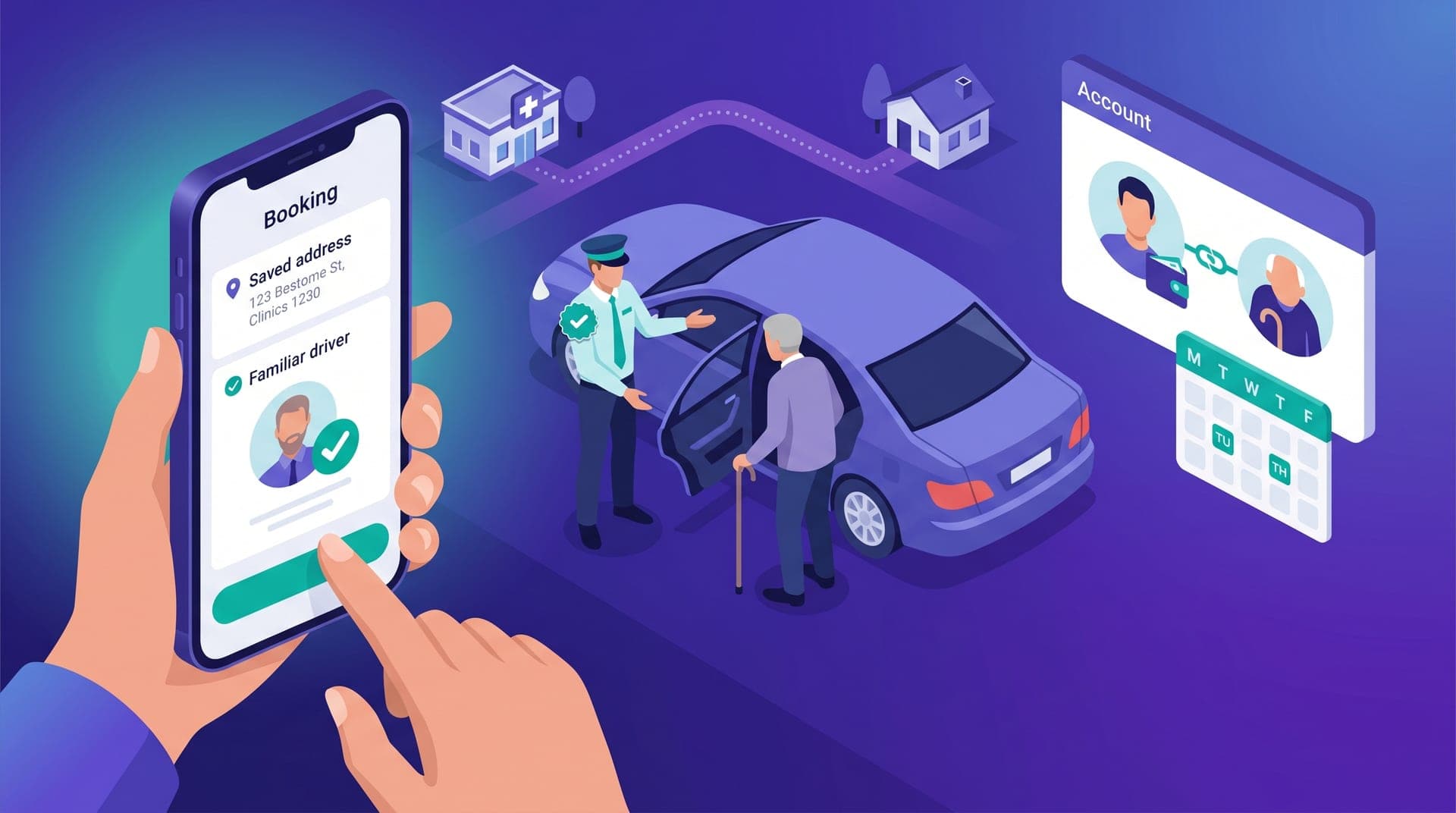
The practical solution to the app barrier is not to simplify the interface until any senior can use it alone — it is to recognize that seniors often have a family member who already manages much of their logistics, and that family member can be the technical user of the service while the senior is the physical user of the transport. In practice this works as an account with a beneficiary: a son, daughter, or spouse installs the app, sets up the account, saves the senior's frequent addresses — clinic, another relative's home, church, pharmacy — and books trips on their behalf from their own phone whenever they can't drive them personally. The senior receives the driver at their door, boards the vehicle, and arrives at their destination without having interacted with any screen. The family member sees the unit's position in real time and receives the arrival confirmation.
The value of that model for the operator goes beyond solving the UX barrier. A family member managing a senior's trips has a predictable demand pattern: clinic on Tuesdays and Thursdays, physical therapy on Fridays, doctor's appointment the first Monday of the month. That predictability makes seniors one of the highest-potential segments for scheduled, recurring trips — the opposite of the typical on-demand user who books sporadically and unpredictably. The family member managing a parent's or grandparent's transport also has a concrete incentive to stay on the same platform if the experience works: switching apps means re-saving addresses, re-configuring payment methods, and potentially re-explaining a different process to the senior. Retention in this segment tends to be structurally higher than in standard on-demand for these reasons.
The familiar driver as a non-negotiable requirement
The driver profile for senior transport shares similarities with school transport but with different motivations. Seniors don't refuse unknown drivers only for safety reasons — they often do so because of a combination of social discomfort, difficulty communicating with someone unfamiliar, and prior experiences with drivers who lacked the patience to wait the extra time needed to board or exit the vehicle. A recurring assigned driver resolves all those barriers simultaneously. After two or three trips with the same driver, the senior and driver develop a practical understanding: the driver knows to wait an extra two minutes at the door, that the passenger needs help with the door handle, that they prefer quiet during the ride, and that a brief phone call is needed when the car arrives. That mutual adjustment is impossible with random driver rotation.
For the operator, the assigned driver for this segment doesn't have to be exclusively a senior transport driver — they can mix those trips with their regular on-demand flow. What the operator needs to configure is that when that specific passenger makes a request, the system prioritizes assignment to the familiar driver if they are available within a reasonable radius. That preferential assignment logic exists in several platforms but is frequently not used deliberately because operators don't classify seniors as a use case with its own profile. Activating it requires configuration, not development: marking the user as eligible for preferential assignment, registering which driver is designated for that account, and defining the additional wait time before the request opens to the general pool. The difference between making that configuration explicit and not making it is the difference between building the segment and handling occasional disconnected trips.
Billing models when the user is not the one paying
Billing for senior transport frequently involves someone other than the passenger. The son managing his father's trips may be in another city — he wants his father to be able to take the taxi without needing cash or a card, and he wants to receive the receipt and the charge on his own payment method. That requires the platform to support accounts where the payment method belongs to the family member but the trips are taken by the senior. Any operator who configures that flow correctly has a direct advantage over platforms that only allow passengers to pay for their own trips with their own payment method. This is not a sophisticated feature — it is an account configuration that most platforms support but operators don't enable deliberately because they have no specific onboarding process for this segment.
The simplest alternative when the platform doesn't support third-party payments is cash combined with a prepaid scheme. The family member loads a fixed amount into the senior's account at the start of the month, the driver collects at trip completion, and the family member receives a digital confirmation with the deducted amount. The senior handles no payment; the family member has full spending visibility from the app. This structure is not as elegant as direct family member digital payment, but it is operationally viable and eliminates the payment barrier for the senior without requiring platform development. What the operator cannot do is ignore the billing question and assume the standard flow will work: that assumption produces trips cancelled at the payment step and frustrated family members who don't recommend the platform for exactly that reason.
How to launch the segment without building a separate app
The common mistake when evaluating whether to serve seniors is assuming a different app with a simplified interface is needed, or a service specifically branded as 'senior taxi.' In practice, the three elements that make this segment work — booking intermediary, familiar driver, flexible billing — are operational configurations, not new product features. An operator can start with five to ten seniors as passive users on family member accounts already on the platform, assign four or five drivers with the right profile for those periodic trips, and activate assignment priority. That starting point requires nothing the platform doesn't already have — it requires the operator to identify those users, identify their drivers, and decide how the system connects them.
The five elements the operator needs to define before activating this segment are:
- Identify 5-10 seniors — current or potential — with family members already on the platform, and configure their accounts as beneficiary accounts with the family member's payment method and the senior's frequent addresses saved
- Select 4-6 drivers with a positive track record in categories requiring patience and communication — medical transport, corporate, school — and assign them specifically to accounts in this segment
- Configure assignment priority so the familiar driver is first to receive the request when available within 5 km of the origin, with an additional 3-5 minute wait time before the assignment opens to the general pool
- Define the arrival protocol: the driver calls briefly upon arriving rather than relying only on a push notification — seniors frequently don't check the app in real time
- Establish a direct channel between the family member and the operator for managing exceptions and last-minute changes — not generic support, but a contact who knows that specific passenger's trip history
We started with one of our drivers' mothers — he registered her in the app, we saved her clinic and home address, and set it up so she would always be assigned to him when he was available. Within three months we had twelve seniors on the same setup, all with family members managing the account. None of them use the app directly. But they are the passengers with the lowest cancellation rate and highest trip frequency in the entire operation — and every family member who recommends the service brings someone else in the same situation.
Seniors are not exceptional passengers requiring an entirely different product — they are passengers with specific constraints that the local operator can serve by adapting three concrete decisions: who books the trip, who drives, and how billing flows. Those three adaptations are operational, not technical, and take days to implement, not months. The operator who resolves them correctly builds a recurring trip segment with the lowest cancellation rate and highest referral rate available in the local market: family members who trust the service with a parent or grandparent become operator advocates with an intensity no digital acquisition campaign can replicate.
The practical signal that the timing is right to explore this segment is not having a hundred drivers or new infrastructure — it is checking whether seniors in the immediate environment of current drivers are already receiving informal trips through family members. That demand exists in most regional ride-hailing operations without the operator having structured it. The first step is enabling beneficiary accounts for three or four family members already on the platform and assigning drivers with the right profile. If after four weeks those trips show high frequency and low cancellation, the operator has the validation needed to scale: more family members, more appropriately profiled drivers, and an onboarding process that converts every referral into a new active user.