Most regional ride-hailing operators choose their technology platform by evaluating three criteria: product features, price, and implementation timeline. Technical support appears on the list but rarely receives the same scrutiny as pricing. That omission has a cost that doesn't show up during onboarding — it appears during the first operational crisis, which might be a driver app failure on a high-demand Friday, a payment processing error blocking transactions for hours, or a dispatch outage that stops the operation with no clear resolution timeline and no clear escalation path. Platform tech support is not a backup service: it is the mechanism that determines whether a crisis lasts two hours or two days.
This article is for operators evaluating a platform for the first time and for operators already on one who have never formalized their support expectations. The central argument is straightforward: tech support terms are negotiated before the contract is signed, not after the first critical incident. The operator who enters the negotiation with concrete criteria — response time by incident type, support language, escalation channel, SLA documented in the contract — holds real leverage. The operator who signs first and asks questions later negotiates from a position of structural disadvantage, because the vendor has little incentive to improve support terms once the contract is in place and the operation already depends on their platform.
The operational risks that tech support directly controls
A ride-hailing platform has failure points with differentiated operational impact. A cosmetic failure in the operator dashboard — a chart that doesn't load, a report filter that's unresponsive — is an inconvenience the operator can work around while waiting for resolution. A failure in the driver app — availability status not syncing, the map not loading, assigned trips not appearing — directly stops driver earnings and the operator's service capacity. A payment processing failure — duplicate charges, incorrect fares the passenger rejects, payments that don't register — creates friction with drivers and passengers simultaneously and generates disputes the operator must resolve manually. The tech support available when those failures happen is not a comfort feature: it is the variable that determines how much time and revenue the operation loses while the problem is being resolved.
Most technology platform contracts include some reference to service levels. The problem is that those terms are frequently worded with enough vagueness to commit the vendor to nothing concrete: "response within a reasonable timeframe," "support available on business days," "ticket-based customer service." None of those phrases say anything about resolution time for a failure that stops the operation on a Sunday at 9 p.m. The operator who signs that language without questioning it is assuming operational risk that the contract has not distributed in any explicit way. The difference between a contract with a documented SLA and one with vague language is the difference between having leverage when the vendor fails and having none.
The four incident categories the operator must define with the vendor
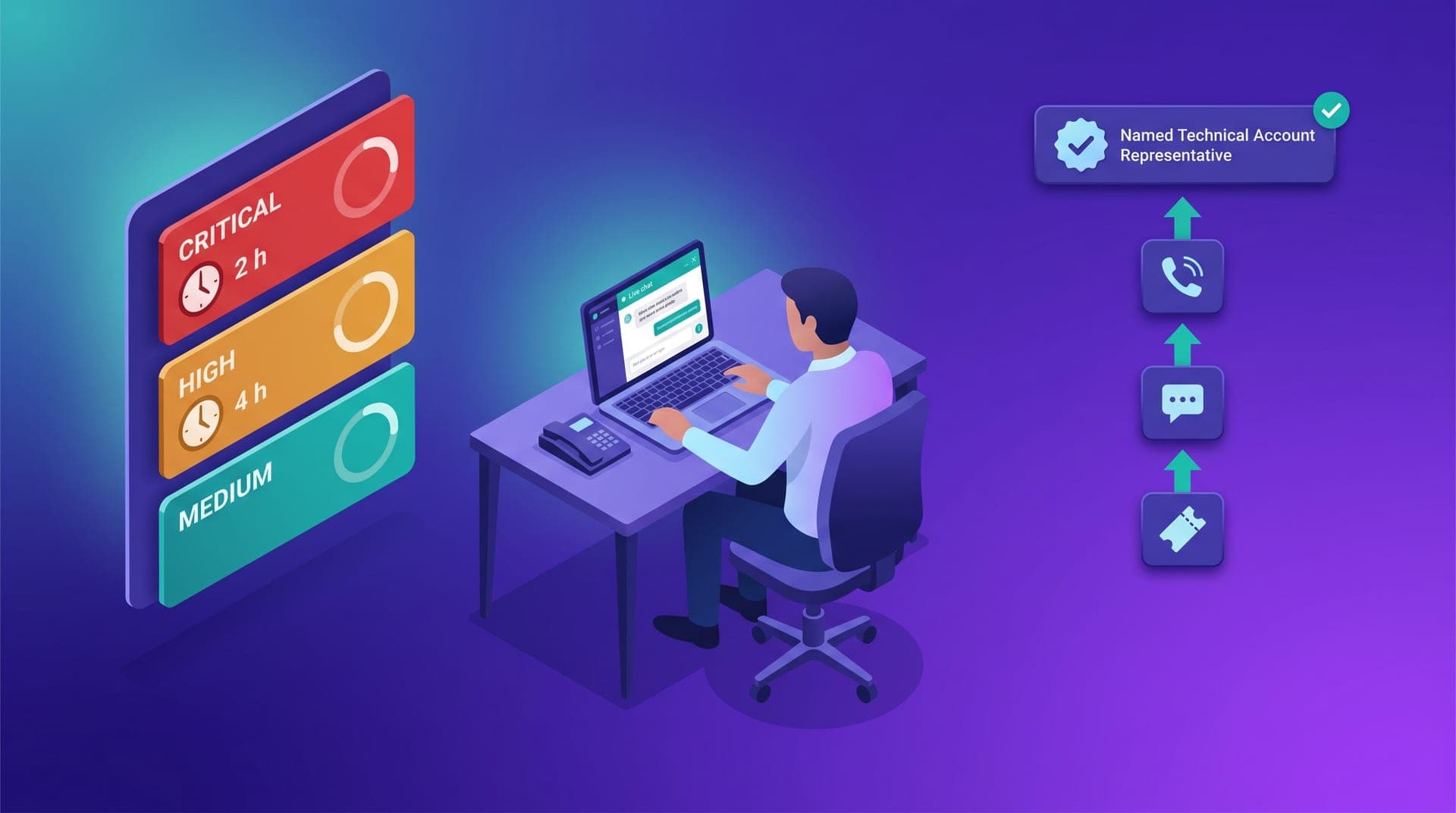
Not all technical failures have the same operational impact, and a sound support agreement treats them differently. The most functional classification for a regional ride-hailing operation has four levels. The first is the critical incident: the driver app can't accept trips, the dispatch system isn't assigning, digital payments are broadly blocked, or the operator can't access their control panel. This category has direct impact on driver and operator revenue and requires resolution — not just an acknowledgment — within two hours. The second level is the high-priority incident: failures affecting a subset of drivers or passengers, fare calculation errors on specific trip types, or tracking issues generating passenger disputes without fully stopping the operation. The acceptable resolution time for this tier is four to six hours.
The third level covers problems that degrade experience without stopping service: reporting errors, secondary dashboard features that don't respond, push notifications arriving late, or inconsistencies in trip history. For this level, a 24-to-48-hour resolution time is acceptable in most operational contexts. The fourth level includes configuration adjustment requests, non-critical UI improvements, and operator team training questions about existing features — for this tier, a five-to-seven-day window is reasonable. The value of having that classification documented in the contract is not bureaucratic: when a critical incident happens at 11 p.m., the operator has a concrete reference to demand resolution within the agreed time, not within the time the vendor finds convenient.
The six elements a support agreement must include explicitly:
- Written definition of all four incident categories with concrete examples of each
- Maximum first acknowledgment time per category (separate from resolution time)
- Maximum resolution or internal escalation time per incident category
- Dedicated channel for critical incidents with synchronous response — not only a ticket system
- Documented credit or compensation if the vendor exceeds SLA on a critical incident
- Named technical account contact with direct escalation access to the engineering team
Support language: why it's a qualification criterion, not a preference
For a regional ride-hailing operator in LATAM, the tech support language is not a comfort preference — it is an operational variable that directly affects resolution time during crises. When the driver app fails on a high-demand Friday and the operator needs to describe the error with technical precision, doing so in a second language introduces latency and ambiguity that can double or triple the time needed for the support team to understand the problem correctly. Misunderstandings in technical fault diagnosis have real consequences: the support team applies a fix for the problem they understood, not necessarily the one that occurred, and the operator waits for a second diagnostic cycle before the incident is resolved.
Several ride-hailing platform vendors offer "support in Spanish" that in practice means translated support: a first-level agent who interprets into English for the technical team, which responds in English, and the agent translates back to Spanish. That model introduces structural delays and loss of technical precision at every communication cycle. The operator who wants effective technical support needs to verify not only whether support is available in Spanish, but whether the technicians resolving critical incidents work in Spanish natively and whether direct Spanish-language escalation to the engineering team exists when the incident warrants it. The practical way to verify this before signing is to request a live demonstration of the support channel with a real technical issue — not a sales presentation where the rep speaks Spanish because it is their native language.
Channels and escalation: from the ticket to the contact who resolves
The ticket system is the correct channel for level-three and level-four incidents — problems without immediate operational urgency where the operator can wait for the vendor's standard resolution flow. For critical incidents, the ticket system is insufficient. The average first acknowledgment time in a ticket system, even from vendors with good processes, is 30 to 60 minutes. If the operator has to describe the problem in text without the ability to share a screen or speak in real time, diagnosis can take another full cycle before the support team understands what is happening. For critical incident level, the channel that works is one that allows synchronous communication — a call, an immediately responsive chat — with a technician who has system access to diagnose in real time, not with a first-level agent reading from a generic troubleshooting script.
Operators with more than 60 active drivers should request a named technical account contact — a specific person on the vendor's team who knows the operation's configuration, has a history of prior incidents, and can escalate directly to the engineering team when the situation requires it. That model is not available from every vendor or for every account, but it exists at the best vendors for accounts of a certain scale. Getting it requires asking for it explicitly in the contract negotiation, not assuming it. A named technical contact doesn't guarantee faster problem resolution on its own — it guarantees the operator has a point of contact with context about their specific operation when an incident demands it, which reduces diagnosis time and the number of communication cycles needed to reach a solution.
How to evaluate tech support before committing
The most direct way to evaluate a vendor's real support quality before committing is to ask for references from current operators with similar characteristics: comparable city size, similar driver count, and equivalent operation type. The question worth asking those references is not "are you happy with the platform?" but "what was the most critical incident you had and how did support respond?" That answer describes real support, not the support from the sales pitch. A vendor who cannot provide references from LATAM operators of comparable size likely does not have the regional operational track record it claims.
During the trial period before the final contract, the operator has an opportunity to evaluate support directly. The practical exercise is to create a level-two incident — not something fabricated, but a real problem noticed during use — and document the time from report to first acknowledgment, the time to confirmed diagnosis, and the time to resolution. If the vendor consistently fails that test during the evaluation period, when they are still trying to win the contract, the actual support quality over the next 18 months will be reliably worse. Evaluating support during the pilot is not an exercise in distrust — it is the only objective way to know what will happen the first time the operation actually needs the vendor in a real situation.
Signs that your current platform's support is below an acceptable level
Operators on existing platforms frequently normalize poor support quality because they have no reference point for comparison. The signs that current support is below acceptable levels are concrete: resolution times that consistently exceed what the contract specifies with no formal consequences for the vendor; incidents closed as "resolved" in the ticket system that continue generating the same problem in the actual operation weeks later; absence of an effective escalation channel for critical incidents, where the ticket is the only available path regardless of urgency; and absence of root-cause diagnosis for major incidents. A good support vendor doesn't just resolve the incident: it explains what caused it and what technical change prevents recurrence. A vendor that applies patches without root-cause diagnosis guarantees the same incident will return.
The second sign, less obvious but equally important, is that the support team cannot explain what the engineering team is doing. When the operator asks "when will this be resolved?" and the answer is "we're working on it" with no time estimate and no explanation of what is causing the delay, the support team lacks real visibility into the internal state of the problem. That opacity is not just poor communication: it signals that the vendor's internal escalation process is not structured, which means resolution depends on someone's heroic individual effort rather than systematic team process. Operations that rely on vendors with that pattern cannot anticipate their downtime windows or manage driver and passenger expectations proactively.
We had a payment system failure on a payday Saturday — the highest-demand day of the month. We opened the ticket at 10 in the morning. The first response came three hours later, in English, asking for information we had already included in the original report. By the afternoon we had drivers threatening to go offline because passengers were asking for cash and the drivers preferred not to accept it. The problem was resolved Monday at noon — 50 hours later. When we changed platforms, the first clause our lawyer negotiated was the payment SLA, with explicit resolution times for critical incidents and documented credit if the vendor misses it. We never sign anything without that anymore.
Tech support is the point of the platform vendor relationship the operator will need precisely when they can least afford to wait — during a high-demand Friday, a local event at peak load, or a payday with double the payment flow. The operator who arrives at that situation without a documented SLA, without an active escalation channel, and without a named technical contact depends on the vendor's goodwill rather than a formal agreement. Goodwill has no guarantee; the contract does. Defining support terms before signing is the only position from which the operator has real leverage to demand compliance when the system fails.
The practical exercise for an operator already on a platform who has never formalized support expectations is to review the current contract and check whether it includes a documented SLA with response times by incident category, an escalation channel for emergencies, and formal consequences if the vendor misses the commitment. If those three elements are absent, the operator has a pending conversation with their vendor that is worth having during a low-friction moment — not during the next crisis, when there is no time to negotiate anything. A technically solid vendor accepts formalizing those terms without resistance because their operation already meets them; the vendor who avoids committing to concrete timelines is precisely the type of vendor that should not be trusted when the operation actually needs them.