The conventional taxi sector has spent four decades accumulating operational knowledge that venture-capital-backed ride-hailing platforms dismissed systematically. When they arrived in LATAM, the narrative was consistent: taxi is broken, radio dispatch is inefficient, cash is friction, fixed bases are rigidity, the numbered driver is a relic. That narrative had real elements — but it also discarded as inefficiency things that were actually operational intelligence earned through decades of practice. The regional operator who in 2026 knows how to distinguish between the two categories has access to knowledge that appears in no digital platform manual and that competitors, both from traditional taxi and global apps, have not yet systematized.
This article is for operators who come from conventional taxi and are migrating to a digital platform, for digital operators competing directly with established taxi bases in their city, and for those who never worked in the traditional sector but feel their on-demand operation isn't capturing the loyalty and predictability the best taxi operators achieved for years. The central argument is not to romanticize radio taxi — it is to identify precisely what it solved well, why it solved it well, and how those solutions can be imported into a modern operation without losing the real advantages the digital platform does provide.
What the platform dismissed as inefficiency was operational knowledge
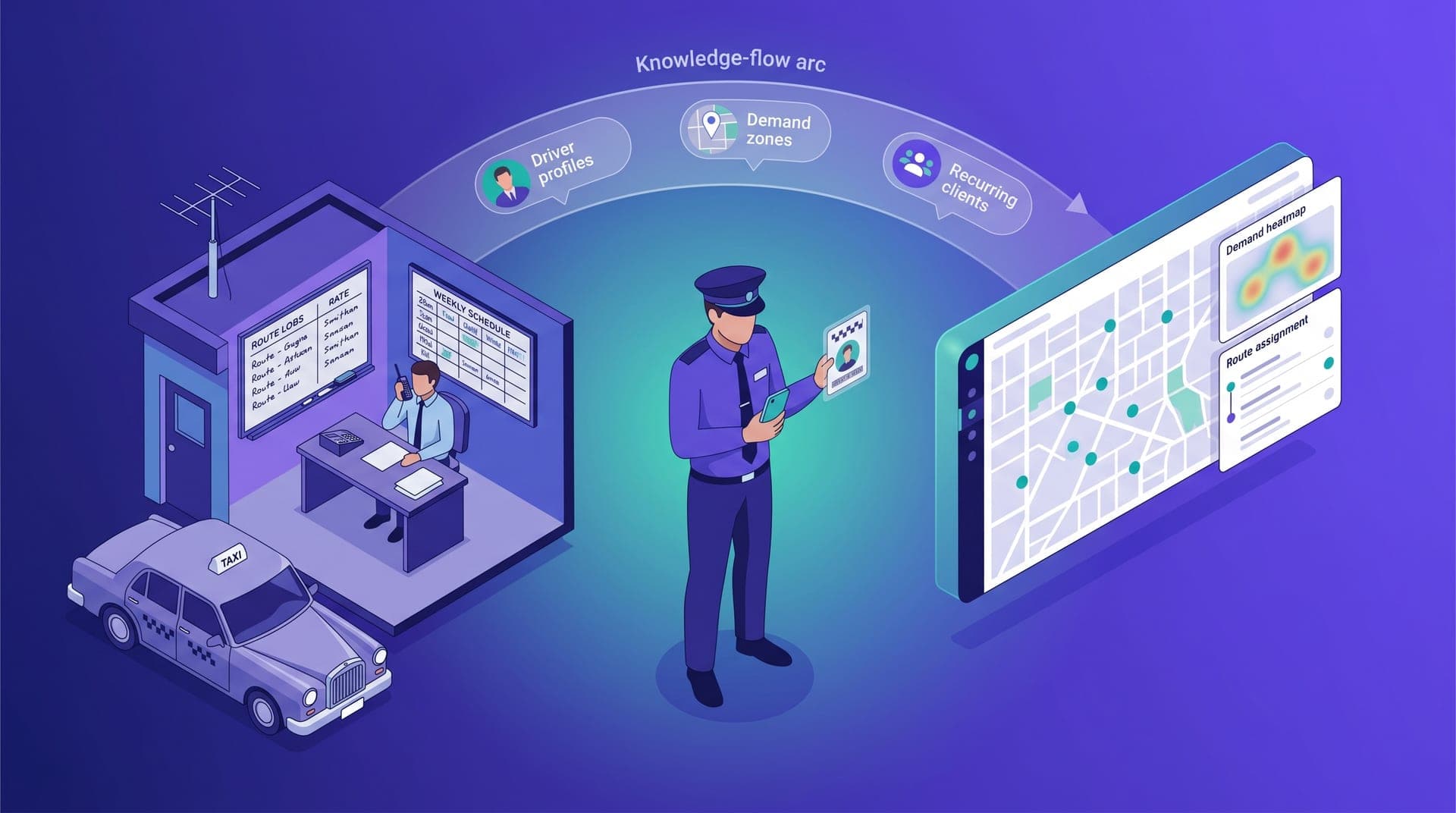
The radio dispatcher at a conventional taxi base was not simply an intermediary between incoming calls and available drivers. They were the living repository of the company's operational knowledge: who performed best with corporate clients, which zones generated demand spikes on payday Fridays, what hours needed more units near the hospital, and which client was difficult and needed a driver with specific patience. That knowledge wasn't in a database — it was distributed across the dispatcher's experience, driver comments at shift end, and patterns the company had observed over ten or twenty years of operating in the same city. First-generation ride-hailing platforms replaced the dispatcher with an algorithm that took years to approach that quality of contextual assignment.
The problem with radio dispatch was not the practice itself — it was that it encoded operational intelligence in a format that couldn't scale or export easily to a second city. VC platforms solved scalability at the expense of local context. The regional operator who in 2026 combines the platform's algorithmic infrastructure with the contextual knowledge they have of their city — demand zones by local event, driver profile by trip type, seasonal peaks — has the best of both without the costs of either extreme. That operator doesn't need to choose between radio and app: they can use the app as the dispatch channel and accumulated knowledge as the configuration logic.
The recurring client as a deliberate asset, not a coincidence
In radio taxi, the client who called every Wednesday to go to the same clinic was an asset the dispatcher recognized, prioritized, and assigned to the preferred driver. There was no formal CRM system — the asset lived in the dispatcher's memory and in the direct relationship with the assigned driver. That relationship produced something few on-demand operations have deliberately: a specific recurring-trip client retention rate, with no need for discounts or reactivation campaigns. The client kept calling because the service was predictable: the same driver, the same schedule, the same route, with no need to explain the destination each time. Conventional taxi built that retention with rudimentary means for decades before the term 'customer success' appeared in any operations manual.
The ride-hailing operator who wants to replicate that pattern doesn't need to recreate radio dispatch — they need to identify in their own data which users have repeated trip patterns and configure those accounts with preferential assignment and a familiar driver. That function already exists in the platform; what's missing is the deliberate decision to activate it for users with weekly or higher frequency. A client taking 10 to 15 trips per month to the same two or three addresses with the same driver has a retention profile no acquisition campaign can match at that cost. Radio taxi understood that value forty years ago and managed it with index cards and dispatcher memory. The digital operator has tools to do it at scale — what's missing is intent.
The fixed base as a managed demand position
Taxi bases at airports, hospitals, bus terminals, and hotels are not relics of the past — they are managed demand positions that the best conventional taxi operators negotiated and protected for decades. A concession spot in the regional airport taxi line is not simply a place to park: it is guaranteed access to a demand source that doesn't depend on algorithms or marketing campaigns. The conventional taxi operator who has held that position for twenty years defends it as a commercial asset because it is one — it can generate 15 to 35 daily trips with an average ticket two or three times higher than regular on-demand, with near-zero cancellation, because the passenger waiting at the airport taxi line has already made the decision to travel.
The regional ride-hailing operator who wants to access those positions has two viable paths. The first is negotiating directly with the airport, hospital, or hotel administration as an institutional transport provider — a process that requires documentation compliance and time, but produces a formal access contract with a defined duration. The second, less obvious but often faster, is establishing an alliance with the conventional taxi operator who already holds that position. Many taxi bases in mid-size LATAM cities have excess demand in certain time windows and lack platform infrastructure to manage it efficiently. A complementary arrangement — taxi keeps its physical position and municipal permit, digital operator manages dispatch during demand peaks — can be more profitable than trying to displace an established base with institutional relationships that took years to build.
Driver loyalty: professional identity, not just commission
The best conventional taxi operators in LATAM had driver churn — but the most stable ones retained their best people for years, not months. The mechanism was not purely economic: it was identity-based. A driver at a recognized radio taxi company had a unit number, a dispatcher who knew their name and preferred zone, a community of shift colleagues, and recognition from frequent clients who requested them by their assigned identifier. That is not a labor benefit in the conventional sense — it is a professional identity that pure on-demand ride-hailing, with its anonymous relationship to the algorithm, has not been able to offer consistently. The driver who on a global platform is 'driver #4.7 stars' has a fundamentally different relationship to their work than the driver who at their local company is recognized by name and operating zone.
Five conventional taxi retention practices any regional operator can import into their platform:
- Assign each driver a visible internal identifier — number or code — that frequent clients can reference when rating or requesting the service
- Create communication channels among drivers in the same operation where the dispatcher or operator participates actively, not just during incidents but in the day-to-day of the operation
- Publicly recognize within the group the performance of drivers with the best rating history, lowest cancellation rate, and highest completed trip frequency per week
- Assign drivers with the most seniority to clients and routes requiring deeper local knowledge or patience — corporate, medical, school — as recognition of competence, not just availability
- Involve the longest-tenured drivers in feedback about demand zones, peak hours, and trip types the algorithm doesn't capture well — their contextual intelligence has real operational value
What traditional taxi never solved — and no operator can ignore
Not every traditional practice encodes intelligence: some simply encode the technological limitations of the moment. Conventional taxi had no real-time tracking visible to passengers because the technology to implement it cheaply didn't exist — not because privacy was an advantage. Cash settlement with end-of-shift reconciliation wasn't a philosophical choice — it was the only available option, with all its risks of loss, discrepancy, and theft. The absence of a bidirectional rating system wasn't a deliberate design to protect driver reputation — it was a model limitation. The regional operator who romanticizes those characteristics as advantages of traditional taxi is confusing adaptation to constraints with model superiority. What survived in conventional taxi was not cash or the absence of tracking — it was the contextual knowledge those constraints forced people to build manually.
The real advantages of the digital platform over conventional taxi are genuine and non-negotiable for any operator who wants to build a growing business: full trip traceability from request to destination, digital payments with automatable billing, a rating system that produces objective feedback, real-time assignment optimization, the ability to manage multiple service types from the same infrastructure, and access to operational metrics conventional taxi never had. The regional operator cannot ignore those advantages — they are why passengers migrated to on-demand. The point is not to replace them with past practices: it is to complement them with the contextual knowledge the platform still doesn't generate automatically.
The hybrid operator: the synthesis neither extreme has alone
In 2026, the regional operators with the most stable operations in LATAM are neither purely platform-native nor purely conventional taxi descendants. They are operators who use platform infrastructure — algorithmic dispatch, digital payments, real-time tracking — and complement it with operational intelligence no algorithm generates automatically: knowledge of demand zones by local event, driver profiles by client type, institutional relationships with fixed demand sources, and an operational culture that builds driver identity rather than treating them as interchangeable units. That combination doesn't happen by accident — it is the result of deliberate decisions about what to import from the traditional model and what to leave behind. The operator who makes those decisions explicitly has a structural advantage that neither traditional taxi nor global apps can replicate: deep local knowledge with modern technology infrastructure.
I spent fifteen years in radio dispatch before opening my own operation. What people don't understand is that the dispatcher wasn't inefficient — they had data the platform took years to generate: which neighborhood books most on payday Fridays, which driver not to send with a difficult client, where demand stacks up when it rains before the algorithm sees it. I used all of that to configure zones, driver profiles, and shifts when I went digital. My drivers have better retention than those at bigger platforms because I treat them the way dispatch did: I know them by name, by zone, by the type of trip they handle best. The algorithm doesn't learn that on its own.
The practical lesson is not to return to radio dispatch or to abandon the tools the digital platform offers. It is to recognize that the best conventional taxi operators solved real problems — driver loyalty, recurring client retention, positioning at fixed demand sources — with the tools available at the time. Those solutions didn't become irrelevant when the digital platform arrived: they became easier to implement. The operator who understands why they worked can apply them with greater precision and lower cost using modern infrastructure that conventional taxi never had. The advantage is neither technological nor traditional — it is the deliberate combination of both.
The practical exercise is to identify the two or three conventional taxi operators in your city who have been active for more than fifteen years and still have loyal clients and drivers. The question worth asking is not 'why haven't they modernized?' but 'what are they still doing right that your operation hasn't solved?' The answer almost always includes at least one of three things: drivers with a stable professional identity, recurring clients with preferential assignment, or a position at a fixed demand source that standard on-demand doesn't reach. Those three things can be imported into any platform operation through configuration decisions, not new development. The operator who imports them doesn't just beat conventional taxi — they build something the global apps don't have either.