Every minute a driver waits in front of a building is a minute somebody pays for. If your fare does not account for waiting at pickup, the driver pays with their time and recovers it some other way: rejecting trips from certain neighborhoods, cancelling when the passenger runs late, or simply leaving your platform for one that does recognize that time. Charging for waiting is not squeezing the passenger; it is deciding explicitly who absorbs a cost that already exists.
This article is for app-based taxi operators and regional fleets that want to bring order to pickup waiting: how many minutes to give away, how to calculate what gets charged after that, how to communicate it so it does not trigger complaints, and what waiting data tells you about your operation. We will not cover the time the passenger waits for the driver, which is a different indicator, but the time the driver waits for the passenger.
Pickup waiting is a cost, and someone is already paying it
In a mid-sized city, an active driver completes between 2 and 3 trips per hour at peak demand. Five minutes of waiting on one trip means losing 10% to 15% of that hour. If that wait repeats on one out of every four trips, the driver ends the shift earning less than their rating and mileage would suggest, and cannot explain why.
The passenger, meanwhile, does not perceive any cost at all. They order the trip while still looking for their keys, because nothing tells them it has consequences. A waiting fee is not meant to punish them: it is meant to make the moment of ordering a trip closer to the moment they are actually ready to leave.
There is also a cost that never shows up on a spreadsheet: tension in the first minute of the trip. A driver who waited eight minutes without compensation starts the ride annoyed, drives in a hurry to make up the time and is less friendly. The passenger does not know why the service felt cold, but remembers it when rating. Setting clear rules for waiting is also a way to protect the experience of the rest of the trip.
How many free minutes to give: the range that works in regional cities
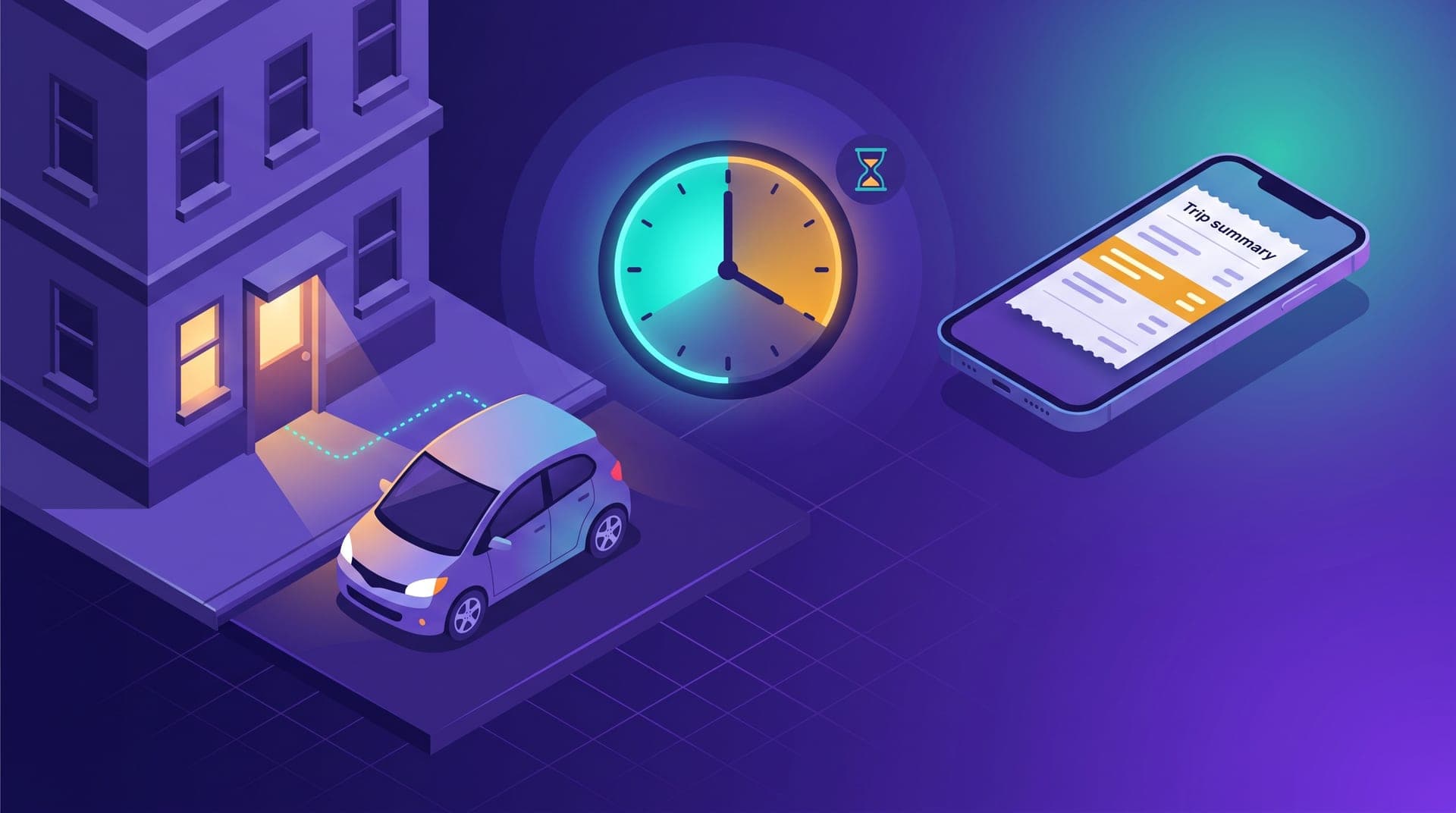
Almost every operation that charges for waiting starts with a grace period. In regional cities, 3 to 5 minutes covers the vast majority of reasonable cases: coming down from an apartment, locking the front door, loading a suitcase. Less than 3 minutes produces charges the passenger feels are unfair; more than 7 removes the incentive almost entirely.
Adjust the grace period according to these factors:
- Dominant housing type: buildings with elevators need more minutes than houses at street level.
- Service: an airport transfer with luggage justifies a longer grace period than a short urban trip.
- Time of day: at peak hours waiting costs the driver more than in off-peak hours.
- Passenger profile: services for older adults usually need a wider margin.
- Local competition: if street-stand taxis do not charge for waiting, start with a generous grace period.
What matters is that the number is configurable per service and that the passenger sees the one you set, not a generic value. A platform that always shows "5 minutes" when your operation gives away 4 creates exactly the argument you want to avoid.
How to calculate the per-minute waiting fee
The most defensible reference is the driver's revenue per active hour. If in your city a driver generates on average the equivalent of 150-200 units of local currency per active hour, one minute of waiting is worth between 2.5 and 3.3 units. Charging less than that does not compensate the driver; charging far more turns waiting into a revenue stream, and passengers notice.
Add a cap as well: after 10 to 15 minutes of charged waiting, the driver should be able to cancel without penalty and with a fixed compensation. That way neither side is trapped in an open-ended wait, and the passenger knows that after a certain point the trip is lost.
A practical way to validate your number is to compare it with the per-minute rate you already charge during the ride. If a waiting minute costs more than a moving minute, passengers feel it as a punishment; if it costs less than half, the driver feels it as charity. A range between 60% and 100% of the in-ride minute usually feels fair to both sides and is easy to explain.
Communicate waiting before the first charge, not after
Waiting charges trigger complaints when they appear as a surprise in the trip summary. They trigger very few when the passenger saw them in advance: on the confirmation screen, in the "your driver has arrived" notification, and in the summary itself, broken out as a separate line. Three touchpoints, one message.
Before switching the charge on, announce it at least a week in advance through the channels you already use with frequent passengers. Explain the reason in terms of the driver, not the platform: "so your driver doesn't lose their time waiting" lands better than any technical justification.
With drivers, the communication runs the other way: they need to know exactly how much they receive for each minute of waiting and when they will see it in their earnings. If the driver cannot see that income clearly, their behavior does not change, they keep rejecting the trips that used to cost them time, and the policy loses half its effect. Show them the waiting charge in every trip summary and mention it during their first week of operation.
What waiting data says about your zones and passengers
After a month of charging for waiting, you have a map that did not exist before: where and with whom drivers wait. A clear pattern almost always emerges, letting you act without touching the general fare.
- Zones with consistently high waiting are usually gated communities with a guard booth: a fixed meeting point helps.
- Passengers who pay waiting on almost every trip need a reminder, not a bigger penalty.
- Hours with high waiting, such as office closing time, call for a different grace period.
- Drivers who log far more waiting than average deserve a review: they may be arriving early on purpose.
The driver has to keep their end of the deal too
A waiting fee is only fair if the clock starts when the driver is truly at the pickup point. If they mark their arrival two blocks away or before parking, the passenger pays for minutes that were not theirs and trust in the system disappears fast. Make it clear during onboarding that marking arrival early is a violation, just like overcharging in cash.
When a passenger disputes a waiting charge, check the trip history before deciding. If arrival was marked far from the pickup point, reverse the charge without argument and talk to the driver. If the driver was on site, uphold the charge politely: always giving in teaches everyone that the rule does not exist.
It also helps if the driver sends a message on arrival when the passenger does not show up, instead of waiting silently for the clock to run. That message changes how the charge is perceived: the passenger knew someone was waiting and chose to take longer. A short, friendly and always identical reminder is enough, and it reduces disputes more than any fare change.
For a year we didn't charge for waiting because we thought we would lose passengers. What we were losing was drivers: they moved to another app or rejected trips from certain neighborhoods. We set four free minutes and a per-minute fee the driver could understand. Complaints lasted two weeks; average waiting dropped almost by half in the first month.
A clear rule for both sides of the trip
Charging for pickup waiting is as much a product decision as a pricing one. Configured well — a grace period adjusted to your city, a per-minute fee anchored to the driver's real earnings, a waiting cap and communication at three moments — it reduces waiting, protects your drivers' income and generates almost no complaints.
Start by measuring: how many minutes your drivers wait at pickup today, and in which zones. With that number in hand, the conversation about how many minutes to give away and how much to charge stops being a hunch and becomes a rule you can explain to passengers and drivers alike.