School transportation as a line of business for regional ride-hailing operators is not simply ride-hailing with a destination labeled school. It is a B2B service contract with a completely different operational logic from the on-demand model: fixed routes, predictable schedules, minor passengers, and a commercial relationship that extends through the entire school year. Operators who try to serve schools with their standard on-demand platform quickly discover that spot pricing structure, driver selection criteria, and service guarantee mechanisms from that model produce results schools won't accept. The argument of this article is that school transportation works as a stable business line only when structured as annual contracts with fixed per-route pricing, and that this model requires deliberate decisions on costs, drivers, and guarantees that operators who improvise it as an on-demand extension cannot sustain.
This article is for operators with 50 to 150 active drivers in cities where private schools currently use owned fleets, informally subcontracted transport routes, or third-party platforms with inconsistent results. The natural market is not public schools — which operate through municipal tender processes in a different framework — but mid-size private schools with 300 to 1,500 students that need transportation predictable for parents, trackable for school administration, and economically competitive against traditional school transport. The local operator's advantage in this segment mirrors general ride-hailing: drivers with stable city presence, knowledge of the neighborhoods where students live, and a cost structure that allows competitive pricing without depending on external capital.
Why the on-demand model doesn't work for school transportation
The fundamental problem with applying on-demand to school transportation is that schools need guarantees the spot model cannot provide by design. When a school contracts transportation for its students, the most important operational question is not whether drivers are available in that area, but whether that specific driver will show up at 7:15am every Tuesday morning for nine months. The dynamic availability of on-demand is exactly the opposite of what a school administrator or parent needs. A trip that isn't assigned because no drivers are nearby at that hour is not just an inconvenience — it is an incident involving a minor waiting on a curb, with the safety and reputational implications that carries for the school and for the operator who offered the service.
The second problem is variable pricing. Parents who pay a fixed monthly school tuition don't accept a transportation line item that changes week to week based on demand and traffic. Dynamic pricing that works well for an adult booking an airport trip — where a twenty-peso variation doesn't define the decision — is unacceptable for a family budgeting monthly with school transportation as a fixed cost. A school offering variable-priced transportation cannot market it as easily as one publishing '1,800 pesos per month for the northern route' in its enrollment offer. Fixed pricing is not an operator requirement — it is a commercial requirement of the school that determines whether the offer is sellable to parents before the school year begins.
The structure of a profitable school contract
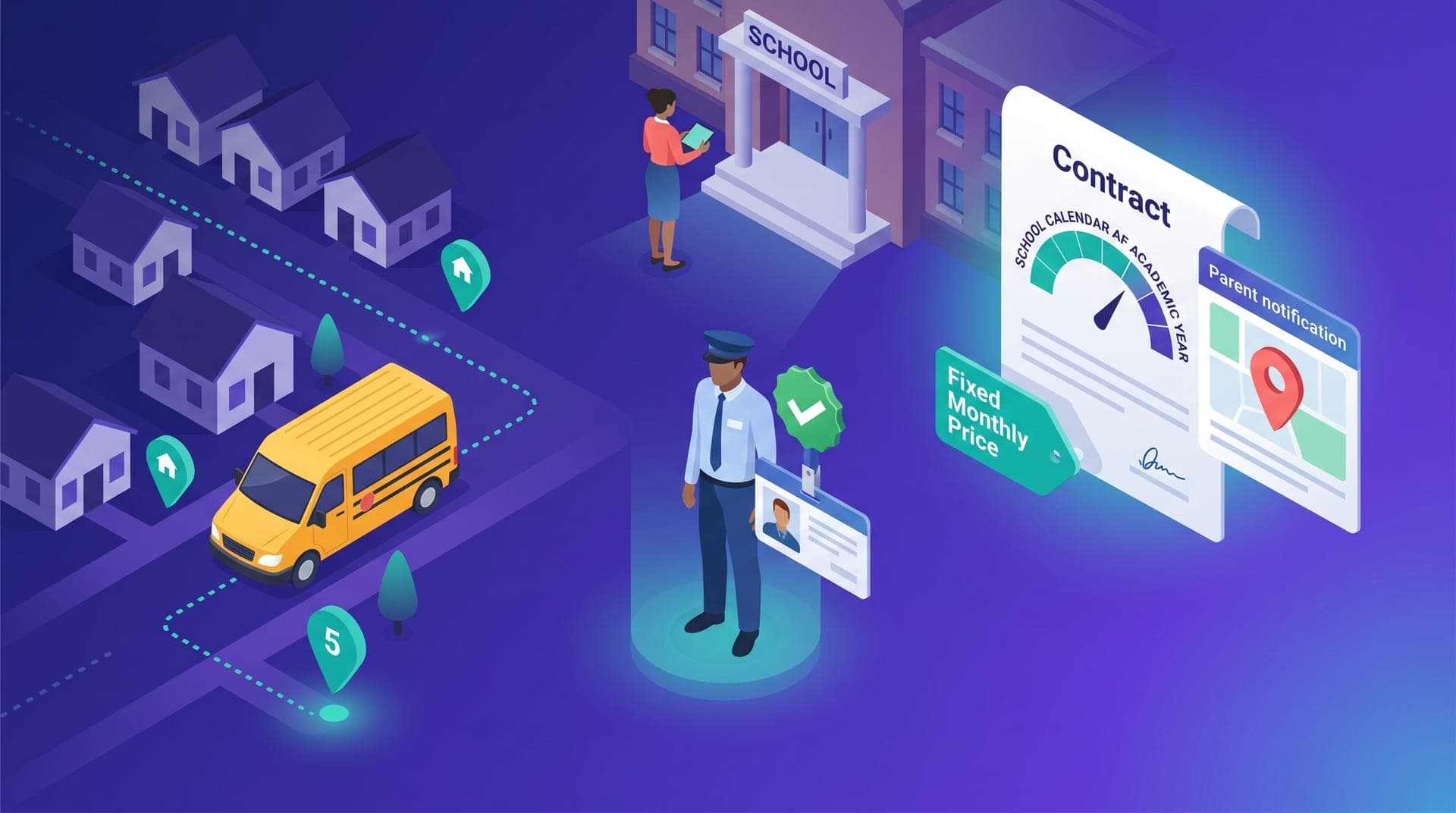
The model that produces sustainable results has a specific structure: the operator assigns a specific driver to a route of 8 to 15 students who live in adjacent neighborhoods. That driver handles the morning pickup at a fixed schedule and the midday or afternoon return, depending on the school's session. The operator charges the school or parents directly a fixed monthly rate per student — in the range of $1,500 to $3,500 pesos in mid-size Mexican cities, depending on total route distance and trips included. The contract runs annually with the school calendar: starting in August or September and ending in June or July. Intermediate holidays are excluded from billing or prorated according to the agreement, giving parents a predictable monthly charge for the ten active months.
The contract structure must include three elements that informal agreements frequently leave out. The first is a substitution clause: exactly what happens when the primary driver cannot show up and the maximum time in which the operator guarantees a substitute. The second is a notification protocol for delays over ten minutes, specifying who notifies whom and through which channel. The third is a clear geographic definition of the route: which neighborhoods it covers and the maximum distance from the student's home to the stop. Without those three elements, the contract works smoothly when everything runs normally and generates conflicts when exceptions occur — which in a school operation happen at least two or three times a month. A contract without exception protocols transfers that friction to the driver, the school's transportation coordinator, and ultimately to the parents.
How to price a route without underestimating idle time
The most common error when pricing a school route is calculating only active service time: the thirty-five minutes of the morning route and thirty-five of the afternoon. That calculation produces a price that looks competitive against traditional transport but ignores the real cost of reserving a driver for a fixed schedule twice a day. The problem is idle time: the driver who finishes the morning route at 7:50am doesn't start the return route until 1:30 or 2:00pm. Those five hours between routes are not free time — they are hours when the driver could be taking on-demand trips but must be available for school emergencies and ready to show up on time for the afternoon route. Ignoring that cost produces contracts that look profitable in the first month and create tension with the driver by the third.
The components a sustainable school route price must include are:
- Active service time: 60-90 minutes daily per route at the equivalent per-kilometer rate for actual kilometers driven, accounting for school-hour traffic
- Availability reserve: 2-3 hours of daily exclusive driver availability, compensated at 30-50% of the active hourly rate
- Verification amortization: background check costs, induction, and first-day accompaniment divided across the school-year months
- Substitution margin: 8-12% of the monthly contract to cover activating a substitute driver without prior notice
- Platform and infrastructure fee: the cost of real-time tracking, parent notifications, and reports for school administration
The guarantees schools always require
Private schools that contract external transportation have an implicit list of requirements their coordinators expect to find before signing. Operators without experience in this segment frequently underestimate the weight those requirements carry — because they are not attributes of the individual trip but of the management system surrounding the service. The first and most non-negotiable is the fixed driver: the same driver for the same route throughout the school year. Parents need to know who is picking up their children, and the school needs to track a specific driver by name, photo, and verified background. The driver rotation that works correctly in on-demand — different drivers serving the same user across different trips — is operationally unacceptable in school transport for safety and parental trust reasons that are non-negotiable in any city.
The second requirement is real-time tracking visible to parents, not just the operator. Systems that show the driver's position only to the dispatcher are insufficient for a private school's expectations: parents expect to see on their phone where their child's route is at every moment of the morning. That requires a shared tracking link or direct real-time access to the unit's position. Operators who already have tracking in the passenger app can adapt that feature for the school case without additional development, by configuring read-only access for parents. The third requirement is a direct line between the school's transportation coordinator and the operator — not a generic support number, but a designated contact who responds during school hours with under-ten-minute response times for active incidents.
School route drivers: profile, compensation, and retention
The school route driver profile doesn't match the average on-demand driver. Schools and parents respond better to drivers with operational seniority and city stability — the 35 to 55 age range has higher acceptance rates in this segment than the typical on-demand range. The selection process must include criminal background checks, extended identity verification, and in more formal operations, an induction session on school protocol: how to handle a mid-route incident, how to communicate with parents in real time, what to do if a student doesn't appear at the pickup point. That more demanding profile has a higher selection cost, justified by the annual contract and the income predictability that contract gives the driver, which in turn reduces turnover in this segment.
Compensation for school routes works better with a fixed monthly component than with the per-trip commission model of on-demand. A driver receiving $8,000 to $12,000 pesos monthly for fixed routes — regardless of traffic variation or the exact number of students who boarded that day — prioritizes those routes with a consistency the variable model doesn't guarantee. The fixed component also simplifies shift planning: the driver can combine school routes with on-demand trips during intermediate hours and manage their workday predictably. For the operator, the retention horizon in school contracts differs from on-demand: losing a school driver mid-year means reassignment, re-notification to the school, and route adjustment — an operational impact significantly greater than normal on-demand pool rotation.
The first year we tried to handle it like regular app trips — drivers rotated and parents complained because they never knew who was going to arrive. We switched to a fixed driver per route with monthly billing to the school, and within three months we had 280 students on 22 contracted routes. The difference wasn't the technology — it was the model: the school signed because we guaranteed the same driver all year, and parents paid without questions because the monthly amount was fixed from enrollment.
When the spot model works better than the contract
Not every school-related trip justifies an annual contract. There are use cases in the school environment with irregular demand or volumes too low to justify a fixed contract structure. Field trips and extracurricular transfers — sports tournaments, cultural visits, graduation rehearsals — happen once or twice a month and involve a variable number of vehicles per event. For those cases, the on-demand model works correctly: the school makes the request in advance, the operator assigns available units, and billing is per one-time service. Trying to structure those events as annual contracts creates unnecessary rigidity for a use case the on-demand platform handles more efficiently and without committing drivers to routes that only activate twice a month.
The practical criterion for deciding whether a school is a candidate for annual contract or spot is the frequency and predictability of use. If students use external transport every school day on a fixed schedule, the contract is the right structure. If the school calls twice a month asking for four vehicles for a field trip, spot is the right structure. The same operator can maintain both types of relationship with the same school — contracts for daily routes and spot for extraordinary events —, and that combination is more profitable than forcing a single model onto every situation. What matters is not applying the rigidity of an annual contract to a relationship that is by nature sporadic, nor the informality of spot to one that by nature requires guarantees sustained over time.
School transportation is not a natural extension of on-demand ride-hailing — it is a distinct business segment that shares infrastructure with on-demand but has its own commercial and operational logic. Operators who structure it correctly — with annual contracts, fixed drivers per route, predictable monthly pricing, and documented exception protocols — build a recurring revenue base representing 15 to 25% of their total trips with a cancellation rate significantly lower than on-demand. That stability has strategic value: the operator who enters the rainy season or a high-demand week with twenty contracted school routes knows in advance that portion of their operation won't fluctuate with demand or price competition.
The first step for an operator who wants to explore this segment is not developing a school-specific app or negotiating with ten institutions simultaneously. It is identifying the two or three private schools in their city within the neighborhoods where their drivers already operate frequently, and making direct contact with the transportation coordinator to understand what solution they currently use and what problems they have with it. The school contracting cycle in LATAM has specific timing: most schools make transportation decisions between May and August for the school year starting in September. An operator who makes that first contact in June has the exact window to prepare a proposal, identify candidate drivers, and sign before the school year begins — instead of trying to enter in October, when routes are already covered and resistance to changing providers is at its highest.