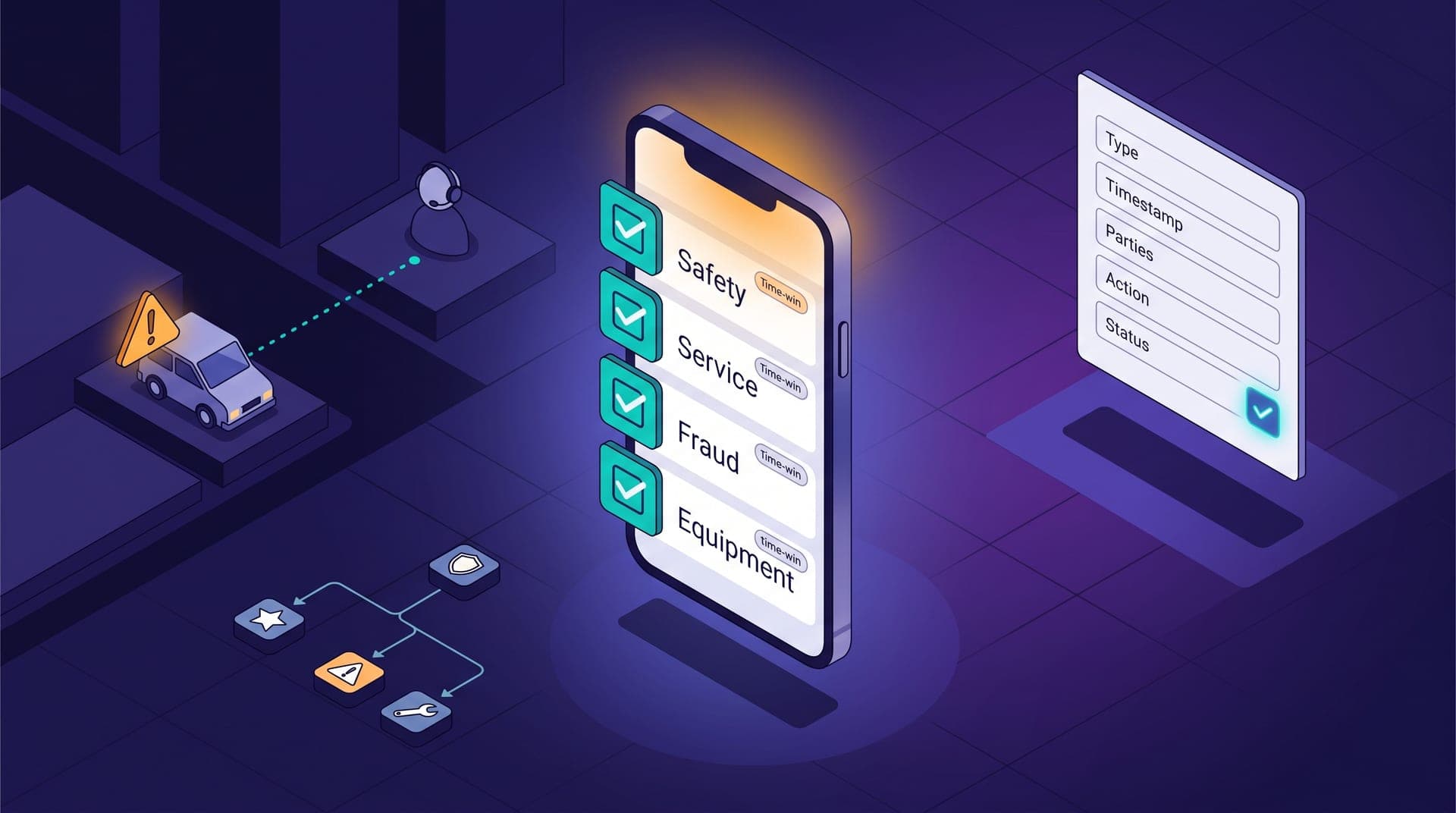
In a fleet of 30 to 70 active drivers, the moment most operators discover they have a driver with an expired license or lapsed insurance is during an incident: an accident, a police check, or the insurer asking for the involved driver's documents. It is the worst possible moment to find out. A driver who operated with an expired license for two months doesn't turn the problem into something between the driver and the authorities — it turns the platform's records into evidence that the operator had no active verification process. In markets where platform transport regulation is active, that discovery can halt the entire operation while the authority assesses whether the problem is isolated or systemic.
This article is for operators with 25 to 70 active drivers who manage document expiry reactively — meaning they check when someone notifies them — and who want to make that process proactive without adding more work for the coordinator. It covers which documents expire in a typical regional fleet and how often; why the coordinator's memory doesn't scale beyond 20 drivers; how to build the minimum tracking system in under four hours; the alert process at 60, 30, and 7 days from expiry; the specific legal risk in LATAM when the insurer discovers a driver was operating with lapsed documents; and the agent query that generates the complete upcoming-expiry report for the entire fleet in under five weekly minutes. The thesis is direct: document compliance isn't an administrative problem — it's an operational risk with an asymmetric cost that a simple, static system eliminates without adding burden to the coordinator.
The five documents that expire in a fleet and what happens when they're ignored
In a regional ride-hailing operation with affiliated drivers and privately owned vehicles, there are five document categories with expiry dates that, if they lapse while the driver is actively operating, create legal, insurance, or regulatory problems with different consequences depending on the market. The cost of each type of expired document has a different nature, and understanding that difference determines the urgency level the tracking system should assign to each one.
The five documents with expiry dates in a regional fleet, ordered by the operational impact of each lapse:
- **Driver's license**: valid for 1 to 10 years depending on the state and license type in Mexico; 5 to 10 years in Colombia; 2 to 5 years in Central America. The highest legal-risk document: a driver without a valid license who has an accident with an active passenger triggers civil liability that in several Latin American legal systems reaches the platform operator.
- **Vehicle insurance**: expires annually in almost all markets; semi-annual policies are common in higher-risk fleets. A claim with lapsed insurance may result in a complete insurer denial, shifting payment liability to the driver and, in some cases, to the operator.
- **Vehicle registration or roadworthiness certificate**: 1 to 2 year terms depending on the state or municipality. When expired, it authorizes the authority to impound the vehicle during an active trip — leaving the passenger on the roadside.
- **Technical or mechanical inspection**: mandatory in several Mexican states and Colombian markets; valid for six months to one year. In some markets, a lapsed technical inspection directly affects insurance validity if the vehicle didn't have current inspection at the time of the incident.
- **Municipal platform operating permit**: in markets with active regulation, valid for 6 months to 2 years. Its expiry can prevent legal operation in the city while renewal is processed, with consequences that affect the entire fleet, not just the individual driver.
Why the coordinator's memory stops working beyond 20 drivers
With 15 to 20 active drivers, the coordinator can track expiry dates with reasonable personal attention: they know each driver by name, know that Ramón renews his license in July and that Jorge's Nissan goes in for inspection in March. That implicit knowledge works until one of three events arrives: the coordinator rotates and the new one didn't inherit that mental map; the fleet grows from 20 to 45 drivers over six months; or the operator starts managing two cities in parallel. In all three cases, the memory-based system fails the same way: the first expiry nobody remembered is the one that creates the problem.
The problem isn't a lack of coordinator attention — it's that expiry management is a volume function, not one of perceived importance. In the daily rhythm of a 50-driver operation with 400 weekly trips, the document expiring in 60 days doesn't compete for attention with this morning's passenger complaint, the driver who cancelled three consecutive trips, or the new driver who doesn't understand demand in their zone. A system with no external signal to the coordinator — a reminder that surfaces before the expiry becomes urgent — turns the exception into the rule for fleets of 30 drivers or more. The coordinator scanning a list of 50 drivers and trying to remember who has documents coming due isn't failing at their job: they're using the wrong tool for that task.
The minimum tracking system: four columns and five minutes on Monday
The expiry tracking system that protects the operation doesn't require specialized software or significant implementation time. It requires a spreadsheet with four columns per active document, a one-time load of existing data, and a weekly review of under five minutes as the coordinator's first step each Monday. The four columns: driver name, document type (license / insurance / vehicle registration / technical inspection / permit), expiry date, and status (current / upcoming / expired). The weekly filter is a single operation: sort by expiry date and review all documents expiring in the next 60 days. Documents outside that window require no attention that week.
The initial data load is the only significant time investment. In a fleet of 40 to 60 drivers with 3 to 5 documents per driver, the full load takes 3 to 5 hours if the coordinator has access to digital copies — time the operation recovers in the first week when the system prevents the first expiry from going unnoticed. Updates afterward are minimal: every time a driver renews a document, the coordinator updates one cell in 30 seconds. The alternative — resolving an expiry discovered during an incident — takes 2 to 8 hours and produces legal risk the simple system would have eliminated entirely. In an operation with two coordinators on different shifts, the shared spreadsheet replaces the implicit knowledge that previously depended on the most senior coordinator being on duty.
The alert process: what to do at 60, 30, and 7 days from expiry
The expiry alert works best at three moments with three distinct actions. At 60 days from expiry, the coordinator sends a message to the driver noting that document X expires in two months and asking whether they've started the renewal process. The goal of this alert isn't pressure — it's to let the driver know the operation has visibility over the expiry. In 70 to 80% of cases, the driver hadn't started the process because they also didn't have the expiry date in mind. The early alert activates the process at the moment when there's sufficient time to complete it without affecting driver availability or generating artificial urgency the driver perceives as pressure.
At 30 days, if the driver reported starting the renewal, the coordinator confirms status. If no progress was reported, the message escalates in tone: the platform cannot assign trips to a driver with expired documents, and renewal must be complete before the expiry date. At 7 days, if the document is still unrenewed, the coordinator activates a preventive suspension until the new document is uploaded to the system. The preventive suspension — which the driver knew was coming because they'd been notified twice — produces a renewal rate of 85 to 90% before the deadline in operations with a documented process. The driver who arrives at day zero without renewing is the remaining 10 to 15%, and in that case suspension is the only correct operational response: running that driver one more day converts a latent risk into an active one.
Legal risk in LATAM: what happens when the insurer discovers the lapsed document
The legal situation regional operators face when a driver has an accident with lapsed insurance varies by market, but the general pattern in Mexico, Colombia, and Central America shares the same risk structure. Vehicle insurance in Latin American markets covers the incident if and only if the driver was authorized to operate at the time of the event — authorization that includes a valid license, active insurance, and where platform permits are required, a valid permit. A claim with any of those elements expired can result in insurer denial, shifting payment liability to the driver and, in models where the platform has established subsidiary responsibility contractually or through case law, to the operator.
The most costly scenario isn't the incident itself — it's the subsequent investigation. In several Mexican states, the Secretariat of Mobility has authority to review whether the platform verified document validity at the time of service. An operator without a tracking system who discovers a driver operated with an expired license for 60 days before an accident cannot demonstrate the problem was isolated versus systemic. The operator who has a complete record of alerts sent, driver responses, and the date the document was renewed or the driver preventively suspended has evidence of due diligence that can be the difference between a one-time administrative fine and suspension of the platform's operating permit in that city. The tracking system isn't just operational management — it's documentation that the operator acted in good faith before the incident.
The agent query that generates the expiry report for the entire fleet
If the operation has driver documents loaded in the platform with their expiry dates, the query that produces the complete real-time diagnostic is straightforward: 'For all drivers active in the last 30 days, show me which documents expire in the next 90 days sorted by expiry date. For each one, include the driver name, document type, exact expiry date, and whether the driver completed any trips in the last 7 days. How many drivers have more than one document expiring in the next 60 days? Are there any drivers with an already-expired document who completed trips in the last 14 days?' That last question is the most critical: if drivers are operating with expired documents, the system has already failed and the first step is immediate suspension.
The report produced in 3 to 4 minutes replaces the manual review of the tracking spreadsheet and adds one element the spreadsheet doesn't produce automatically: the combination of upcoming expiry with recent activity. A driver whose insurance expires in 12 days and who completed 28 trips in the last week is a different operational priority from a driver whose insurance also expires in 12 days but who completed only 2 trips in that period. The agent can produce that distinction in the report, letting the coordinator prioritize alert messages by operational impact rather than expiry date alone. The operation that combines the static tracking spreadsheet with the agent's dynamic diagnostic has both visibility layers that a 50-driver fleet's volume requires.
For seven months, one of my most active drivers — the one with the highest rating in the fleet — operated with an expired license. Neither of us knew. We found out when a patrol stopped him during a trip with a passenger. The driver lost the vehicle for three days, the passenger never used the platform again, and I had to explain to the insurer why I had no verification process. Since that month I've had the expiry spreadsheet. It's four hours of initial setup. In two years of having it I've never had that problem again, and three times I prevented a driver with an insurance expiry coming up from continuing to operate without knowing it.
Document expiry tracking isn't the most urgent operational process in the daily rhythm of a regional ride-hailing operation — and that's precisely why most operators don't build it until the first ignored expiry produces consequences. The cost to build it is low: 3 to 5 hours of initial setup and 5 weekly minutes of review. The cost of not having it is asymmetric: zero in the 95% of months when no document lapses at a bad moment, and very high in the 5% when one lapses at exactly the worst possible time. The structure of the problem makes the system always superior to the coordinator's personal memory — not because the coordinator is careless, but because no human memory was designed to manage 200 expiry dates across five document categories with asynchronous updates.
The platform that manages the fleet as a portfolio of stages, has an incident protocol, and raises fares with a process also has the assets to build document compliance tracking without depending on improvisation. That system doesn't make drivers more responsible with their documents — it makes the operation not dependent on whether they are. In a fleet of 50 active drivers, the statistical probability that in any given month at least one driver has a document within 30 days of expiry that nobody noticed is above 60%. The system that turns that probability into a visible alert on Monday morning doesn't eliminate the coordinator's work — it eliminates the coordinator's work at exactly the moment when they have the least attention to give it.